QUESTION IMAGE
Question
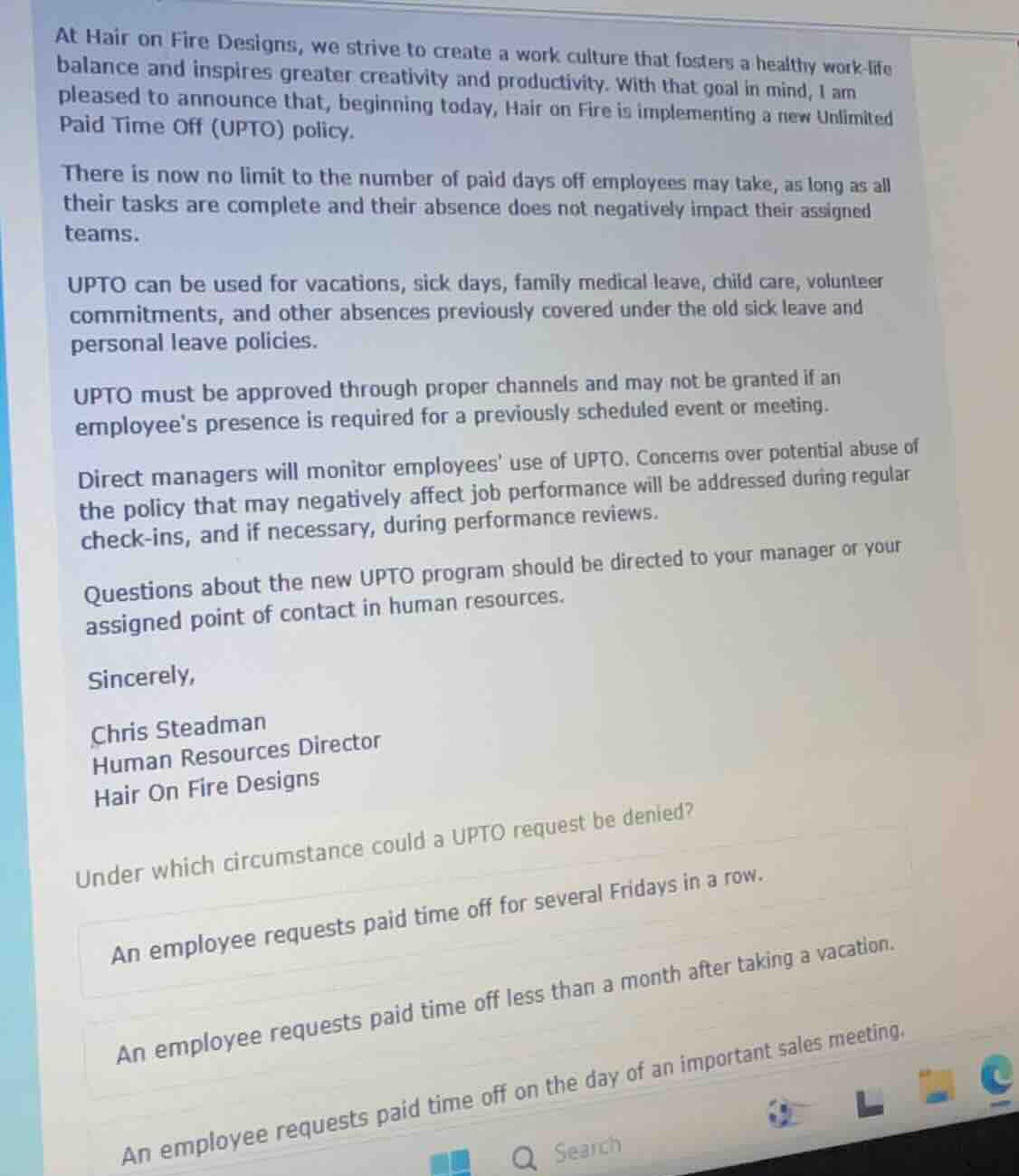
at hair on fire designs, we strive to create a work culture that fosters a healthy work-life balance and inspires greater creativity and productivity. with that goal in mind, i am pleased to announce that, beginning today, hair on fire is implementing a new unlimited paid time off (upto) policy.
there is now no limit to the number of paid days off employees may take, as long as all their tasks are complete and their absence does not negatively impact their assigned teams.
upto can be used for vacations, sick days, family medical leave, child care, volunteer commitments, and other absences previously covered under the old sick leave and personal leave policies.
upto must be approved through proper channels and may not be granted if an employees presence is required for a previously scheduled event or meeting.
direct managers will monitor employees use of upto. concerns over potential abuse of the policy that may negatively affect job performance will be addressed during regular check-ins, and if necessary, during performance reviews.
questions about the new upto program should be directed to your manager or your assigned point of contact in human resources.
sincerely,
chris steadman
human resources director
hair on fire designs
under which circumstance could a upto request be denied?
- an employee requests paid time off for several fridays in a row.
- an employee requests paid time off less than a month after taking a vacation.
- an employee requests paid time off on the day of an important sales meeting.
Analyze the question
The question asks: "Under which circumstance could a UPTO request be denied?" We need to find the specific rule in the memo regarding the denial of Unlimited Paid Time Off (UPTO).
Locate relevant information
Using Business Memo Reading skills, we scan the text for terms like "denied," "not be granted," or "approved."
The fourth paragraph states:
"UPTO must be approved through proper channels and may not be granted if an employee's presence is required for a previously scheduled event or meeting."
Evaluate the options
Using Workplace Communication analysis, we compare the options to the rule found:
- Option 1: "An employee requests paid time off for several Fridays in a row." (Not mentioned as a reason for denial).
- Option 2: "An employee requests paid time off less than a month after taking a vacation." (Not mentioned as a reason for denial).
- Option 3: "An employee requests paid time off on the day of an important sales meeting." (This matches "required for a previously scheduled event or meeting").
Formulate the final choice
The third option directly aligns with the policy restriction regarding scheduled events or meetings.

Snap & solve any problem in the app
Get step-by-step solutions on Sovi AI
Photo-based solutions with guided steps
Explore more problems and detailed explanations
- An employee requests paid time off for several Fridays in a row.
- An employee requests paid time off less than a month after taking a vacation.
- An employee requests paid time off on the day of an important sales meeting. (Correct answer)