Sovi.AI - AI Math Tutor

Scan to solve math questions

QUESTION IMAGE

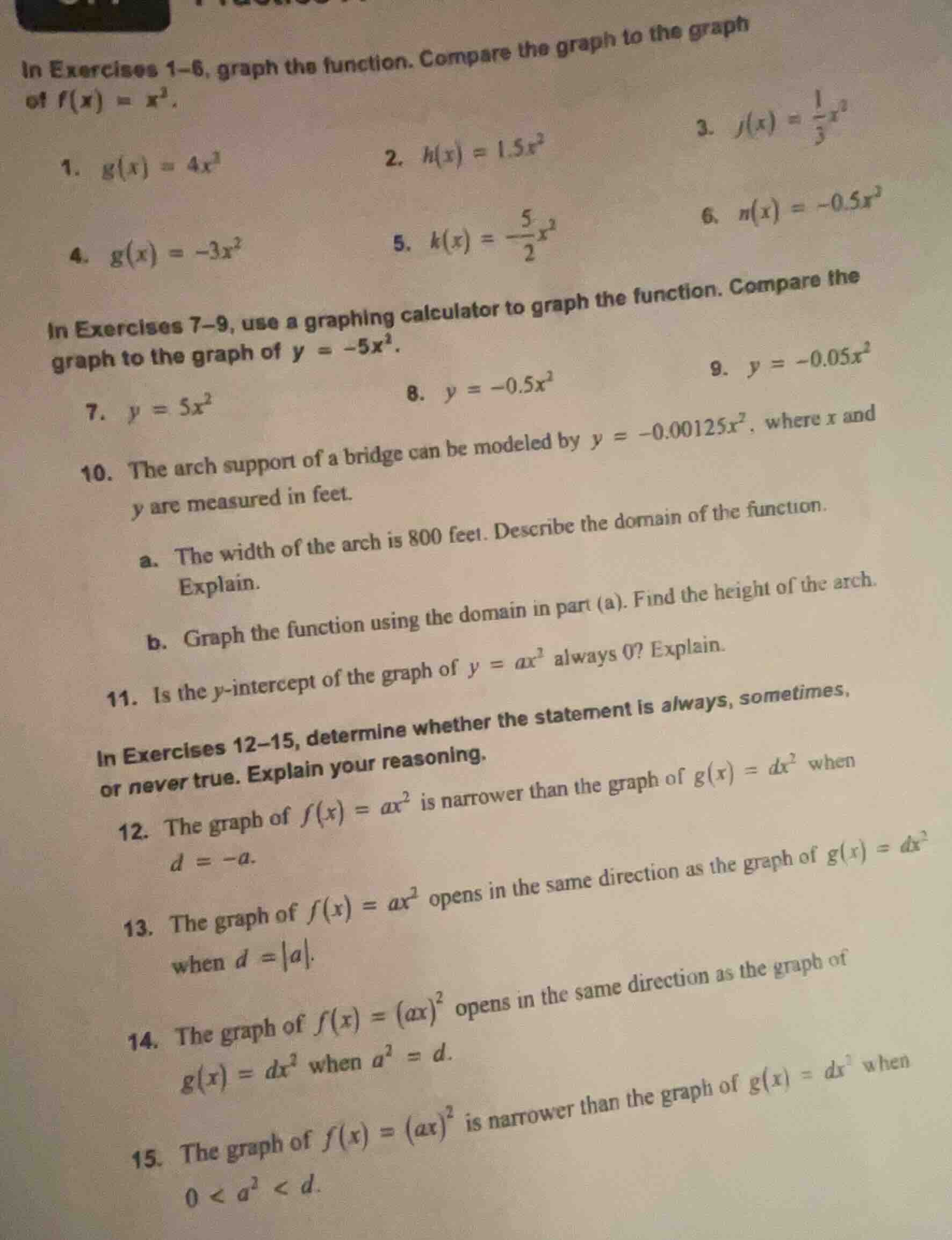
in exercises 1-6, graph the function. compare the graph to the graph of…

Question

in exercises 1-6, graph the function. compare the graph to the graph of \\(f(x) = x^2\\).

  1. \\(g(x) = 4x^2\\)
  2. \\(h(x) = 1.5x^2\\)
  3. \\(j(x) = \frac{1}{3}x^2\\)
  4. \\(g(x) = -3x^2\\)
  5. \\(k(x) = -\frac{5}{2}x^2\\)
  6. \\(n(x) = -0.5x^2\\)

in exercises 7-9, use a graphing calculator to graph the function. compare the graph to the graph of \\(y = -5x^2\\).

  1. \\(y = 5x^2\\)
  2. \\(y = -0.5x^2\\)
  3. \\(y = -0.05x^2\\)
  1. the arch support of a bridge can be modeled by \\(y = -0.00125x^2\\), where \\(x\\) and \\(y\\) are measured in feet.

a. the width of the arch is 800 feet. describe the domain of the function. explain.
b. graph the function using the domain in part (a). find the height of the arch.

  1. is the \\(y\\)-intercept of the graph of \\(y = ax^2\\) always 0? explain.

in exercises 12-15, determine whether the statement is always, sometimes, or never true. explain your reasoning.

  1. the graph of \\(f(x) = ax^2\\) is narrower than the graph of \\(g(x) = dx^2\\) when \\(d = -a\\).
  1. the graph of \\(f(x) = ax^2\\) opens in the same direction as the graph of \\(g(x) = dx^2\\) when \\(d = |a|\\).
  1. the graph of \\(f(x) = (ax)^2\\) opens in the same direction as the graph of \\(g(x) = dx^2\\) when \\(a^2 = d\\).
  1. the graph of \\(f(x) = (ax)^2\\) is narrower than the graph of \\(g(x) = dx^2\\) when \\(0 < a^2 < d\\).

Explanation:

Response

<pre_analysis>
{
"quality": "clear",
"question_count": 15,
"skills_matched": [
"step_cot",
"table_formatter",
"explain_then_answer",
"tutor",
"mastery_adaptive_brevity"
],
"needs_drawing": false,
"concepts_used": [
"Quadratic Transformations",
"Vertical Stretching",
"Vertical Shrinking"
],
"new_concepts": [
"Quadratic Domain and Range",
"Quadratic Modeling",
"Quadratic Parameter Analysis"
],
"current_concepts": [
"Quadratic Transformations",
"Vertical Stretching",
"Vertical Shrinking",
"Quadratic Domain and Range",
"Quadratic Modeling",
"Quadratic Parameter Analysis"
]
}
</pre_analysis>

<reasoning>

Analyze Exercises 1–6

Using the Quadratic Transformations, Vertical Stretching, and Vertical Shrinking knowledge points
\[

$$\begin{aligned} &\text{For } y = ax^2:\\ &1.\ g(x) = 4x^2: |a| = 4 > 1 \implies \text{vertical stretch by a factor of 4, opens up.}\\ &2.\ h(x) = 1.5x^2: |a| = 1.5 > 1 \implies \text{vertical stretch by a factor of 1.5, opens up.}\\ &3.\ j(x) = \frac{1}{3}x^2: |a| = \frac{1}{3} < 1 \implies \text{vertical shrink by a factor of } \frac{1}{3}\text{, opens up.}\\ &4.\ g(x) = -3x^2: |a| = 3 > 1, a < 0 \implies \text{vertical stretch by a factor of 3 and reflection in the x-axis.}\\ &5.\ k(x) = \frac{5}{2}x^2: |a| = 2.5 > 1 \implies \text{vertical stretch by a factor of 2.5, opens up.}\\ &6.\ n(x) = -0.5x^2: |a| = 0.5 < 1, a < 0 \implies \text{vertical shrink by a factor of 0.5 and reflection in the x-axis.} \end{aligned}$$

\]

Analyze Exercises 7–9

Using the Quadratic Transformations knowledge point
\[

$$\begin{aligned} &\text{Compare to } y = -5x^2:\\ &7.\ y = 5x^2: |5| = |-5| \implies \text{reflection in the x-axis.}\\ &8.\ y = -0.5x^2: |-0.5| < |-5| \implies \text{vertical shrink (wider) and opens in the same direction.}\\ &9.\ y = -0.05x^2: |-0.05| < |-5| \implies \text{vertical shrink (much wider) and opens in the same direction.} \end{aligned}$$

\]

Solve Exercise 10

Using the Quadratic Modeling knowledge point
\[

$$\begin{aligned} &\text{Equation: } y = -0.00125x^2\\ &\text{a. Width is } 800\text{ ft. Assuming symmetry about the y-axis: } -400 \le x \le 400.\\ &\text{b. Height is the maximum value of } y \text{ minus the value at the boundaries:}\\ &y(0) = 0\\ &y(400) = -0.00125(400)^2 = -200\\ &\text{Height } = 0 - (-200) = 200\text{ feet.} \end{aligned}$$

\]

Solve Exercise 11

Using the Quadratic Parameter Analysis knowledge point
\[

$$\begin{aligned} &\text{Let } x = 0:\\ &y = a(0)^2 = 0\\ &\text{The y-intercept is always } 0\text{ because substituting } x=0 \text{ always yields } y=0. \end{aligned}$$

\]

Analyze Exercises 12–15

Using the Quadratic Parameter Analysis knowledge point
\[

$$\begin{aligned} &12.\ |a| = |-a| = |d| \implies \text{They have the same width. Statement is Never True.}\\ &13.\ d = |a| \ge 0 \implies g(x) \text{ opens up. } f(x) \text{ opens in the same direction only if } a > 0\text{. Statement is Sometimes True.}\\ &14.\ f(x) = a^2x^2 \text{ and } g(x) = dx^2. \text{ Since } a^2 = d \ge 0\text{, both coefficients are positive. Statement is Always True.}\\ &15.\ f(x) = a^2x^2 \text{ is narrower than } g(x) = dx^2 \text{ when } a^2 > d\text{. Given } a^2 < d\text{, } f(x) \text{ is wider. Statement is Never True.} \end{aligned}$$

\]
</reasoning>

<answer>

No.Answer
2Vertical stretch by a factor of 1.5; opens up.
3Vertical shrink by a factor of \(\frac{1}{3}\); opens up.

| 4 | Vertical stretch by…

Answer:

<pre_analysis>
{
"quality": "clear",
"question_count": 15,
"skills_matched": [
"step_cot",
"table_formatter",
"explain_then_answer",
"tutor",
"mastery_adaptive_brevity"
],
"needs_drawing": false,
"concepts_used": [
"Quadratic Transformations",
"Vertical Stretching",
"Vertical Shrinking"
],
"new_concepts": [
"Quadratic Domain and Range",
"Quadratic Modeling",
"Quadratic Parameter Analysis"
],
"current_concepts": [
"Quadratic Transformations",
"Vertical Stretching",
"Vertical Shrinking",
"Quadratic Domain and Range",
"Quadratic Modeling",
"Quadratic Parameter Analysis"
]
}
</pre_analysis>

<reasoning>

Analyze Exercises 1–6

Using the Quadratic Transformations, Vertical Stretching, and Vertical Shrinking knowledge points
\[

$$\begin{aligned} &\text{For } y = ax^2:\\ &1.\ g(x) = 4x^2: |a| = 4 > 1 \implies \text{vertical stretch by a factor of 4, opens up.}\\ &2.\ h(x) = 1.5x^2: |a| = 1.5 > 1 \implies \text{vertical stretch by a factor of 1.5, opens up.}\\ &3.\ j(x) = \frac{1}{3}x^2: |a| = \frac{1}{3} < 1 \implies \text{vertical shrink by a factor of } \frac{1}{3}\text{, opens up.}\\ &4.\ g(x) = -3x^2: |a| = 3 > 1, a < 0 \implies \text{vertical stretch by a factor of 3 and reflection in the x-axis.}\\ &5.\ k(x) = \frac{5}{2}x^2: |a| = 2.5 > 1 \implies \text{vertical stretch by a factor of 2.5, opens up.}\\ &6.\ n(x) = -0.5x^2: |a| = 0.5 < 1, a < 0 \implies \text{vertical shrink by a factor of 0.5 and reflection in the x-axis.} \end{aligned}$$

\]

Analyze Exercises 7–9

Using the Quadratic Transformations knowledge point
\[

$$\begin{aligned} &\text{Compare to } y = -5x^2:\\ &7.\ y = 5x^2: |5| = |-5| \implies \text{reflection in the x-axis.}\\ &8.\ y = -0.5x^2: |-0.5| < |-5| \implies \text{vertical shrink (wider) and opens in the same direction.}\\ &9.\ y = -0.05x^2: |-0.05| < |-5| \implies \text{vertical shrink (much wider) and opens in the same direction.} \end{aligned}$$

\]

Solve Exercise 10

Using the Quadratic Modeling knowledge point
\[

$$\begin{aligned} &\text{Equation: } y = -0.00125x^2\\ &\text{a. Width is } 800\text{ ft. Assuming symmetry about the y-axis: } -400 \le x \le 400.\\ &\text{b. Height is the maximum value of } y \text{ minus the value at the boundaries:}\\ &y(0) = 0\\ &y(400) = -0.00125(400)^2 = -200\\ &\text{Height } = 0 - (-200) = 200\text{ feet.} \end{aligned}$$

\]

Solve Exercise 11

Using the Quadratic Parameter Analysis knowledge point
\[

$$\begin{aligned} &\text{Let } x = 0:\\ &y = a(0)^2 = 0\\ &\text{The y-intercept is always } 0\text{ because substituting } x=0 \text{ always yields } y=0. \end{aligned}$$

\]

Analyze Exercises 12–15

Using the Quadratic Parameter Analysis knowledge point
\[

$$\begin{aligned} &12.\ |a| = |-a| = |d| \implies \text{They have the same width. Statement is Never True.}\\ &13.\ d = |a| \ge 0 \implies g(x) \text{ opens up. } f(x) \text{ opens in the same direction only if } a > 0\text{. Statement is Sometimes True.}\\ &14.\ f(x) = a^2x^2 \text{ and } g(x) = dx^2. \text{ Since } a^2 = d \ge 0\text{, both coefficients are positive. Statement is Always True.}\\ &15.\ f(x) = a^2x^2 \text{ is narrower than } g(x) = dx^2 \text{ when } a^2 > d\text{. Given } a^2 < d\text{, } f(x) \text{ is wider. Statement is Never True.} \end{aligned}$$

\]
</reasoning>

<answer>

No.Answer
2Vertical stretch by a factor of 1.5; opens up.
3Vertical shrink by a factor of \(\frac{1}{3}\); opens up.
4Vertical stretch by a factor of 3 and reflection in the x-axis; opens down.
5Vertical stretch by a factor of 2.5; opens up.
6Vertical shrink by a factor of 0.5 and reflection in the x-axis; opens down.
7Reflection in the x-axis; same width.
8Vertical shrink (wider); opens in the same direction.
9Vertical shrink (wider); opens in the same direction.
10aDomain: \(-400 \le x \le 400\). The arch is symmetric about the y-axis with a total width of 800 feet.
10bHeight: 200 feet.
11Always; substituting \(x = 0\) into \(y = ax^2\) always yields \(y = 0\).
12Never; since \(a=-a\), the graphs have the same width.
13Sometimes; true only when \(a > 0\).
14Always; since \(a^2 = d\), both coefficients are positive and equal, so both open up.
15Never; since \(a^2 < d\), the graph of \(f(x)\) is wider, not narrower.

</answer>

<post_analysis>
{
"subject": "Mathematics",
"question_type": "Multi-part",
"knowledge_point": [
"Mathematics",
"Algebra",
"Quadratic Transformations"
]
}
</post_analysis>