QUESTION IMAGE
Question
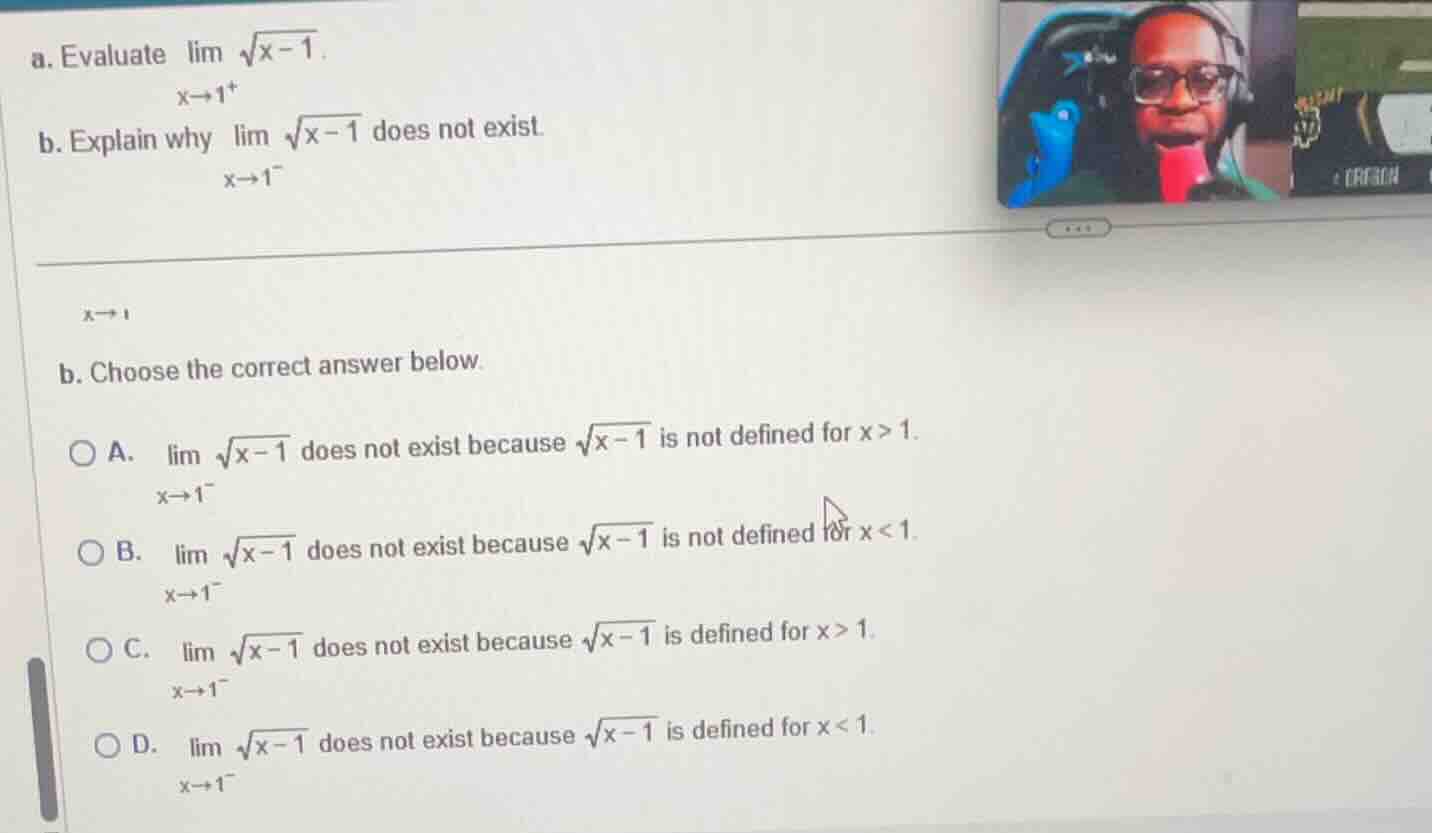
a. evaluate \\(\lim_{x \to 1^+} \sqrt{x-1}\\).
b. explain why \\(\lim_{x \to 1^-} \sqrt{x-1}\\) does not exist.
b. choose the correct answer below.
a. \\(\lim_{x \to 1^-} \sqrt{x-1}\\) does not exist because \\(\sqrt{x-1}\\) is not defined for \\(x > 1\\).
b. \\(\lim_{x \to 1^-} \sqrt{x-1}\\) does not exist because \\(\sqrt{x-1}\\) is not defined for \\(x < 1\\).
c. \\(\lim_{x \to 1^-} \sqrt{x-1}\\) does not exist because \\(\sqrt{x-1}\\) is defined for \\(x > 1\\).
d. \\(\lim_{x \to 1^-} \sqrt{x-1}\\) does not exist because \\(\sqrt{x-1}\\) is defined for \\(x < 1\\).
Determine the domain of the radical function
$$
LATEXBLOCK0
$$
Analyze the left-sided limit behavior
$$
LATEXBLOCK1
$$
Match with the correct multiple-choice option
$$
\lim_{x \to 1^{-}} \sqrt{x-1} \text{ does not exist because } \sqrt{x-1} \text{ is not defined for } x < 1.
$$

Snap & solve any problem in the app
Get step-by-step solutions on Sovi AI
Photo-based solutions with guided steps
Explore more problems and detailed explanations
- (A) \(\lim_{x \to 1^{-}} \sqrt{x-1}\) does not exist because \(\sqrt{x-1}\) is not defined for \(x > 1\).
- (B) \(\lim_{x \to 1^{-}} \sqrt{x-1}\) does not exist because \(\sqrt{x-1}\) is not defined for \(x < 1\). (Correct answer)
- (C) \(\lim_{x \to 1^{-}} \sqrt{x-1}\) does not exist because \(\sqrt{x-1}\) is defined for \(x > 1\).
- (D) \(\lim_{x \to 1^{-}} \sqrt{x-1}\) does not exist because \(\sqrt{x-1}\) is defined for \(x < 1\).