QUESTION IMAGE
Question
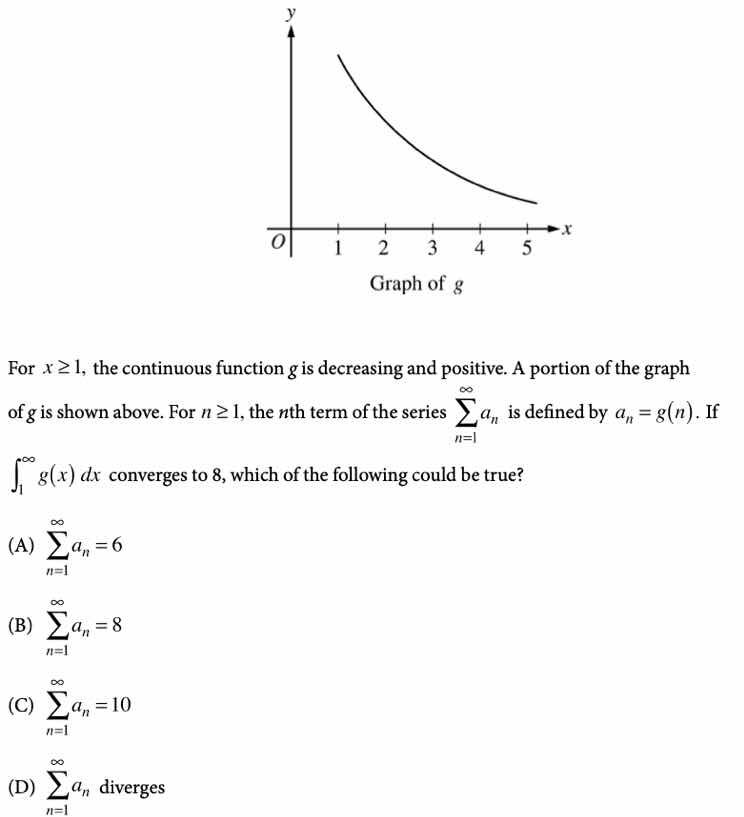
for (x \ge 1), the continuous function (g) is decreasing and positive. a portion of the graph of (g) is shown above. for (n \ge 1), the (n)th term of the series (\sum_{n=1}^{\infty} a_n) is defined by (a_n = g(n)). if (\int_{1}^{\infty} g(x) \\, dx) converges to 8, which of the following could be true?
(a) (\sum_{n=1}^{\infty} a_n = 6)
(b) (\sum_{n=1}^{\infty} a_n = 8)
(c) (\sum_{n=1}^{\infty} a_n = 10)
(d) (\sum_{n=1}^{\infty} a_n) diverges
Relate the series to the improper integral using left and right Riemann sums
$$
\int_{1}^{\infty} g(x) \, dx = 8
$$
$$
\sum_{n=2}^{\infty} a_n \le \int_{1}^{\infty} g(x) \, dx \le \sum_{n=1}^{\infty} a_n
$$
Establish the lower bound for the infinite series
$$
\sum_{n=1}^{\infty} a_n = a_1 + \sum_{n=2}^{\infty} a_n
$$
$$
\sum_{n=1}^{\infty} a_n \ge \int_{1}^{\infty} g(x) \, dx = 8
$$
$$
\sum_{n=1}^{\infty} a_n > 8 \quad (\text{since } g(x) \text{ is strictly decreasing and positive})
$$
Evaluate the given options based on the inequality
$$
\sum_{n=1}^{\infty} a_n > 8 \implies \sum_{n=1}^{\infty} a_n = 10
$$

Snap & solve any problem in the app
Get step-by-step solutions on Sovi AI
Photo-based solutions with guided steps
Explore more problems and detailed explanations
- (A) \(\sum_{n=1}^{\infty} a_n = 6\)
- (B) \(\sum_{n=1}^{\infty} a_n = 8\)
- (C) \(\sum_{n=1}^{\infty} a_n = 10\) (Correct answer)
- (D) \(\sum_{n=1}^{\infty} a_n \text{ diverges}\)