QUESTION IMAGE
Question
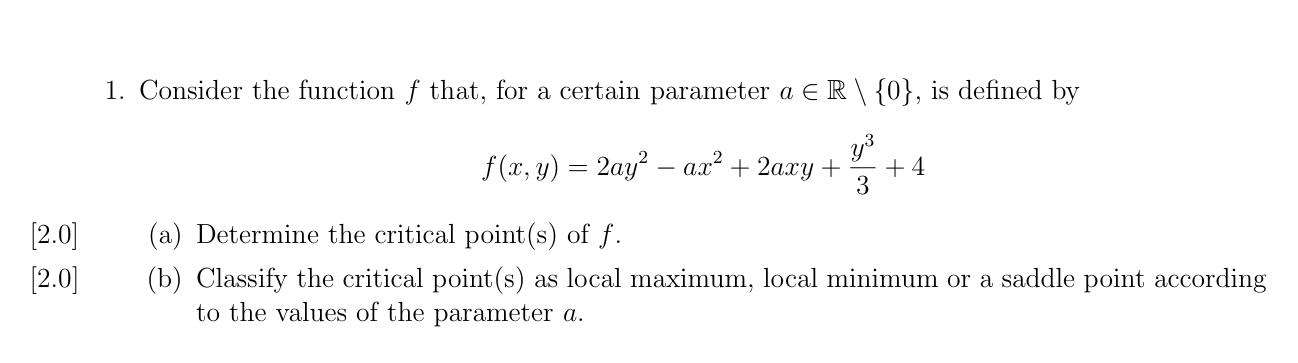
- consider the function (f) that, for a certain parameter (a in mathbb{r} \setminus \\{0\\}), is defined by
\\f(x, y) = 2ay^2 - ax^2 + 2axy + \frac{y^3}{3} + 4\\
2.0 (a) determine the critical point(s) of (f).
2.0 (b) classify the critical point(s) as local maximum, local minimum or a saddle point according to the values of the parameter (a).
⚡ Using what you learned: Partial Derivatives and Gradients · 🆕 New: Second Derivative Test for Multivariable Functions
Classifying critical points using the Hessian determinant
Step 1: Find the first partial derivatives
To find the critical points, we compute the first-order partial derivatives of \( f(x, y) = 2ay^2 - ax^2 + 2axy + \frac{y^3}{3} + 4 \) with respect to \( x \) and \( y \):
Step 2: Solve for the critical points
Set both partial derivatives to zero:
- \( -2ax + 2ay = 0 \implies 2ax = 2ay \)
Since \( a \in \mathbb{R} \setminus \{0\} \), we can divide by \( 2a \):
- Substitute \( x = y \) into \( f_y(x, y) = 0 \):
Factor the equation:
This yields two solutions for \( y \):
- \( y_1 = 0 \implies x_1 = 0 \)
- \( y_2 = -6a \implies x_2 = -6a \)
Thus, the critical points are:
Step 3: Compute the second-order partial derivatives
To classify these points, we find the second-order partial derivatives to construct the Hessian matrix:
The Hessian determinant \( D(x, y) \) is defined as:
Step 4: Classify the critical point \((0, 0)\)
Evaluate the Hessian determinant at \((0, 0)\):
Since \( a
eq 0 \), \( a^2 > 0 \), which means:
Because the Hessian determinant is strictly negative, the point \((0, 0)\) is always a saddle point for any \( a \in \mathbb{R} \setminus \{0\} \).
Step 5: Classify the critical point \((-6a, -6a)\)
Evaluate the Hessian determinant at \((-6a, -6a)\):
Since \( a
eq 0 \), \( 12a^2 > 0 \), which means \( D(-6a, -6a) > 0 \). This point is a local extremum. We determine its nature using the sign of \( f_{xx} = -2a \):
- If \( a > 0 \), then \( f_{xx} = -2a < 0 \). Since \( D > 0 \) and \( f_{xx} < 0 \), the point \((-6a, -6a)\) is a local maximum.
- If \( a < 0 \), then \( f_{xx} = -2a > 0 \). Since \( D > 0 \) and \( f_{xx} > 0 \), the point \((-6a, -6a)\) is a local minimum.

Snap & solve any problem in the app
Get step-by-step solutions on Sovi AI
Photo-based solutions with guided steps
Explore more problems and detailed explanations
(a) Critical Points:
The critical points of \( f \) are:
(b) Classification:
- The critical point \((0, 0)\) is a saddle point for all \( a \in \mathbb{R} \setminus \{0\} \).
- The critical point \((-6a, -6a)\) is:
- A local maximum if \( a > 0 \).
- A local minimum if \( a < 0 \).