QUESTION IMAGE
Question
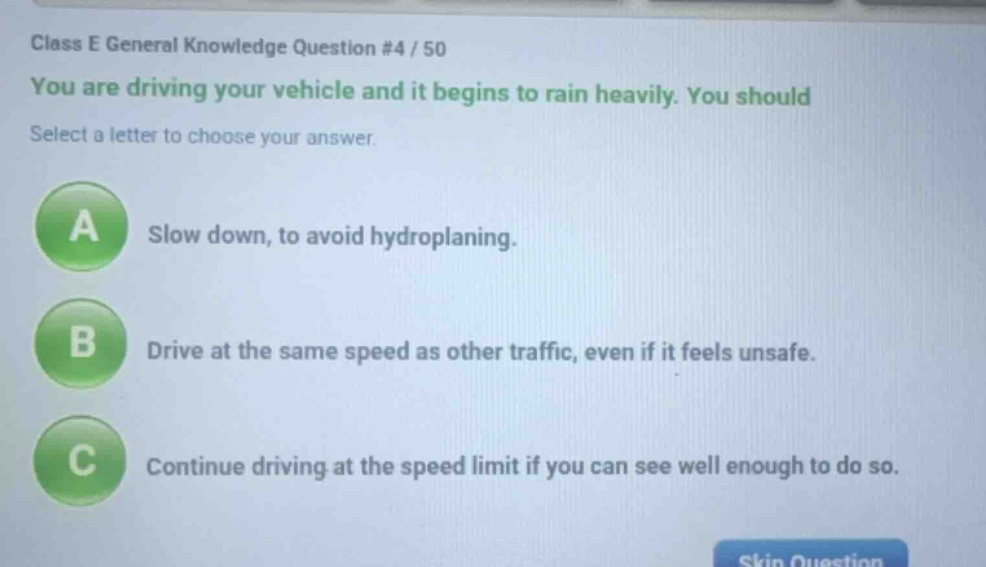
class e general knowledge question #4 / 50
you are driving your vehicle and it begins to rain heavily. you should
select a letter to choose your answer.
a slow down, to avoid hydroplaning.
b drive at the same speed as other traffic, even if it feels unsafe.
c continue driving at the speed limit if you can see well enough to do so.
🆕 New Concept Discovered: Safe Driving Practices in Adverse Weather
Adjusting vehicle control to maintain traction and visibility
Step 1: Understand the hazard of heavy rain
When it begins to rain heavily, water accumulates on the roadway. This creates two major hazards:
- Reduced visibility: It becomes harder to see the road and other vehicles.
- Loss of traction (Hydroplaning): At higher speeds, your tires can lose contact with the road surface and slide on a thin film of water, causing you to lose control of steering and braking.
Step 2: Evaluate the options
- A. Slow down, to avoid hydroplaning.
Slowing down reduces the risk of your tires losing contact with the road, giving you more control and more time to react to hazards. This is the safest and correct action.
- B. Drive at the same speed as other traffic, even if it feels unsafe.
You should never drive at a speed that feels unsafe or compromises your control of the vehicle, regardless of what other drivers are doing.
- C. Continue driving at the speed limit if you can see well enough to do so.
Even if visibility is acceptable, the speed limit is designed for ideal dry conditions. Heavy rain requires reducing your speed below the limit to prevent hydroplaning.

Snap & solve any problem in the app
Get step-by-step solutions on Sovi AI
Photo-based solutions with guided steps
Explore more problems and detailed explanations
A Slow down, to avoid hydroplaning.