QUESTION IMAGE
Question
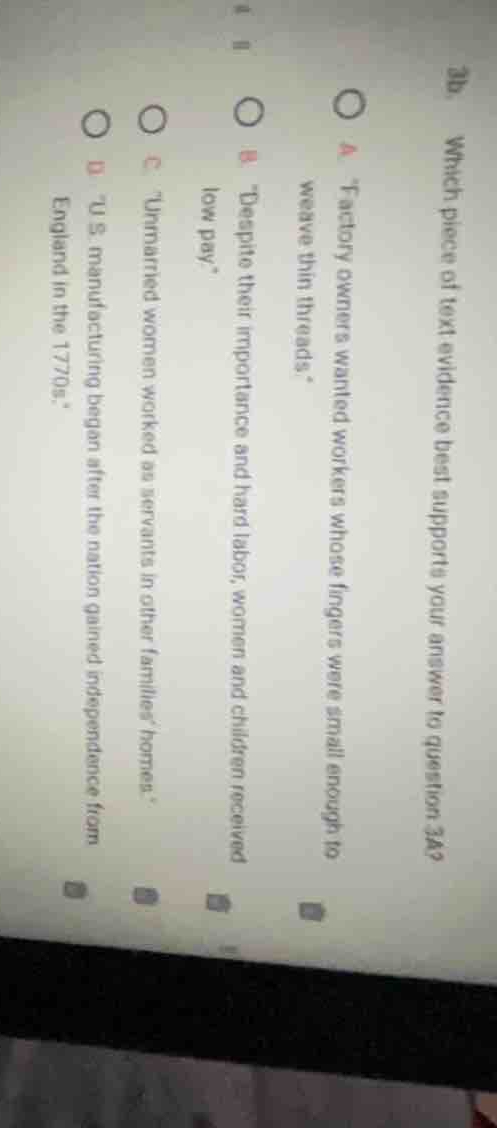
3b. which piece of text evidence best supports your answer to question 3a?
a \factory owners wanted workers whose fingers were small enough to weave thin threads.\
b \despite their importance and hard labor, women and children received low pay.\
c \unmarried women worked as servants in other families homes.\
d \u.s. manufacturing began after the nation gained independence from england in the 1770s.\
Identify the question goal
The question asks which piece of text evidence best supports the answer to a previous question (Question 3a).
Analyze the options
We must evaluate the options based on standard historical themes of early industrialization and labor:
- Option A focuses on physical requirements for specific tasks (weaving thin threads).
- Option B highlights the economic disparity and exploitation of labor: "Despite their importance and hard labor, women and children received low pay." This is a central theme in Labor History regarding early factory work.
- Option C describes domestic service, which is separate from factory labor.
- Option D states a historical timeline fact about manufacturing beginning after independence.
Connect to text evidence
Using Text Evidence, Option B provides a strong, comprehensive statement about the working conditions and treatment of women and children in early factories, which is typically the focus of such historical reading comprehension questions.

Snap & solve any problem in the app
Get step-by-step solutions on Sovi AI
Photo-based solutions with guided steps
Explore more problems and detailed explanations
- (A) "Factory owners wanted workers whose fingers were small enough to weave thin threads."
- (B) "Despite their importance and hard labor, women and children received low pay." (Correct answer)
- (C) "Unmarried women worked as servants in other families' homes."
- (D) "U.S. manufacturing began after the nation gained independence from England in the 1770s."