Sovi.AI - AI Math Tutor

Scan to solve math questions

QUESTION IMAGE

you have identified moderate injuries to a patient who was involved in …

Question

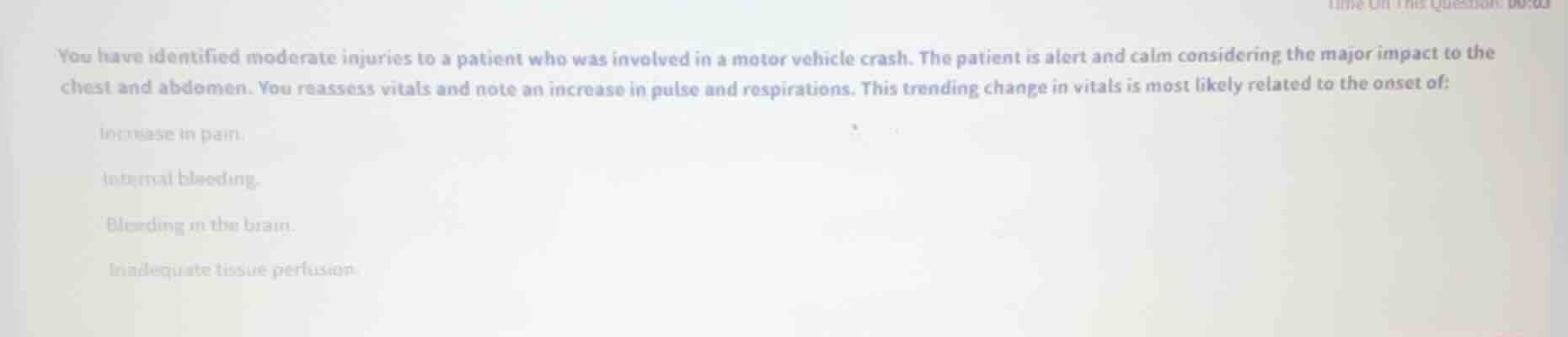
you have identified moderate injuries to a patient who was involved in a motor vehicle crash. the patient is alert and calm considering the major impact to the chest and abdomen. you reassess vitals and note an increase in pulse and respirations. this trending change in vitals is most likely related to the onset of:

increase in pain.
internal bleeding.
bleeding in the brain.
inadequate tissue perfusion.

Explanation:

Response

<pre_analysis>
{
"quality": "clear",
"question_count": 1,
"skills_matched": [
"direct_cot",
"multiple_choice_formatter",
"explain_then_answer",
"tutor",
"mastery_adaptive_brevity"
],
"needs_drawing": false,
"concepts_used": [
"Internal Bleeding Indicators",
"Compensatory Shock Mechanisms"
],
"new_concepts": [
"Shock Pathophysiology"
],
"current_concepts": [
"Internal Bleeding Indicators",
"Compensatory Shock Mechanisms",
"Shock Pathophysiology"
]
}
</pre_analysis>

<reasoning>

Analyze the clinical presentation

The patient was involved in a motor vehicle crash with a major impact to the chest and abdomen. Initially, the patient is alert and calm, but reassessment reveals a trending increase in pulse (tachycardia) and respirations (tachypnea).

Evaluate physiological mechanisms

Using the Internal Bleeding Indicators and Compensatory Shock Mechanisms knowledge points:

  • An impact to the chest and abdomen carries a high risk of occult internal hemorrhage (e.g., spleen, liver, or large vessel injury).
  • As blood volume decreases due to active internal bleeding, the body initiates compensatory mechanisms to maintain cardiac output and systemic perfusion.
  • The baroreceptor reflex detects a drop in blood pressure, triggering sympathetic nervous system activation. This results in an increased heart rate (pulse) and increased respiratory rate to optimize oxygenation of the remaining circulating blood volume.
  • While "inadequate tissue perfusion" (decompensated shock) is a consequence of uncorrected bleeding, the initial trending elevation of vital signs in an alert patient represents the active compensatory phase directly responding to the onset of internal bleeding.

Differentiate the options

  • Increase in pain: While pain can elevate vitals, the mechanism of major abdominal/thoracic impact strongly points to a perfusion-related threat.
  • Internal bleeding: This is the direct underlying cause of the volume loss triggering the compensatory rise in pulse and respirations.
  • Bleeding in the brain: Intracranial hemorrhage typically presents with Cushing's triad (bradycardia, irregular respirations, and widening pulse pressure), which is opposite to the trending increase in pulse observed here.
  • Inadequate tissue perfusion: This describes shock itself, but the physiological trigger for the trending vital changes is the active volume loss from internal bleeding.

</reasoning>

<answer>
<mcq-option>increase in pain.</mcq-option>
<mcq-correct>internal bleeding.</mcq-correct>
<mcq-option>Bleeding in the brain.</mcq-option>
<mcq-option>Inadequate tissue perfusion.</mcq-option>
</answer>

<post_analysis>
{
"subject": "Natural Science",
"question_type": "Multiple Choice",
"knowledge_point": [
"Natural Science",
"Medicine",
"Emergency Medical Services"
]
}
</post_analysis>

Answer:

<pre_analysis>
{
"quality": "clear",
"question_count": 1,
"skills_matched": [
"direct_cot",
"multiple_choice_formatter",
"explain_then_answer",
"tutor",
"mastery_adaptive_brevity"
],
"needs_drawing": false,
"concepts_used": [
"Internal Bleeding Indicators",
"Compensatory Shock Mechanisms"
],
"new_concepts": [
"Shock Pathophysiology"
],
"current_concepts": [
"Internal Bleeding Indicators",
"Compensatory Shock Mechanisms",
"Shock Pathophysiology"
]
}
</pre_analysis>

<reasoning>

Analyze the clinical presentation

The patient was involved in a motor vehicle crash with a major impact to the chest and abdomen. Initially, the patient is alert and calm, but reassessment reveals a trending increase in pulse (tachycardia) and respirations (tachypnea).

Evaluate physiological mechanisms

Using the Internal Bleeding Indicators and Compensatory Shock Mechanisms knowledge points:

  • An impact to the chest and abdomen carries a high risk of occult internal hemorrhage (e.g., spleen, liver, or large vessel injury).
  • As blood volume decreases due to active internal bleeding, the body initiates compensatory mechanisms to maintain cardiac output and systemic perfusion.
  • The baroreceptor reflex detects a drop in blood pressure, triggering sympathetic nervous system activation. This results in an increased heart rate (pulse) and increased respiratory rate to optimize oxygenation of the remaining circulating blood volume.
  • While "inadequate tissue perfusion" (decompensated shock) is a consequence of uncorrected bleeding, the initial trending elevation of vital signs in an alert patient represents the active compensatory phase directly responding to the onset of internal bleeding.

Differentiate the options

  • Increase in pain: While pain can elevate vitals, the mechanism of major abdominal/thoracic impact strongly points to a perfusion-related threat.
  • Internal bleeding: This is the direct underlying cause of the volume loss triggering the compensatory rise in pulse and respirations.
  • Bleeding in the brain: Intracranial hemorrhage typically presents with Cushing's triad (bradycardia, irregular respirations, and widening pulse pressure), which is opposite to the trending increase in pulse observed here.
  • Inadequate tissue perfusion: This describes shock itself, but the physiological trigger for the trending vital changes is the active volume loss from internal bleeding.

</reasoning>

<answer>
<mcq-option>increase in pain.</mcq-option>
<mcq-correct>internal bleeding.</mcq-correct>
<mcq-option>Bleeding in the brain.</mcq-option>
<mcq-option>Inadequate tissue perfusion.</mcq-option>
</answer>

<post_analysis>
{
"subject": "Natural Science",
"question_type": "Multiple Choice",
"knowledge_point": [
"Natural Science",
"Medicine",
"Emergency Medical Services"
]
}
</post_analysis>