Sovi.AI - AI Math Tutor

Scan to solve math questions

QUESTION IMAGE

what best describes the relationship between the two sets of reactions …

Question

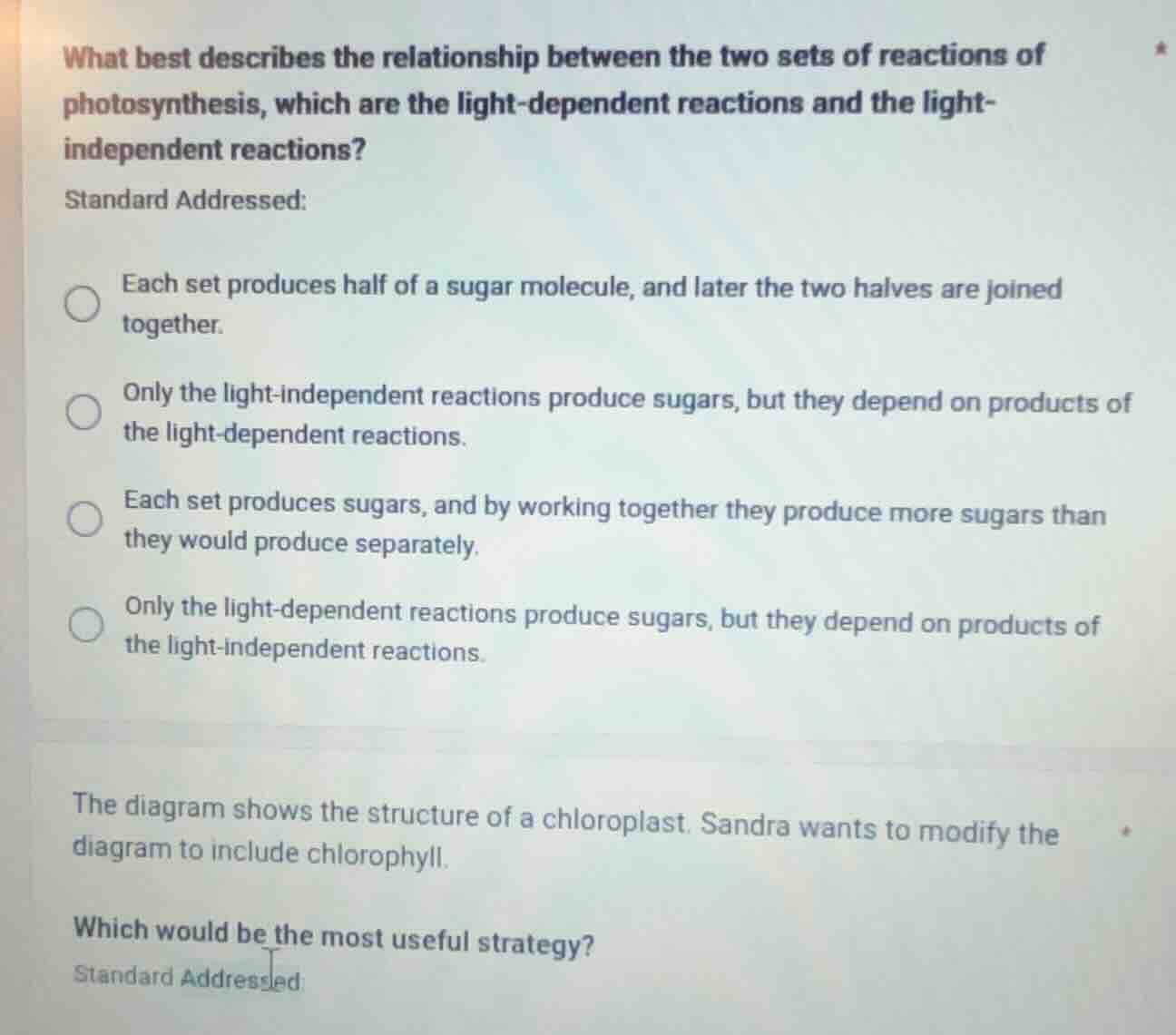
what best describes the relationship between the two sets of reactions of photosynthesis, which are the light-dependent reactions and the light-independent reactions?
standard addressed:
each set produces half of a sugar molecule, and later the two halves are joined together.
only the light-independent reactions produce sugars, but they depend on products of the light-dependent reactions.
each set produces sugars, and by working together they produce more sugars than they would produce separately.
only the light-dependent reactions produce sugars, but they depend on products of the light-independent reactions.

the diagram shows the structure of a chloroplast. sandra wants to modify the diagram to include chlorophyll.
which would be the most useful strategy?
standard addressed:

Explanation:

Response

<pre_analysis>
{
"quality": "clear",
"question_count": 2,
"skills_matched": [
"direct_cot",
"multiple_choice_formatter",
"explain_then_answer",
"tutor"
],
"needs_drawing": false,
"concepts_used": [],
"new_concepts": [
"Photosynthesis Reactions",
"Chloroplast Structure"
],
"current_concepts": [
"Photosynthesis Reactions",
"Chloroplast Structure"
]
}
</pre_analysis>

<reasoning>

Analyze the first question on photosynthesis reactions

The first question asks for the relationship between the light-dependent and light-independent reactions of photosynthesis.

  • Light-dependent reactions capture light energy to produce \(ATP\) and \(NADPH\), releasing oxygen as a byproduct.
  • Light-independent reactions (Calvin cycle) use this \(ATP\) and \(NADPH\) to fix carbon dioxide into sugars.
  • Therefore, only the light-independent reactions produce sugars, but they are entirely dependent on the chemical energy products (\(ATP\) and \(NADPH\)) generated by the light-dependent reactions.
  • Looking at the options:
  • Option 1: "Each set produces half of a sugar molecule..." is incorrect.
  • Option 2: "Only the light-independent reactions produce sugars, but they depend on products of the light-dependent reactions." is correct.
  • Option 3: "Each set produces sugars..." is incorrect.
  • Option 4: "Only the light-dependent reactions produce sugars..." is incorrect.

Analyze the second question on chloroplast modification

The second question is cut off at the bottom and does not show the diagram or the multiple-choice options. It states: "The diagram shows the structure of a chloroplast. Sandra wants to modify the diagram to include chlorophyll. Which would be the most useful strategy?"

  • Chlorophyll is the green pigment that absorbs light energy for photosynthesis.
  • It is located within the thylakoid membranes (specifically in the photosystems) of the chloroplast.
  • Therefore, the most useful strategy to represent chlorophyll in a chloroplast diagram is to color or label the thylakoids (or grana) green, or to add labels pointing to the thylakoid membranes indicating the presence of chlorophyll.
  • Since the options are missing, we will provide the direct conceptual answer for this second part.

</reasoning>

<answer>

Question 1

<mcq-option>(A) Each set produces half of a sugar molecule, and later the two halves are joined together.</mcq-option>
<mcq-correct>(B) Only the light-independent reactions produce sugars, but they depend on products of the light-dependent reactions.</mcq-correct>
<mcq-option>(C) Each set produces sugars, and by working together they produce more sugars than they would produce separately.</mcq-option>
<mcq-option>(D) Only the light-dependent reactions produce sugars, but they depend on products of the light-independent reactions.</mcq-option>

Question 2

To represent chlorophyll accurately, Sandra should label or color the thylakoid membranes (or the grana, which are stacks of thylakoids) green, as this is where chlorophyll pigments are located and where light absorption occurs.
</answer>

<post_analysis>
{
"subject": "Natural Science",
"question_type": "Multi-part",
"knowledge_point": [
"Natural Science",
"Biology",
"Photosynthesis"
]
}
</post_analysis>

Answer:

<pre_analysis>
{
"quality": "clear",
"question_count": 2,
"skills_matched": [
"direct_cot",
"multiple_choice_formatter",
"explain_then_answer",
"tutor"
],
"needs_drawing": false,
"concepts_used": [],
"new_concepts": [
"Photosynthesis Reactions",
"Chloroplast Structure"
],
"current_concepts": [
"Photosynthesis Reactions",
"Chloroplast Structure"
]
}
</pre_analysis>

<reasoning>

Analyze the first question on photosynthesis reactions

The first question asks for the relationship between the light-dependent and light-independent reactions of photosynthesis.

  • Light-dependent reactions capture light energy to produce \(ATP\) and \(NADPH\), releasing oxygen as a byproduct.
  • Light-independent reactions (Calvin cycle) use this \(ATP\) and \(NADPH\) to fix carbon dioxide into sugars.
  • Therefore, only the light-independent reactions produce sugars, but they are entirely dependent on the chemical energy products (\(ATP\) and \(NADPH\)) generated by the light-dependent reactions.
  • Looking at the options:
  • Option 1: "Each set produces half of a sugar molecule..." is incorrect.
  • Option 2: "Only the light-independent reactions produce sugars, but they depend on products of the light-dependent reactions." is correct.
  • Option 3: "Each set produces sugars..." is incorrect.
  • Option 4: "Only the light-dependent reactions produce sugars..." is incorrect.

Analyze the second question on chloroplast modification

The second question is cut off at the bottom and does not show the diagram or the multiple-choice options. It states: "The diagram shows the structure of a chloroplast. Sandra wants to modify the diagram to include chlorophyll. Which would be the most useful strategy?"

  • Chlorophyll is the green pigment that absorbs light energy for photosynthesis.
  • It is located within the thylakoid membranes (specifically in the photosystems) of the chloroplast.
  • Therefore, the most useful strategy to represent chlorophyll in a chloroplast diagram is to color or label the thylakoids (or grana) green, or to add labels pointing to the thylakoid membranes indicating the presence of chlorophyll.
  • Since the options are missing, we will provide the direct conceptual answer for this second part.

</reasoning>

<answer>

Question 1

<mcq-option>(A) Each set produces half of a sugar molecule, and later the two halves are joined together.</mcq-option>
<mcq-correct>(B) Only the light-independent reactions produce sugars, but they depend on products of the light-dependent reactions.</mcq-correct>
<mcq-option>(C) Each set produces sugars, and by working together they produce more sugars than they would produce separately.</mcq-option>
<mcq-option>(D) Only the light-dependent reactions produce sugars, but they depend on products of the light-independent reactions.</mcq-option>

Question 2

To represent chlorophyll accurately, Sandra should label or color the thylakoid membranes (or the grana, which are stacks of thylakoids) green, as this is where chlorophyll pigments are located and where light absorption occurs.
</answer>

<post_analysis>
{
"subject": "Natural Science",
"question_type": "Multi-part",
"knowledge_point": [
"Natural Science",
"Biology",
"Photosynthesis"
]
}
</post_analysis>