Sovi.AI - AI Math Tutor

Scan to solve math questions

QUESTION IMAGE

at which stage of dna replication are the sugar-phosphate backbones of …

Question

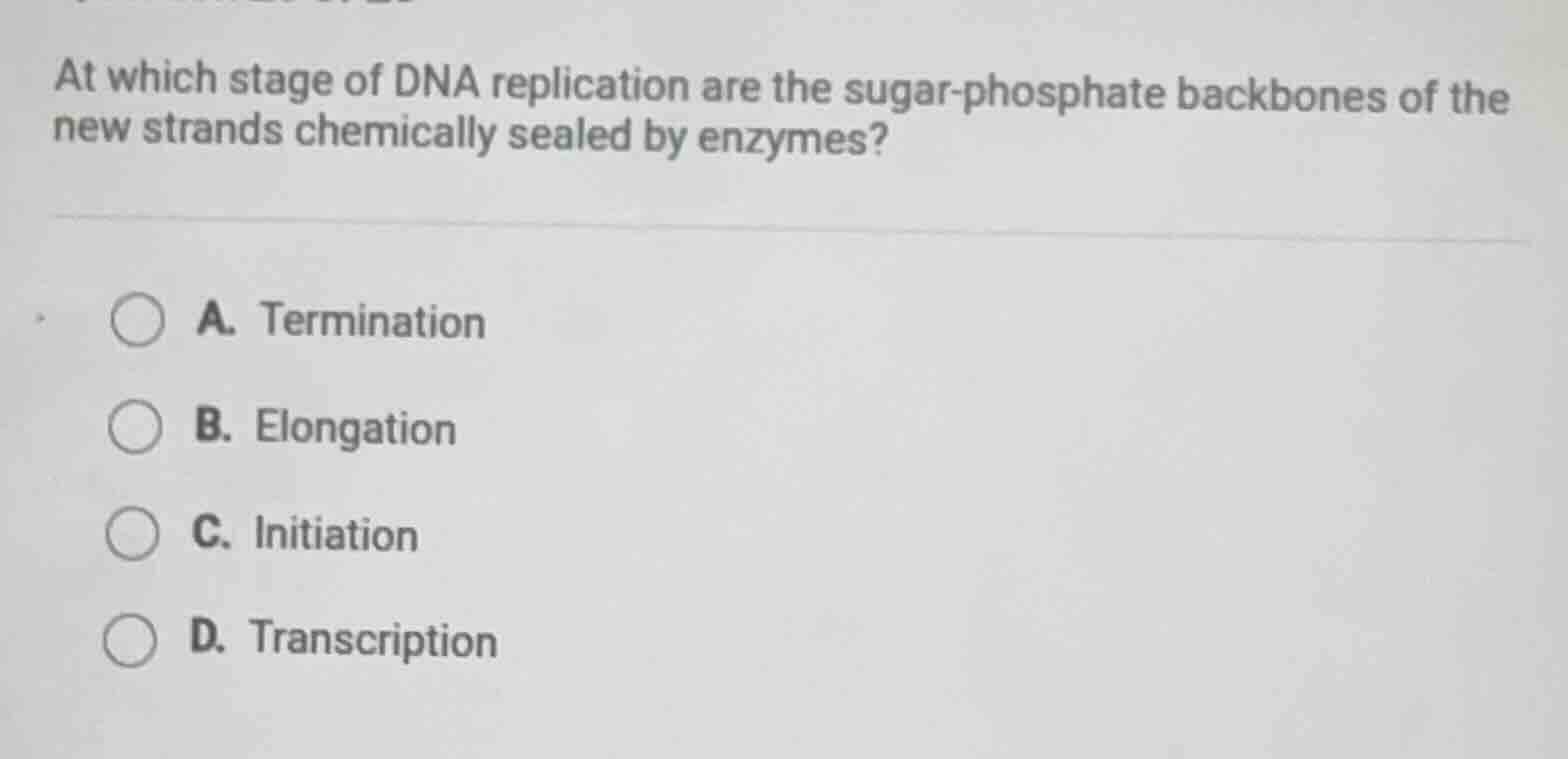
at which stage of dna replication are the sugar-phosphate backbones of the new strands chemically sealed by enzymes?

a. termination
b. elongation
c. initiation
d. transcription

Explanation:

Response

<pre_analysis>
{
"quality": "clear",
"question_count": 1,
"skills_matched": [
"direct_cot",
"multiple_choice_formatter",
"explain_then_answer",
"tutor"
],
"needs_drawing": false,
"concepts_used": [
"DNA Structure"
],
"new_concepts": [
"DNA Replication Stages",
"DNA Ligase Function"
],
"current_concepts": [
"DNA Structure",
"DNA Replication Stages",
"DNA Ligase Function"
]
}
</pre_analysis>

<reasoning>

Identify the biological process

The question asks about a specific event during DNA replication: the chemical sealing of the sugar-phosphate backbones of new strands by enzymes.

Analyze the role of enzymes

During replication, DNA polymerase synthesizes new strands, but leaves nicks in the sugar-phosphate backbone, especially between Okazaki fragments on the lagging strand. The enzyme DNA ligase catalyzes the formation of phosphodiester bonds to seal these nicks.

Map the event to replication stages

This sealing of the backbone and joining of fragments occurs during the Elongation phase of DNA replication, where the new strands are actively synthesized and completed.

Evaluate the given options

  • A. Termination: This is the final stage where replication forks meet and replication halts, rather than where active backbone sealing of newly synthesized strands occurs.
  • B. Elongation: This is the stage where DNA synthesis, fragment joining, and backbone sealing actively take place.
  • C. Initiation: This is the start of replication where the double helix unwinds and primers are laid down.
  • D. Transcription: This is an entirely different process (synthesis of RNA from a DNA template), not a stage of DNA replication.

</reasoning>

<answer>
<mcq-option>A. Termination</mcq-option>
<mcq-correct>B. Elongation</mcq-correct>
<mcq-option>C. Initiation</mcq-option>
<mcq-option>D. Transcription</mcq-option>
</answer>

<post_analysis>
{
"subject": "Natural Science",
"question_type": "Multiple Choice",
"knowledge_point": [
"Natural Science",
"Biology",
"DNA Replication"
]
}
</post_analysis>

Answer:

<pre_analysis>
{
"quality": "clear",
"question_count": 1,
"skills_matched": [
"direct_cot",
"multiple_choice_formatter",
"explain_then_answer",
"tutor"
],
"needs_drawing": false,
"concepts_used": [
"DNA Structure"
],
"new_concepts": [
"DNA Replication Stages",
"DNA Ligase Function"
],
"current_concepts": [
"DNA Structure",
"DNA Replication Stages",
"DNA Ligase Function"
]
}
</pre_analysis>

<reasoning>

Identify the biological process

The question asks about a specific event during DNA replication: the chemical sealing of the sugar-phosphate backbones of new strands by enzymes.

Analyze the role of enzymes

During replication, DNA polymerase synthesizes new strands, but leaves nicks in the sugar-phosphate backbone, especially between Okazaki fragments on the lagging strand. The enzyme DNA ligase catalyzes the formation of phosphodiester bonds to seal these nicks.

Map the event to replication stages

This sealing of the backbone and joining of fragments occurs during the Elongation phase of DNA replication, where the new strands are actively synthesized and completed.

Evaluate the given options

  • A. Termination: This is the final stage where replication forks meet and replication halts, rather than where active backbone sealing of newly synthesized strands occurs.
  • B. Elongation: This is the stage where DNA synthesis, fragment joining, and backbone sealing actively take place.
  • C. Initiation: This is the start of replication where the double helix unwinds and primers are laid down.
  • D. Transcription: This is an entirely different process (synthesis of RNA from a DNA template), not a stage of DNA replication.

</reasoning>

<answer>
<mcq-option>A. Termination</mcq-option>
<mcq-correct>B. Elongation</mcq-correct>
<mcq-option>C. Initiation</mcq-option>
<mcq-option>D. Transcription</mcq-option>
</answer>

<post_analysis>
{
"subject": "Natural Science",
"question_type": "Multiple Choice",
"knowledge_point": [
"Natural Science",
"Biology",
"DNA Replication"
]
}
</post_analysis>