Sovi.AI - AI Math Tutor

Scan to solve math questions

QUESTION IMAGE

which of the following is not a right explicitly protected by the first…

Question

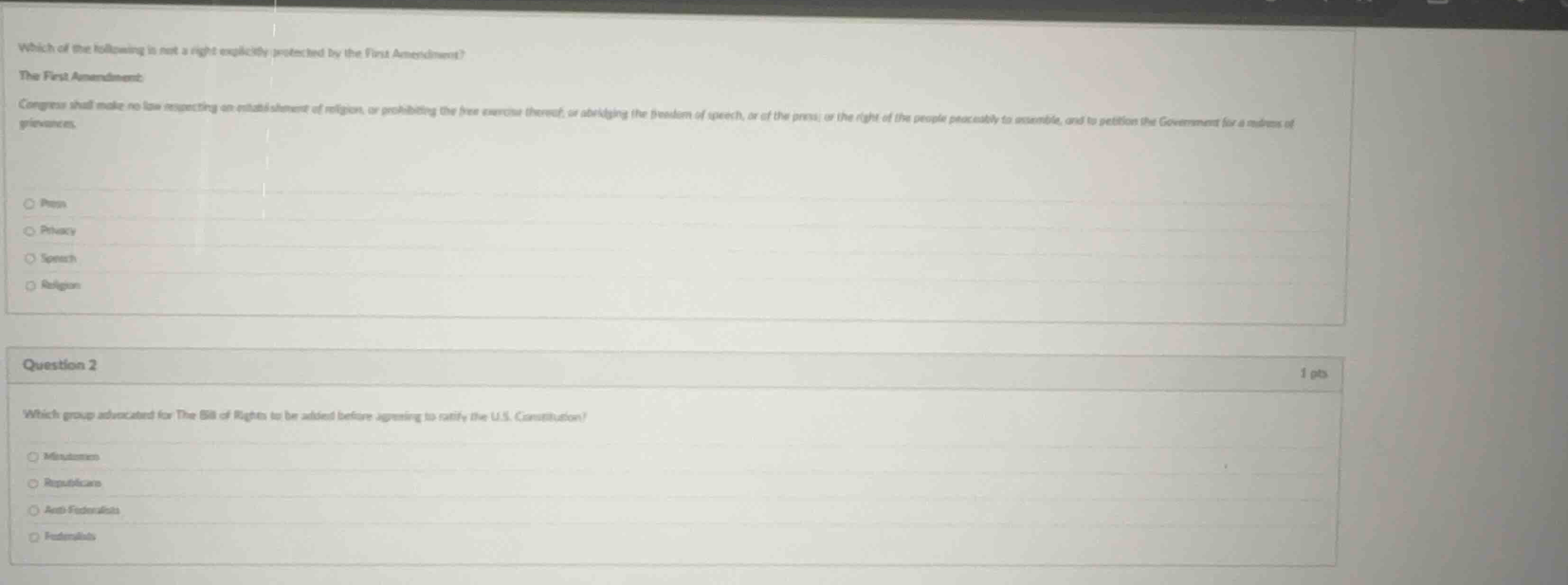
which of the following is not a right explicitly protected by the first amendment?

the first amendment:

congress shall make no law respecting an establishment of religion, or prohibiting the free exercise thereof; or abridging the freedom of speech, or of the press; or the right of the people peaceably to assemble, and to petition the government for a redress of grievances.

press
privacy
speech
religion

question 2
1 pts

which group advocated for the bill of rights to be added before agreeing to ratify the u.s. constitution?

minutemen
republicans
anti-federalists
federalists

Explanation:

Response

<pre_analysis>
{
"quality": "clear",
"question_count": 2,
"skills_matched": [
"direct_cot",
"multiple_choice_formatter",
"explain_then_answer",
"quick"
],
"needs_drawing": false,
"concepts_used": [
"Bill of Rights",
"Federalists and Anti-Federalists"
],
"new_concepts": [
"First Amendment Rights"
],
"current_concepts": [
"Bill of Rights",
"Federalists and Anti-Federalists",
"First Amendment Rights"
]
}
</pre_analysis>

<reasoning>

Analyze First Amendment protections

The text of the First Amendment explicitly protects the establishment and free exercise of religion, freedom of speech, freedom of the press, the right to peaceably assemble, and the right to petition the government. Among the choices, "Privacy" is not explicitly mentioned in the text of the First Amendment.

Identify advocates for the Bill of Rights

During the constitutional ratification debates, the Anti-Federalists argued that a Bill of Rights was necessary to protect individual liberties from potential federal overreach before they would agree to ratify the U.S. Constitution.
</reasoning>

<answer>

Question 1

<mcq-option>Press</mcq-option>
<mcq-correct>Privacy</mcq-correct>
<mcq-option>Speech</mcq-option>
<mcq-option>Religion</mcq-option>

Question 2

<mcq-option>Minutemen</mcq-option>
<mcq-option>Republicans</mcq-option>
<mcq-correct>Anti-Federalists</mcq-correct>
<mcq-option>Federalists</mcq-option>
</answer>

<post_analysis>
{
"subject": "Social Science",
"question_type": "Multiple Choice",
"knowledge_point": [
"Social Science",
"U.S. History",
"Constitutional Ratification and the Bill of Rights"
]
}
</post_analysis>

Answer:

<pre_analysis>
{
"quality": "clear",
"question_count": 2,
"skills_matched": [
"direct_cot",
"multiple_choice_formatter",
"explain_then_answer",
"quick"
],
"needs_drawing": false,
"concepts_used": [
"Bill of Rights",
"Federalists and Anti-Federalists"
],
"new_concepts": [
"First Amendment Rights"
],
"current_concepts": [
"Bill of Rights",
"Federalists and Anti-Federalists",
"First Amendment Rights"
]
}
</pre_analysis>

<reasoning>

Analyze First Amendment protections

The text of the First Amendment explicitly protects the establishment and free exercise of religion, freedom of speech, freedom of the press, the right to peaceably assemble, and the right to petition the government. Among the choices, "Privacy" is not explicitly mentioned in the text of the First Amendment.

Identify advocates for the Bill of Rights

During the constitutional ratification debates, the Anti-Federalists argued that a Bill of Rights was necessary to protect individual liberties from potential federal overreach before they would agree to ratify the U.S. Constitution.
</reasoning>

<answer>

Question 1

<mcq-option>Press</mcq-option>
<mcq-correct>Privacy</mcq-correct>
<mcq-option>Speech</mcq-option>
<mcq-option>Religion</mcq-option>

Question 2

<mcq-option>Minutemen</mcq-option>
<mcq-option>Republicans</mcq-option>
<mcq-correct>Anti-Federalists</mcq-correct>
<mcq-option>Federalists</mcq-option>
</answer>

<post_analysis>
{
"subject": "Social Science",
"question_type": "Multiple Choice",
"knowledge_point": [
"Social Science",
"U.S. History",
"Constitutional Ratification and the Bill of Rights"
]
}
</post_analysis>