QUESTION IMAGE
Question
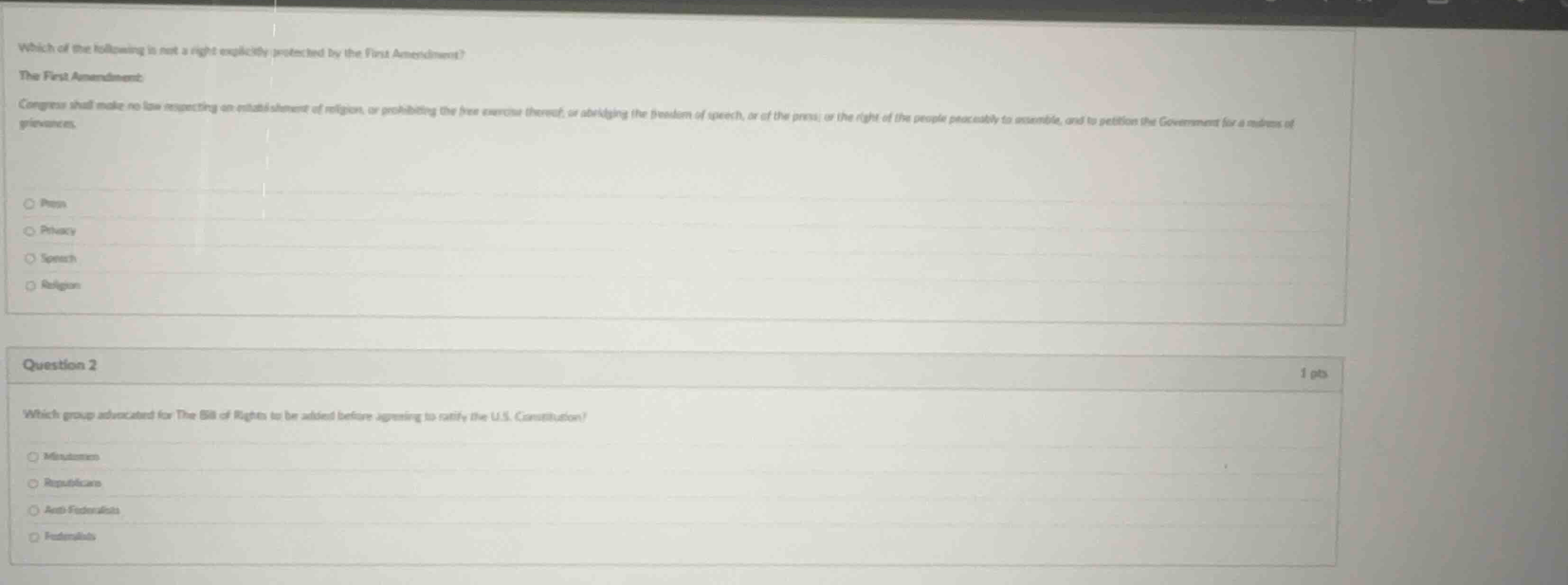
which of the following is not a right explicitly protected by the first amendment?
the first amendment:
congress shall make no law respecting an establishment of religion, or prohibiting the free exercise thereof; or abridging the freedom of speech, or of the press; or the right of the people peaceably to assemble, and to petition the government for a redress of grievances.
press
privacy
speech
religion
question 2
1 pts
which group advocated for the bill of rights to be added before agreeing to ratify the u.s. constitution?
minutemen
republicans
anti-federalists
federalists
<pre_analysis>
{
"quality": "clear",
"question_count": 2,
"skills_matched": [
"direct_cot",
"multiple_choice_formatter",
"explain_then_answer",
"quick"
],
"needs_drawing": false,
"concepts_used": [
"Bill of Rights",
"Federalists and Anti-Federalists"
],
"new_concepts": [
"First Amendment Rights"
],
"current_concepts": [
"Bill of Rights",
"Federalists and Anti-Federalists",
"First Amendment Rights"
]
}
</pre_analysis>
<reasoning>
Analyze First Amendment protections
The text of the First Amendment explicitly protects the establishment and free exercise of religion, freedom of speech, freedom of the press, the right to peaceably assemble, and the right to petition the government. Among the choices, "Privacy" is not explicitly mentioned in the text of the First Amendment.
Identify advocates for the Bill of Rights
During the constitutional ratification debates, the Anti-Federalists argued that a Bill of Rights was necessary to protect individual liberties from potential federal overreach before they would agree to ratify the U.S. Constitution.
</reasoning>
<answer>
Question 1
<mcq-option>Press</mcq-option>
<mcq-correct>Privacy</mcq-correct>
<mcq-option>Speech</mcq-option>
<mcq-option>Religion</mcq-option>
Question 2
<mcq-option>Minutemen</mcq-option>
<mcq-option>Republicans</mcq-option>
<mcq-correct>Anti-Federalists</mcq-correct>
<mcq-option>Federalists</mcq-option>
</answer>
<post_analysis>
{
"subject": "Social Science",
"question_type": "Multiple Choice",
"knowledge_point": [
"Social Science",
"U.S. History",
"Constitutional Ratification and the Bill of Rights"
]
}
</post_analysis>
Snap & solve any problem in the app
Get step-by-step solutions on Sovi AI
Photo-based solutions with guided steps
Explore more problems and detailed explanations
<pre_analysis>
{
"quality": "clear",
"question_count": 2,
"skills_matched": [
"direct_cot",
"multiple_choice_formatter",
"explain_then_answer",
"quick"
],
"needs_drawing": false,
"concepts_used": [
"Bill of Rights",
"Federalists and Anti-Federalists"
],
"new_concepts": [
"First Amendment Rights"
],
"current_concepts": [
"Bill of Rights",
"Federalists and Anti-Federalists",
"First Amendment Rights"
]
}
</pre_analysis>
<reasoning>
Analyze First Amendment protections
The text of the First Amendment explicitly protects the establishment and free exercise of religion, freedom of speech, freedom of the press, the right to peaceably assemble, and the right to petition the government. Among the choices, "Privacy" is not explicitly mentioned in the text of the First Amendment.
Identify advocates for the Bill of Rights
During the constitutional ratification debates, the Anti-Federalists argued that a Bill of Rights was necessary to protect individual liberties from potential federal overreach before they would agree to ratify the U.S. Constitution.
</reasoning>
<answer>
Question 1
<mcq-option>Press</mcq-option>
<mcq-correct>Privacy</mcq-correct>
<mcq-option>Speech</mcq-option>
<mcq-option>Religion</mcq-option>
Question 2
<mcq-option>Minutemen</mcq-option>
<mcq-option>Republicans</mcq-option>
<mcq-correct>Anti-Federalists</mcq-correct>
<mcq-option>Federalists</mcq-option>
</answer>
<post_analysis>
{
"subject": "Social Science",
"question_type": "Multiple Choice",
"knowledge_point": [
"Social Science",
"U.S. History",
"Constitutional Ratification and the Bill of Rights"
]
}
</post_analysis>