QUESTION IMAGE
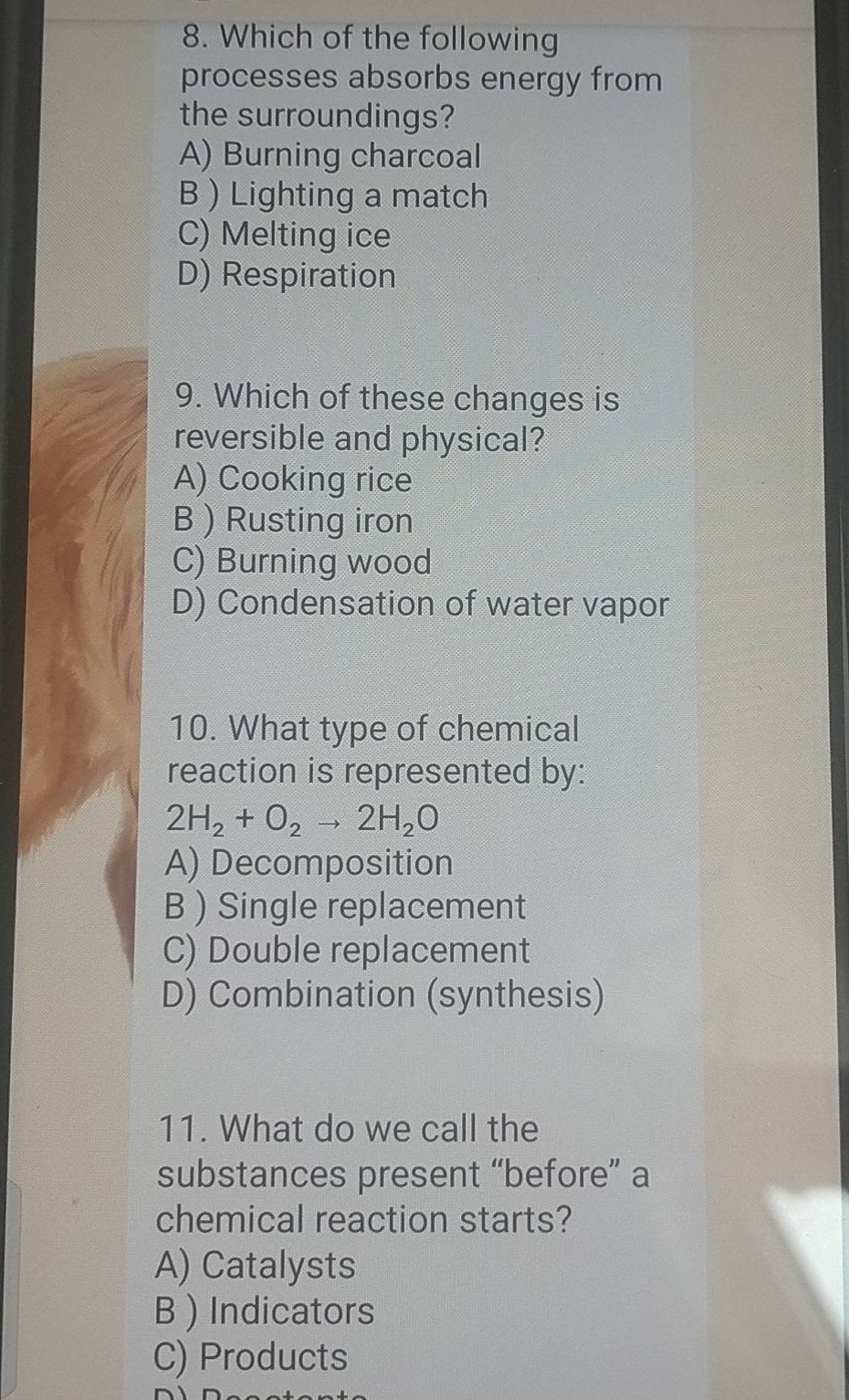
Question
- which of the following processes absorbs energy from the surroundings?
a) burning charcoal
b ) lighting a match
c) melting ice
d) respiration
- which of these changes is reversible and physical?
a) cooking rice
b ) rusting iron
c) burning wood
d) condensation of water vapor
- what type of chemical reaction is represented by:
\\(2\text{h}_2 + \text{o}_2 \
ightarrow 2\text{h}_2\text{o}\\)
a) decomposition
b ) single replacement
c) double replacement
d) combination (synthesis)
- what do we call the substances present \before\ a chemical reaction starts?
a) catalysts
b ) indicators
c) products
d) reactants
🆕 New Concept Discovered: Endothermic vs. Exothermic Processes · 🆕 New: Physical vs. Chemical Changes
---
Step 1: Analyze Question 8 (Energy Changes)
We need to find the process that absorbs energy from the surroundings (an endothermic process).
- Burning charcoal (A) and Lighting a match (B) are combustion reactions. They release heat energy to the surroundings (exothermic).
- Melting ice (C) is a phase change from solid to liquid. To break the intermolecular bonds holding the ice together, the system must absorb heat energy from its surroundings.
- Respiration (D) is a metabolic process that breaks down glucose to release energy for cells (exothermic).
Therefore, melting ice is the process that absorbs energy.
---
Step 2: Analyze Question 9 (Physical vs. Chemical Changes)
We need to find a change that is both reversible (can be undone to get the original substance back) and physical (does not alter the chemical identity of the substance).
- Cooking rice (A), Rusting iron (B), and Burning wood (C) are chemical changes. They create new chemical substances and cannot be easily reversed.
- Condensation of water vapor (D) is a phase change from gas to liquid. The chemical structure of the water molecules remains \( \text{H}_2\text{O} \) (physical change), and it can easily be reversed by boiling or evaporating the water back into vapor.
Therefore, condensation of water vapor is a reversible physical change.
---
Step 3: Analyze Question 10 (Types of Chemical Reactions)
We need to classify the chemical equation:
- In this reaction, two simpler reactant substances (\( \text{H}_2 \) and \( \text{O}_2 \)) combine to form a single, more complex product (\( \text{H}_2\text{O} \)).
- This fits the general form:
- This type of reaction is called a combination or synthesis reaction.
---
Step 4: Analyze Question 11 (Reaction Terminology)
We need to identify the term for substances present before a chemical reaction starts.
- Reactants are the starting substances written on the left side of a chemical equation.
- Products are the substances formed after the reaction takes place, written on the right side.
- Catalysts speed up a reaction but are not consumed by it.
- Indicators change color to show the presence of a substance or a change in pH.
Therefore, the starting substances are called reactants.
---

Snap & solve any problem in the app
Get step-by-step solutions on Sovi AI
Photo-based solutions with guided steps
Explore more problems and detailed explanations
- Question 8: C) Melting ice
- Question 9: D) Condensation of water vapor
- Question 10: D) Combination (synthesis)
- Question 11: D) Reactants