QUESTION IMAGE
Question
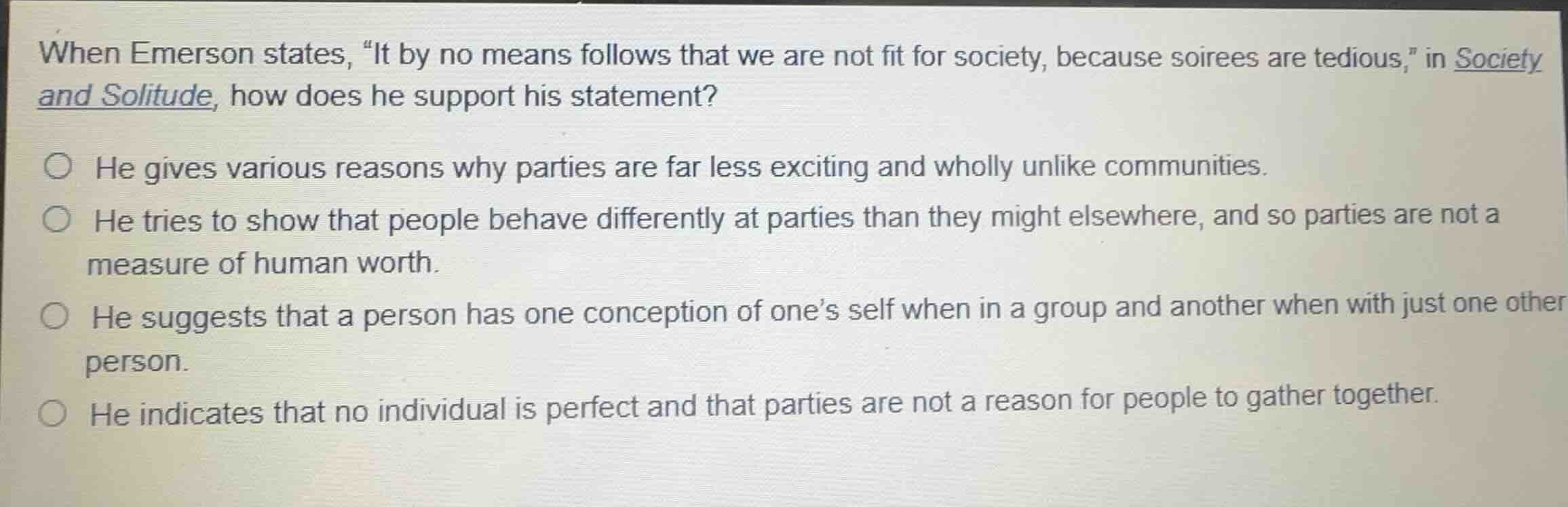
when emerson states, \it by no means follows that we are not fit for society, because soirees are tedious,\ in society and solitude, how does he support his statement?
he gives various reasons why parties are far less exciting and wholly unlike communities.
he tries to show that people behave differently at parties than they might elsewhere, and so parties are not a measure of human worth.
he suggests that a person has one conception of ones self when in a group and another when with just one other person.
he indicates that no individual is perfect and that parties are not a reason for people to gather together.
Analyze the quote's context
In "Society and Solitude," Ralph Waldo Emerson discusses the balance between social interaction and individual solitude. When he states that being bored by "soirees" (parties/social gatherings) does not mean one is unfit for genuine society, he is distinguishing superficial social events from meaningful human connection.
Evaluate the author's support
To support this statement, Emerson examines how people behave in these artificial settings. He argues that the superficiality of parties forces people to act in ways that do not reflect their true nature or worth. Therefore, a person's dislike or failure in a tedious soiree is not a reflection of their capacity for real, deep social connection.
Match with options
Using Authorial Choice to analyze the options:
- Option 1 suggests parties are unlike communities, but does not address the "fitness for society" aspect.
- Option 2 directly addresses how people behave differently at parties and why these events are not a true measure of human worth or social fitness.
- Option 3 focuses on self-conception in groups vs. pairs, which is not the primary support for this specific quote.
- Option 4 discusses human imperfection, which is off-topic.
Thus, Option 2 is the correct choice.

Snap & solve any problem in the app
Get step-by-step solutions on Sovi AI
Photo-based solutions with guided steps
Explore more problems and detailed explanations
- (A) He gives various reasons why parties are far less exciting and wholly unlike communities.
- (B) He tries to show that people behave differently at parties than they might elsewhere, and so parties are not a measure of human worth. (Correct answer)
- (C) He suggests that a person has one conception of one's self when in a group and another when with just one other person.
- (D) He indicates that no individual is perfect and that parties are not a reason for people to gather together.