QUESTION IMAGE
Question
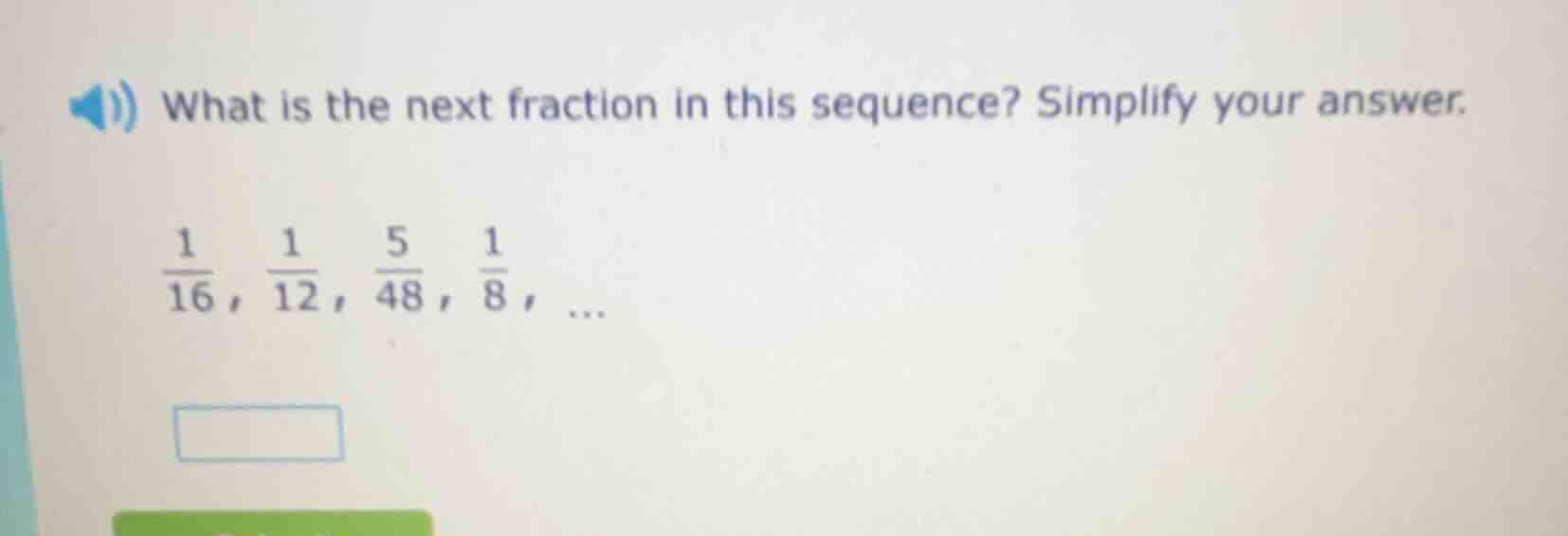
what is the next fraction in this sequence? simplify your answer. $\frac{1}{16}$, $\frac{1}{12}$, $\frac{5}{48}$, $\frac{1}{8}$, ...
Step1: Convert to common denominator
Rewrite all fractions with denominator 48:
$\frac{1}{16} = \frac{3}{48}$, $\frac{1}{12} = \frac{4}{48}$, $\frac{5}{48} = \frac{5}{48}$, $\frac{1}{8} = \frac{6}{48}$
Step2: Identify numerator pattern
Numerators follow: 3, 4, 5, 6 (increasing by 1 each term)
Next numerator = $6 + 1 = 7$
Step3: Form and simplify fraction
New fraction is $\frac{7}{48}$, which is already in simplest form.

Snap & solve any problem in the app
Get step-by-step solutions on Sovi AI
Photo-based solutions with guided steps
Explore more problems and detailed explanations
$\frac{7}{48}$