QUESTION IMAGE
Question
vocabulary
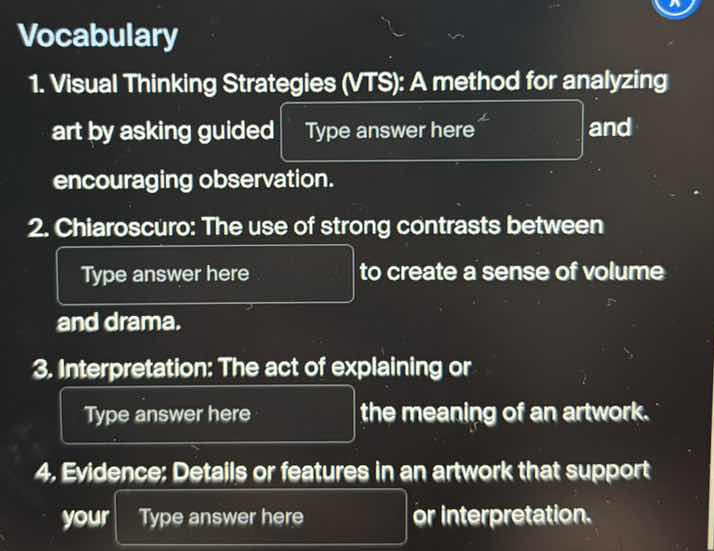
- visual thinking strategies (vts): a method for analyzing art by asking guided type answer here and encouraging observation.
- chiaroscuro: the use of strong contrasts between type answer here to create a sense of volume and drama.
- interpretation: the act of explaining or type answer here the meaning of an artwork.
- evidence: details or features in an artwork that support your type answer here or interpretation.
<pre_analysis>
{
"quality": "clear",
"question_count": 4,
"skills_matched": [
"direct_cot",
"blank_filling_formatter",
"explain_then_answer",
"quick"
],
"needs_drawing": false,
"concepts_used": [],
"new_concepts": [
"Art Vocabulary",
"Visual Analysis Terms"
],
"current_concepts": [
"Visual Thinking Strategies",
"Chiaroscuro",
"Art Interpretation",
"Artistic Evidence"
]
}
</pre_analysis>
<reasoning>
Define Visual Thinking Strategies (VTS)
VTS is a student-centered facilitation method that uses three open-ended questions to encourage observation and discussion. The missing term is "questions".
Define Chiaroscuro
Chiaroscuro is an Italian artistic term referring to the contrast between light and dark to model three-dimensional objects. The missing terms are "light and dark".
Define Interpretation
In art analysis, interpretation is the act of explaining, translating, or clarifying the meaning of an artwork. The missing term is "translating" (or "clarifying").
Define Evidence
Evidence in art analysis refers to visual details or features that support an observer's claim, argument, or interpretation. The missing term is "claim" (or "argument").
</reasoning>
<answer>
Question 1
- Visual Thinking Strategies (VTS): A method for analyzing art by asking guided <blank>questions</blank> and encouraging observation.
Question 2
- Chiaroscuro: The use of strong contrasts between <blank>light and dark</blank> to create a sense of volume and drama.
Question 3
- Interpretation: The act of explaining or <blank>translating</blank> the meaning of an artwork.
Question 4
- Evidence: Details or features in an artwork that support your <blank>claim</blank> or interpretation.
</answer>
<post_analysis>
{
"subject": "Arts",
"question_type": "Fill-in-the-blank",
"knowledge_point": [
"Arts",
"Art History",
"Art Terminology"
]
}
</post_analysis>
Snap & solve any problem in the app
Get step-by-step solutions on Sovi AI
Photo-based solutions with guided steps
Explore more problems and detailed explanations
<pre_analysis>
{
"quality": "clear",
"question_count": 4,
"skills_matched": [
"direct_cot",
"blank_filling_formatter",
"explain_then_answer",
"quick"
],
"needs_drawing": false,
"concepts_used": [],
"new_concepts": [
"Art Vocabulary",
"Visual Analysis Terms"
],
"current_concepts": [
"Visual Thinking Strategies",
"Chiaroscuro",
"Art Interpretation",
"Artistic Evidence"
]
}
</pre_analysis>
<reasoning>
Define Visual Thinking Strategies (VTS)
VTS is a student-centered facilitation method that uses three open-ended questions to encourage observation and discussion. The missing term is "questions".
Define Chiaroscuro
Chiaroscuro is an Italian artistic term referring to the contrast between light and dark to model three-dimensional objects. The missing terms are "light and dark".
Define Interpretation
In art analysis, interpretation is the act of explaining, translating, or clarifying the meaning of an artwork. The missing term is "translating" (or "clarifying").
Define Evidence
Evidence in art analysis refers to visual details or features that support an observer's claim, argument, or interpretation. The missing term is "claim" (or "argument").
</reasoning>
<answer>
Question 1
- Visual Thinking Strategies (VTS): A method for analyzing art by asking guided <blank>questions</blank> and encouraging observation.
Question 2
- Chiaroscuro: The use of strong contrasts between <blank>light and dark</blank> to create a sense of volume and drama.
Question 3
- Interpretation: The act of explaining or <blank>translating</blank> the meaning of an artwork.
Question 4
- Evidence: Details or features in an artwork that support your <blank>claim</blank> or interpretation.
</answer>
<post_analysis>
{
"subject": "Arts",
"question_type": "Fill-in-the-blank",
"knowledge_point": [
"Arts",
"Art History",
"Art Terminology"
]
}
</post_analysis>