QUESTION IMAGE
Question
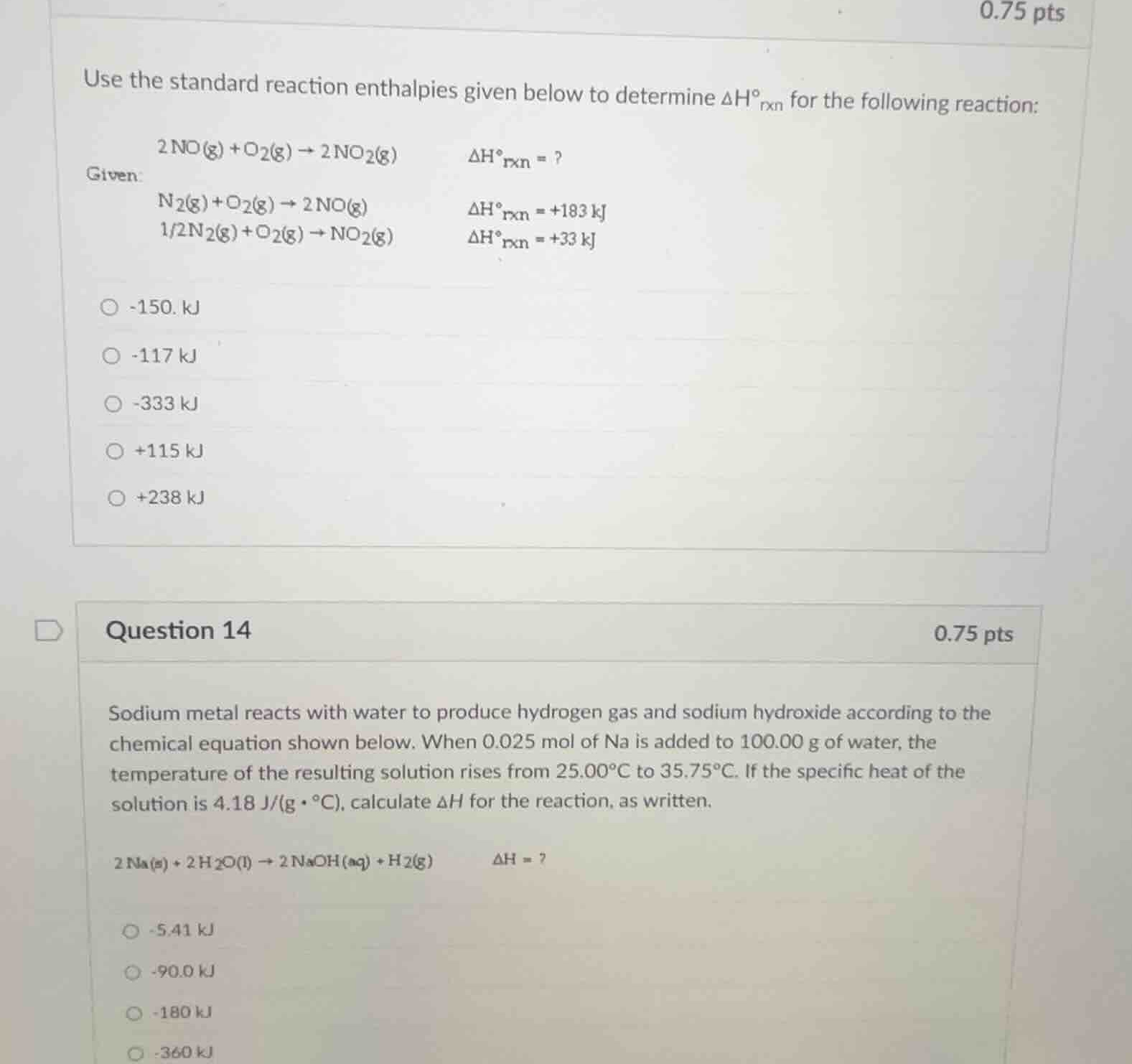
use the standard reaction enthalpies given below to determine \\(\delta h^\circ_{\text{rxn}}\\) for the following reaction:
\\2\text{no(g)} + \text{o}_2\text{(g)} \
ightarrow 2\text{no}_2\text{(g)} \quad \delta h^\circ_{\text{rxn}} = ?\\
given:
\\\text{n}_2\text{(g)} + \text{o}_2\text{(g)} \
ightarrow 2\text{no(g)} \quad \delta h^\circ_{\text{rxn}} = +183\text{ kj}\\
\\1/2\text{n}_2\text{(g)} + \text{o}_2\text{(g)} \
ightarrow \text{no}_2\text{(g)} \quad \delta h^\circ_{\text{rxn}} = +33\text{ kj}\\
-150. kj
-117 kj
-333 kj
+115 kj
+238 kj
question 14
sodium metal reacts with water to produce hydrogen gas and sodium hydroxide according to the chemical equation shown below. when 0.025 mol of na is added to 100.00 g of water, the temperature of the resulting solution rises from 25.00°c to 35.75°c. if the specific heat of the solution is \\(4.18\text{ j}/(\text{g} \cdot ^\circ\text{c})\\), calculate \\(\delta h\\) for the reaction, as written.
\\2\text{na(s)} + 2\text{h}_2\text{o(l)} \
ightarrow 2\text{naoh(aq)} + \text{h}_2\text{(g)} \quad \delta h = ?\\
-5.41 kj
-90.0 kj
-180 kj
-360 kj
Manipulate the given thermochemical equations
Using the Reaction Enthalpy Scaling knowledge point
We need to determine \(\Delta H^\circ_{\text{rxn}}\) for:
Given equations:
- \(\text{N}_2(g) + \text{O}_2(g)
ightarrow 2\text{NO}(g) \quad \Delta H^\circ_1 = +183\text{ kJ}\)
- \(\frac{1}{2}\text{N}_2(g) + \text{O}_2(g)
ightarrow \text{NO}_2(g) \quad \Delta H^\circ_2 = +33\text{ kJ}\)
We reverse equation (1) to place \(\text{NO}(g)\) on the reactant side:
We multiply equation (2) by 2 to match the coefficient of \(\text{NO}_2(g)\):
Sum the modified equations
Using the Reaction Enthalpy Scaling knowledge point
Adding the two modified equations:
Canceling common species on both sides (\(\text{N}_2\) and one \(\text{O}_2\)) yields:
The overall enthalpy change is:
Calculate heat absorbed by the solution
Using the Specific Heat Capacity knowledge point
For Question 14, we first find the mass of the solution. Since \(0.025\text{ mol}\) of \(\text{Na}\) is added to \(100.00\text{ g}\) of water:
The temperature change is:
The heat absorbed by the solution is:
Determine reaction enthalpy per mole of reaction
Using the Specific Heat Capacity knowledge point
Assuming an isolated system, the heat of the reaction is:
This heat is released by the reaction of \(0.025\text{ mol}\) of \(\text{Na}\). The balanced equation is:
The stoichiometric coefficient of \(\text{Na}\) is 2. Therefore, the enthalpy change \(\Delta H\) for the reaction as written (per 2 moles of \(\text{Na}\)) is:
Rounding to two significant figures based on the \(0.025\text{ mol}\) of \(\text{Na}\) gives approximately \(-360\text{ kJ}\).

Snap & solve any problem in the app
Get step-by-step solutions on Sovi AI
Photo-based solutions with guided steps
Explore more problems and detailed explanations
Question 1
- o -150. kJ
- o -117 kJ (Correct answer)
- o -333 kJ
- o +115 kJ
- o +238 kJ
Question 14
- o -5.41 kJ
- o -90.0 kJ
- o -180 kJ
- o -360 kJ (Correct answer)