Sovi.AI - AI Math Tutor

Scan to solve math questions

QUESTION IMAGE

use the following information to answer question 11. organisms have dif…

Question

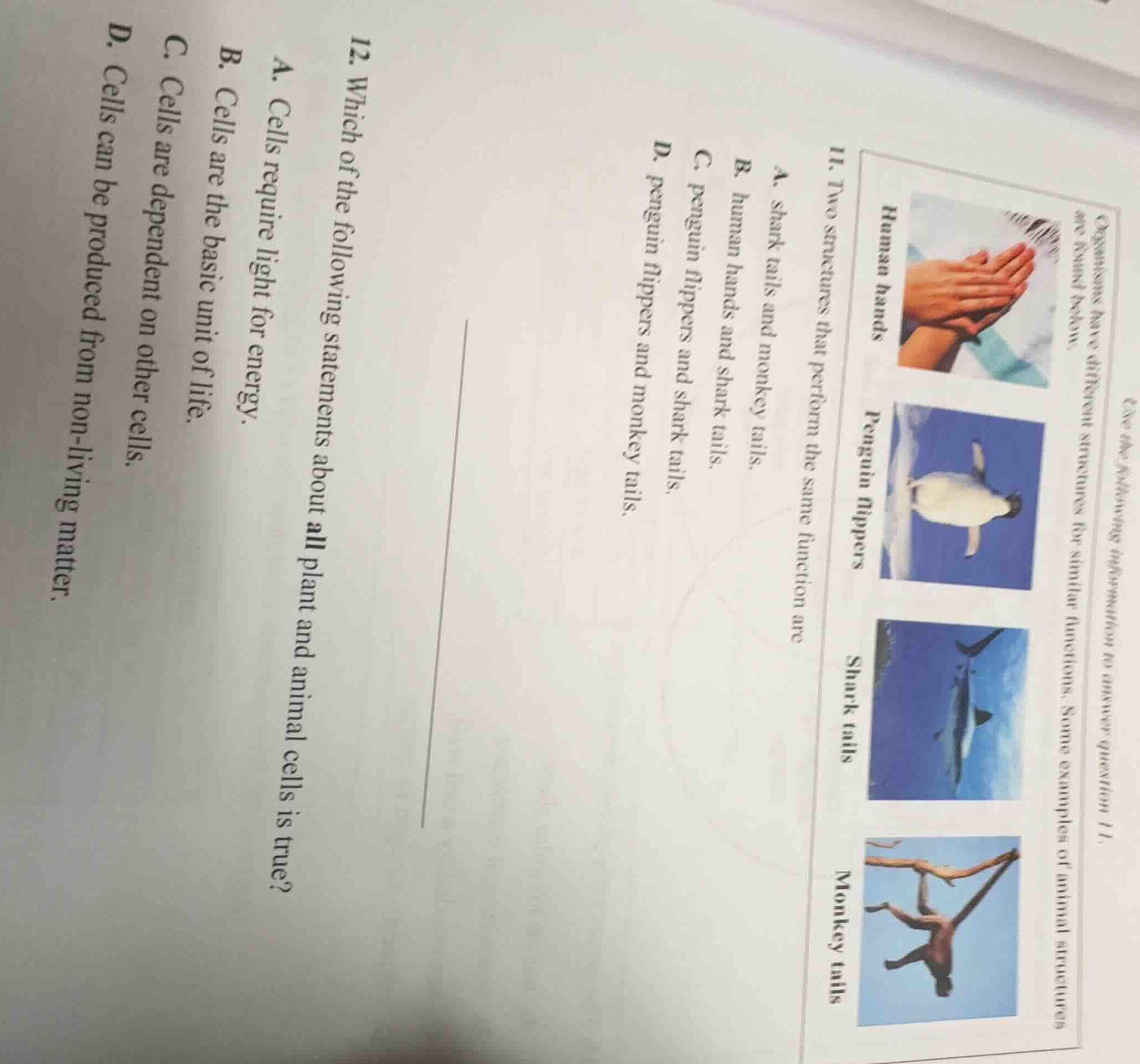
use the following information to answer question 11.
organisms have different structures for similar functions. some examples of animal structures are found below.
human hands
penguin flippers
shark tails
monkey tails

  1. two structures that perform the same function are

a. shark tails and monkey tails.
b. human hands and shark tails.
c. penguin flippers and shark tails.
d. penguin flippers and monkey tails.

  1. which of the following statements about all plant and animal cells is true?

a. cells require light for energy.
b. cells are the basic unit of life.
c. cells are dependent on other cells.
d. cells can be produced from non-living matter.

Explanation:

Response

<pre_analysis>
{
"quality": "clear",
"question_count": 2,
"skills_matched": [
"direct_cot",
"multiple_choice_formatter",
"explain_then_answer",
"tutor"
],
"needs_drawing": false,
"concepts_used": [
"Analogous Structures",
"Cell Theory"
],
"new_concepts": [],
"current_concepts": [
"Analogous Structures",
"Cell Theory",
"Plant and Animal Cells"
]
}
</pre_analysis>

<reasoning>

Analyze Question 11

Using the Analogous Structures knowledge point, we need to find two structures that perform the same function.

  • Human hands are used for grasping and manipulation.
  • Penguin flippers are used for swimming (propulsion in water).
  • Shark tails are used for swimming (propulsion in water).
  • Monkey tails are used for grasping branches (balance and prehensile gripping).

Comparing the functions:

  • Penguin flippers and shark tails both serve the function of swimming through water.
  • Therefore, penguin flippers and shark tails perform the same function. This matches option C.

Analyze Question 12

Using the Cell Theory knowledge point, we evaluate the statements about all plant and animal cells:

  • Option A: "Cells require light for energy." This is incorrect because animal cells and non-photosynthetic plant cells (like root cells) do not require light directly for energy; they use chemical energy (glucose).
  • Option B: "Cells are the basic unit of life." This is a fundamental tenet of cell theory and is true for all living organisms, including all plants and animals.
  • Option C: "Cells are dependent on other cells." This is incorrect because unicellular organisms exist independently, and even within multicellular organisms, some cells can function autonomously in culture.
  • Option D: "Cells can be produced from non-living matter." This is incorrect because cell theory states that all cells arise from pre-existing cells (biogenesis).

Thus, the correct statement is option B.
</reasoning>

<answer>

Question 11

<mcq-option>A. shark tails and monkey tails.</mcq-option>
<mcq-option>B. human hands and shark tails.</mcq-option>
<mcq-correct>C. penguin flippers and shark tails.</mcq-correct>
<mcq-option>D. penguin flippers and monkey tails.</mcq-option>

Question 12

<mcq-option>A. Cells require light for energy.</mcq-option>
<mcq-correct>B. Cells are the basic unit of life.</mcq-correct>
<mcq-option>C. Cells are dependent on other cells.</mcq-option>
<mcq-option>D. Cells can be produced from non-living matter.</mcq-option>
</answer>

<post_analysis>
{
"subject": "Natural Science",
"question_type": "Multiple Choice",
"knowledge_point": [
"Natural Science",
"Biology",
"Cell Theory"
]
}
</post_analysis>

Answer:

<pre_analysis>
{
"quality": "clear",
"question_count": 2,
"skills_matched": [
"direct_cot",
"multiple_choice_formatter",
"explain_then_answer",
"tutor"
],
"needs_drawing": false,
"concepts_used": [
"Analogous Structures",
"Cell Theory"
],
"new_concepts": [],
"current_concepts": [
"Analogous Structures",
"Cell Theory",
"Plant and Animal Cells"
]
}
</pre_analysis>

<reasoning>

Analyze Question 11

Using the Analogous Structures knowledge point, we need to find two structures that perform the same function.

  • Human hands are used for grasping and manipulation.
  • Penguin flippers are used for swimming (propulsion in water).
  • Shark tails are used for swimming (propulsion in water).
  • Monkey tails are used for grasping branches (balance and prehensile gripping).

Comparing the functions:

  • Penguin flippers and shark tails both serve the function of swimming through water.
  • Therefore, penguin flippers and shark tails perform the same function. This matches option C.

Analyze Question 12

Using the Cell Theory knowledge point, we evaluate the statements about all plant and animal cells:

  • Option A: "Cells require light for energy." This is incorrect because animal cells and non-photosynthetic plant cells (like root cells) do not require light directly for energy; they use chemical energy (glucose).
  • Option B: "Cells are the basic unit of life." This is a fundamental tenet of cell theory and is true for all living organisms, including all plants and animals.
  • Option C: "Cells are dependent on other cells." This is incorrect because unicellular organisms exist independently, and even within multicellular organisms, some cells can function autonomously in culture.
  • Option D: "Cells can be produced from non-living matter." This is incorrect because cell theory states that all cells arise from pre-existing cells (biogenesis).

Thus, the correct statement is option B.
</reasoning>

<answer>

Question 11

<mcq-option>A. shark tails and monkey tails.</mcq-option>
<mcq-option>B. human hands and shark tails.</mcq-option>
<mcq-correct>C. penguin flippers and shark tails.</mcq-correct>
<mcq-option>D. penguin flippers and monkey tails.</mcq-option>

Question 12

<mcq-option>A. Cells require light for energy.</mcq-option>
<mcq-correct>B. Cells are the basic unit of life.</mcq-correct>
<mcq-option>C. Cells are dependent on other cells.</mcq-option>
<mcq-option>D. Cells can be produced from non-living matter.</mcq-option>
</answer>

<post_analysis>
{
"subject": "Natural Science",
"question_type": "Multiple Choice",
"knowledge_point": [
"Natural Science",
"Biology",
"Cell Theory"
]
}
</post_analysis>