Sovi.AI - AI Math Tutor

Scan to solve math questions

QUESTION IMAGE

1. type o negative blood is considered to be the universal donor. why? …

Question

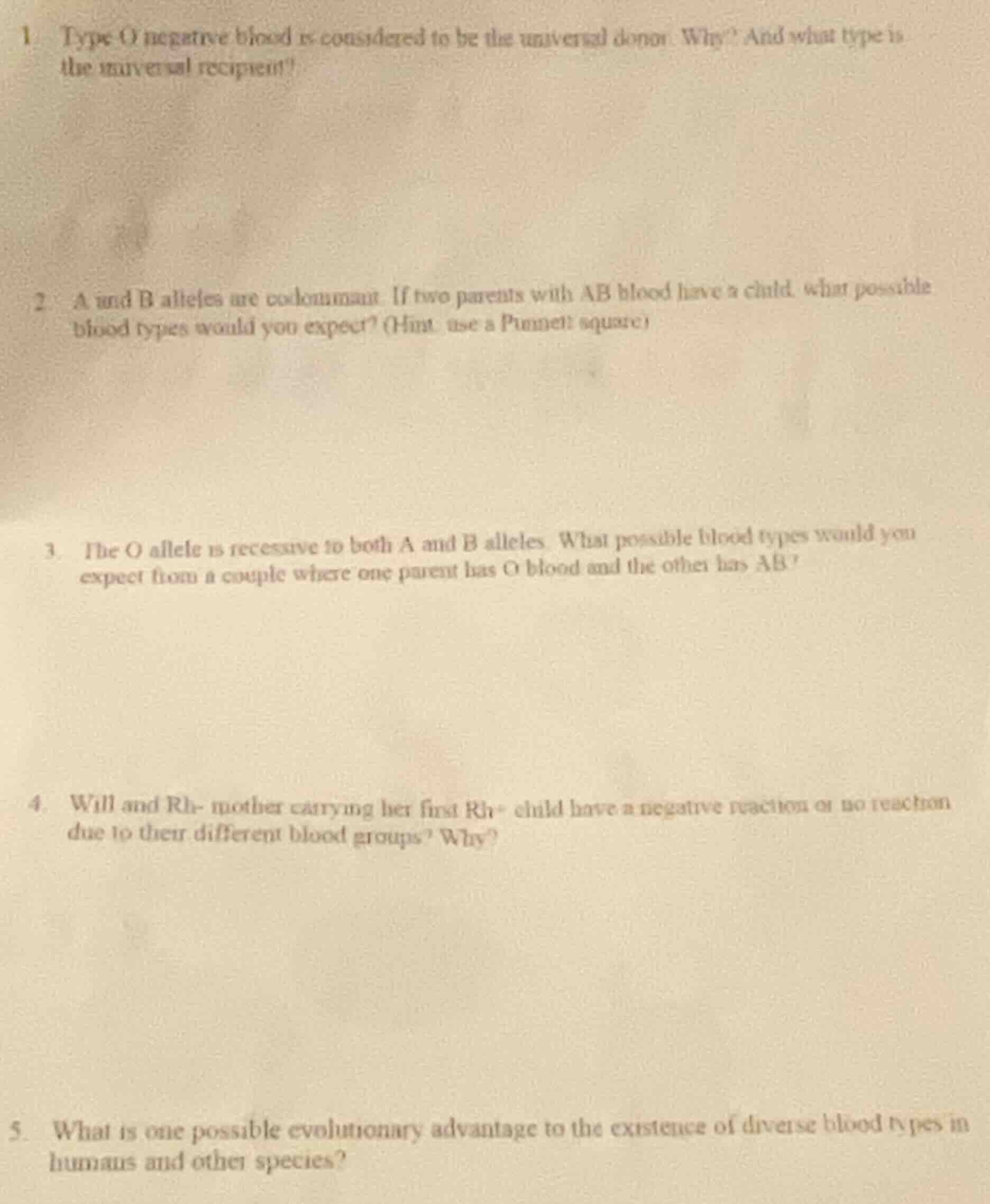
  1. type o negative blood is considered to be the universal donor. why? and what type is the universal recipient?
  1. a and b alleles are codominant. if two parents with ab blood have a child, what possible blood types would you expect? (hint: use a punnett square)
  1. the o allele is recessive to both a and b alleles. what possible blood types would you expect from a couple where one parent has o blood and the other has ab?
  1. will an rh- mother carrying her first rh+ child have a negative reaction or no reaction due to their different blood groups? why?
  1. what is one possible evolutionary advantage to the existence of diverse blood types in humans and other species?

Explanation:

Response

<pre_analysis>
{
"quality": "clear",
"question_count": 5,
"skills_matched": [
"direct_cot",
"explain_then_answer",
"tutor"
],
"needs_drawing": false,
"concepts_used": [],
"new_concepts": [
"ABO Blood Groups",
"Codominance",
"Rh Incompatibility"
],
"current_concepts": [
"ABO Blood Groups",
"Codominance",
"Rh Incompatibility",
"Evolutionary Advantage"
]
}
</pre_analysis>

<reasoning>

Analyze universal donor and recipient

Type O negative blood lacks A, B, and Rh antigens on red blood cells, preventing immune attacks in recipients. Type AB positive blood has A, B, and Rh antigens, meaning the recipient's immune system recognizes all these antigens as "self" and lacks antibodies against them, allowing them to receive any blood type safely.

Determine offspring of AB x AB parents

Parents with AB blood have the genotype \(I^A I^B\). Crossing them (\(I^A I^B \times I^A I^B\)) yields offspring genotypes: \(I^A I^A\) (Type A), \(I^A I^B\) (Type AB), and \(I^B I^B\) (Type B). Thus, the expected blood types are A, B, and AB.

Determine offspring of O x AB parents

A parent with O blood has the genotype \(ii\), and a parent with AB blood has the genotype \(I^A I^B\). Crossing them (\(ii \times I^A I^B\)) yields offspring genotypes: \(I^A i\) (Type A) and \(I^B i\) (Type B). Thus, the expected blood types are A and B.

Evaluate Rh incompatibility in first pregnancy

An Rh- mother carrying her first Rh+ child will experience no reaction. The mother's immune system has not yet been exposed to Rh+ blood to produce anti-Rh antibodies. Exposure typically occurs during delivery, meaning subsequent Rh+ pregnancies are at risk, but the first is safe.

Identify evolutionary advantage of diverse blood types

Diverse blood types provide population-level resistance to infectious diseases. Pathogens often use specific cell-surface antigens to infect host cells. Variation in blood group antigens prevents a single pathogen from easily infecting and wiping out an entire population.
</reasoning>

<answer>

Question 1

  • Universal Donor: Type O negative (\(\text{O}^-\)) is the universal donor because its red blood cells lack A, B, and Rh antigens, meaning it will not trigger an immune response in any recipient.
  • Universal Recipient: Type AB positive (\(\text{AB}^+\)) is the universal recipient because it possesses A, B, and Rh antigens, meaning the recipient's immune system will not produce antibodies against any of these antigens.

Question 2

The expected blood types are A, B, and AB.

  • Genotype Cross: \(I^A I^B \times I^A I^B\)
  • Punnett Square:
  • \(I^A \times I^A

ightarrow I^A I^A\) (Type A)

  • \(I^A \times I^B

ightarrow I^A I^B\) (Type AB)

  • \(I^B \times I^B

ightarrow I^B I^B\) (Type B)

Question 3

The expected blood types are A and B.

  • Genotype Cross: \(ii \times I^A I^B\)
  • Punnett Square:
  • \(i \times I^A

ightarrow I^A i\) (Type A)

  • \(i \times I^B

ightarrow I^B i\) (Type B)

Question 4

There will be no reaction. During a first pregnancy, the maternal and fetal blood supplies remain separated. The mother's immune system is only exposed to the baby's Rh+ red blood cells during delivery, which is too late to affect the first child. Sensitization occurs after birth, posing a risk only to future Rh+ pregnancies.

Question 5

One major evolutionary advantage is resistance to infectious diseases. Having diverse blood types prevents a single pathogen (such as a virus, bacterium, or parasite that binds to specific blood group antigen…

Answer:

<pre_analysis>
{
"quality": "clear",
"question_count": 5,
"skills_matched": [
"direct_cot",
"explain_then_answer",
"tutor"
],
"needs_drawing": false,
"concepts_used": [],
"new_concepts": [
"ABO Blood Groups",
"Codominance",
"Rh Incompatibility"
],
"current_concepts": [
"ABO Blood Groups",
"Codominance",
"Rh Incompatibility",
"Evolutionary Advantage"
]
}
</pre_analysis>

<reasoning>

Analyze universal donor and recipient

Type O negative blood lacks A, B, and Rh antigens on red blood cells, preventing immune attacks in recipients. Type AB positive blood has A, B, and Rh antigens, meaning the recipient's immune system recognizes all these antigens as "self" and lacks antibodies against them, allowing them to receive any blood type safely.

Determine offspring of AB x AB parents

Parents with AB blood have the genotype \(I^A I^B\). Crossing them (\(I^A I^B \times I^A I^B\)) yields offspring genotypes: \(I^A I^A\) (Type A), \(I^A I^B\) (Type AB), and \(I^B I^B\) (Type B). Thus, the expected blood types are A, B, and AB.

Determine offspring of O x AB parents

A parent with O blood has the genotype \(ii\), and a parent with AB blood has the genotype \(I^A I^B\). Crossing them (\(ii \times I^A I^B\)) yields offspring genotypes: \(I^A i\) (Type A) and \(I^B i\) (Type B). Thus, the expected blood types are A and B.

Evaluate Rh incompatibility in first pregnancy

An Rh- mother carrying her first Rh+ child will experience no reaction. The mother's immune system has not yet been exposed to Rh+ blood to produce anti-Rh antibodies. Exposure typically occurs during delivery, meaning subsequent Rh+ pregnancies are at risk, but the first is safe.

Identify evolutionary advantage of diverse blood types

Diverse blood types provide population-level resistance to infectious diseases. Pathogens often use specific cell-surface antigens to infect host cells. Variation in blood group antigens prevents a single pathogen from easily infecting and wiping out an entire population.
</reasoning>

<answer>

Question 1

  • Universal Donor: Type O negative (\(\text{O}^-\)) is the universal donor because its red blood cells lack A, B, and Rh antigens, meaning it will not trigger an immune response in any recipient.
  • Universal Recipient: Type AB positive (\(\text{AB}^+\)) is the universal recipient because it possesses A, B, and Rh antigens, meaning the recipient's immune system will not produce antibodies against any of these antigens.

Question 2

The expected blood types are A, B, and AB.

  • Genotype Cross: \(I^A I^B \times I^A I^B\)
  • Punnett Square:
  • \(I^A \times I^A

ightarrow I^A I^A\) (Type A)

  • \(I^A \times I^B

ightarrow I^A I^B\) (Type AB)

  • \(I^B \times I^B

ightarrow I^B I^B\) (Type B)

Question 3

The expected blood types are A and B.

  • Genotype Cross: \(ii \times I^A I^B\)
  • Punnett Square:
  • \(i \times I^A

ightarrow I^A i\) (Type A)

  • \(i \times I^B

ightarrow I^B i\) (Type B)

Question 4

There will be no reaction. During a first pregnancy, the maternal and fetal blood supplies remain separated. The mother's immune system is only exposed to the baby's Rh+ red blood cells during delivery, which is too late to affect the first child. Sensitization occurs after birth, posing a risk only to future Rh+ pregnancies.

Question 5

One major evolutionary advantage is resistance to infectious diseases. Having diverse blood types prevents a single pathogen (such as a virus, bacterium, or parasite that binds to specific blood group antigens) from infecting and decimating an entire population.
</answer>

<post_analysis>
{
"subject": "Natural Science",
"question_type": "Multi-part",
"knowledge_point": [
"Natural Science",
"Biology",
"Genetics and Immunology"
]
}
</post_analysis>