QUESTION IMAGE
Question
texes mathematics 4-8 (115)
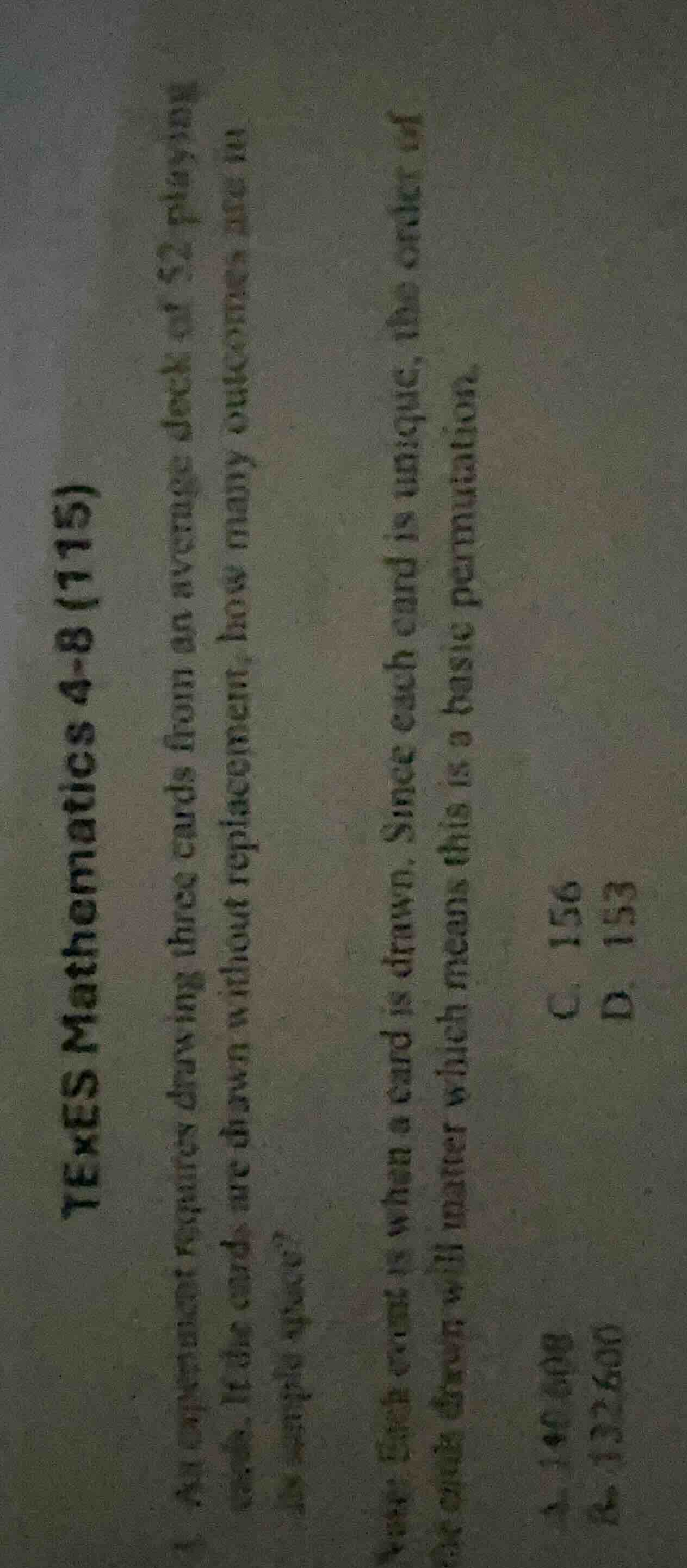
- an experiment requires drawing three cards from an average deck of 52 playing cards. if the cards are drawn without replacement, how many outcomes are in its sample space?
note: each event is when a card is drawn. since each card is unique, the order of the cards drawn will matter which means this is a basic permutation.
a. 140,608
b. 132,600
c. 156
d. 153
🆕 New Concept Discovered: Permutations and Combinations
Arranging items where order matters.
Step 1: Identify the type of counting problem
The problem asks for the number of outcomes in the sample space when drawing three cards from a standard deck of 52 cards without replacement.
The note states: "Each event is when a card is drawn. Since each card is unique, the order of the cards drawn will matter which means this is a basic permutation."
Because order matters and we are drawing without replacement, we use permutations.
Step 2: Apply the permutation formula
To find the number of ways to arrange \( r \) items chosen from a set of \( n \) distinct items, we use the permutation formula:
Here, the total number of cards is \( n = 52 \), and we are drawing \( r = 3 \) cards:
Step 3: Calculate the product
Calculate the product of the three choices:

Snap & solve any problem in the app
Get step-by-step solutions on Sovi AI
Photo-based solutions with guided steps
Explore more problems and detailed explanations
B. 132,600