QUESTION IMAGE
Question
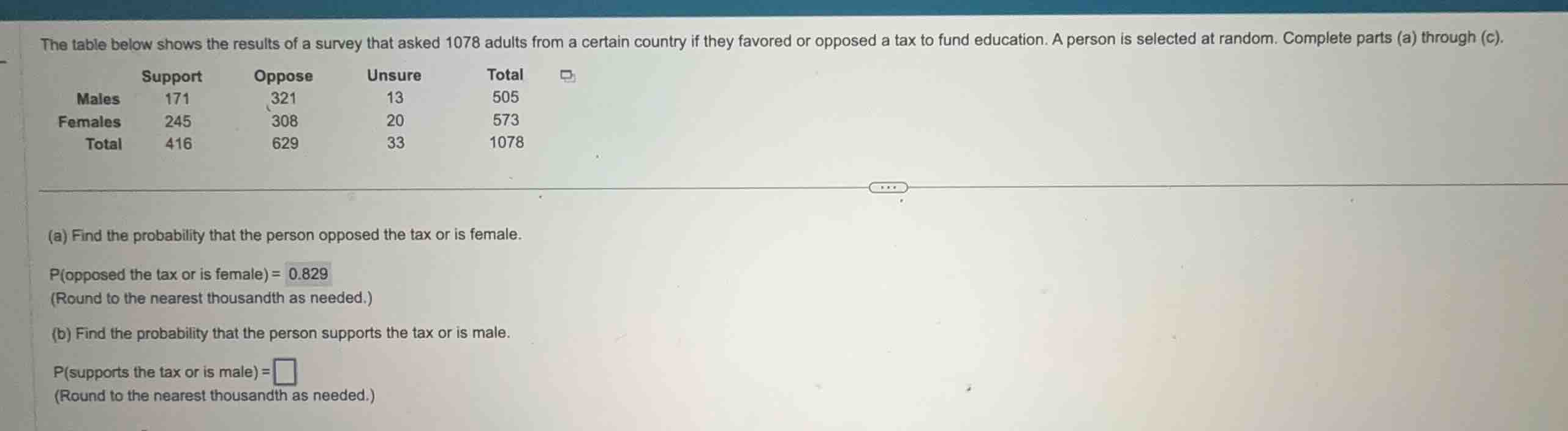
the table below shows the results of a survey that asked 1078 adults from a certain country if they favored or opposed a tax to fund education. a person is selected at random. complete parts (a) through (c).
(a) find the probability that the person opposed the tax or is female.
\\(p(\text{opposed the tax or is female}) = 0.829\\)
(round to the nearest thousandth as needed.)
(b) find the probability that the person supports the tax or is male.
\\(p(\text{supports the tax or is male}) = \\)
(round to the nearest thousandth as needed.)
Identify the given values and target
Using the Two-Way Contingency Table Probability knowledge point
- Total number of adults: \(N = 1078\)
- Number of males: \(n(\text{Male}) = 505\)
- Number of females: \(n(\text{Female}) = 573\)
- Number of people who support the tax: \(n(\text{Support}) = 416\)
- Number of males who support the tax: \(n(\text{Support} \cap \text{Male}) = 171\)
- Target: \(P(\text{supports the tax or is male})\)
Apply the addition rule for probability
Using the Addition Rule for Probability knowledge point
Calculate the final probability
Using the Addition Rule for Probability knowledge point
Rounding to the nearest thousandth gives \(0.696\).

Snap & solve any problem in the app
Get step-by-step solutions on Sovi AI
Photo-based solutions with guided steps
Explore more problems and detailed explanations
(b) Find the probability that the person supports the tax or is male.
P(supports the tax or is male) = <blank>0.696</blank>
(Round to the nearest thousandth as needed.)