QUESTION IMAGE
Question
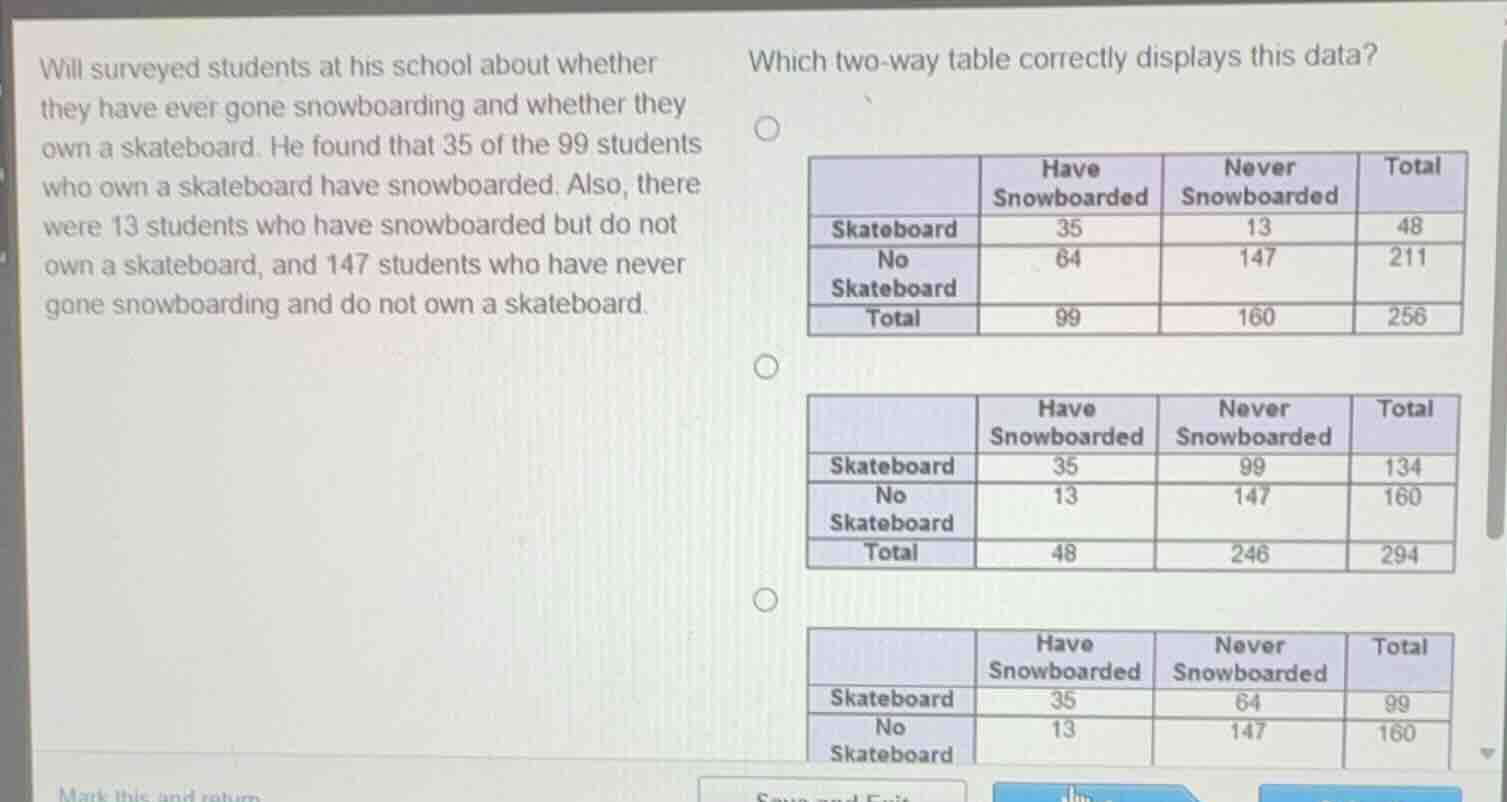
will surveyed students at his school about whether they have ever gone snowboarding and whether they own a skateboard. he found that 35 of the 99 students who own a skateboard have snowboarded. also, there were 13 students who have snowboarded but do not own a skateboard, and 147 students who have never gone snowboarding and do not own a skateboard.
which two-way table correctly displays this data?
Analyze the given data
We are given the following information from the survey:
- "35 of the 99 students who own a skateboard have snowboarded."
- This means the total number of students who own a skateboard is \(99\).
- Out of these, the number of students who own a skateboard and have snowboarded is \(35\).
- Consequently, the number of students who own a skateboard and have never snowboarded is:
- "there were 13 students who have snowboarded but do not own a skateboard."
- This means the number of students in the "No Skateboard" and "Have Snowboarded" category is \(13\).
- "147 students who have never gone snowboarding and do not own a skateboard."
- This means the number of students in the "No Skateboard" and "Never Snowboarded" category is \(147\).
Determine the table values
Using the Two-Way Frequency Tables concept, we construct the cells:
- Skateboard / Have Snowboarded: \(35\)
- Skateboard / Never Snowboarded: \(64\)
- Skateboard Total: \(35 + 64 = 99\)
- No Skateboard / Have Snowboarded: \(13\)
- No Skateboard / Never Snowboarded: \(147\)
- No Skateboard Total: \(13 + 147 = 160\)
Calculate column totals
Now we calculate the totals for each column:
- Have Snowboarded Total:
- Never Snowboarded Total:
- Grand Total:
Compare with the given options
Let's examine the third option shown in the image (partially visible at the bottom):
- Row 1 (Skateboard): Have Snowboarded = \(35\), Never Snowboarded = \(64\), Total = \(99\).
- Row 2 (No Skateboard): Have Snowboarded = \(13\), Never Snowboarded = \(147\), Total = \(160\).
This matches our derived values perfectly.

Snap & solve any problem in the app
Get step-by-step solutions on Sovi AI
Photo-based solutions with guided steps
Explore more problems and detailed explanations
- (A) Table with Skateboard Total = 48, No Skateboard Total = 211
- (B) Table with Skateboard Total = 134, No Skateboard Total = 160
- (C) Table with Skateboard Total = 99 (35 Have Snowboarded, 64 Never Snowboarded) and No Skateboard Total = 160 (13 Have Snowboarded, 147 Never Snowboarded) (Correct answer)