QUESTION IMAGE
Question
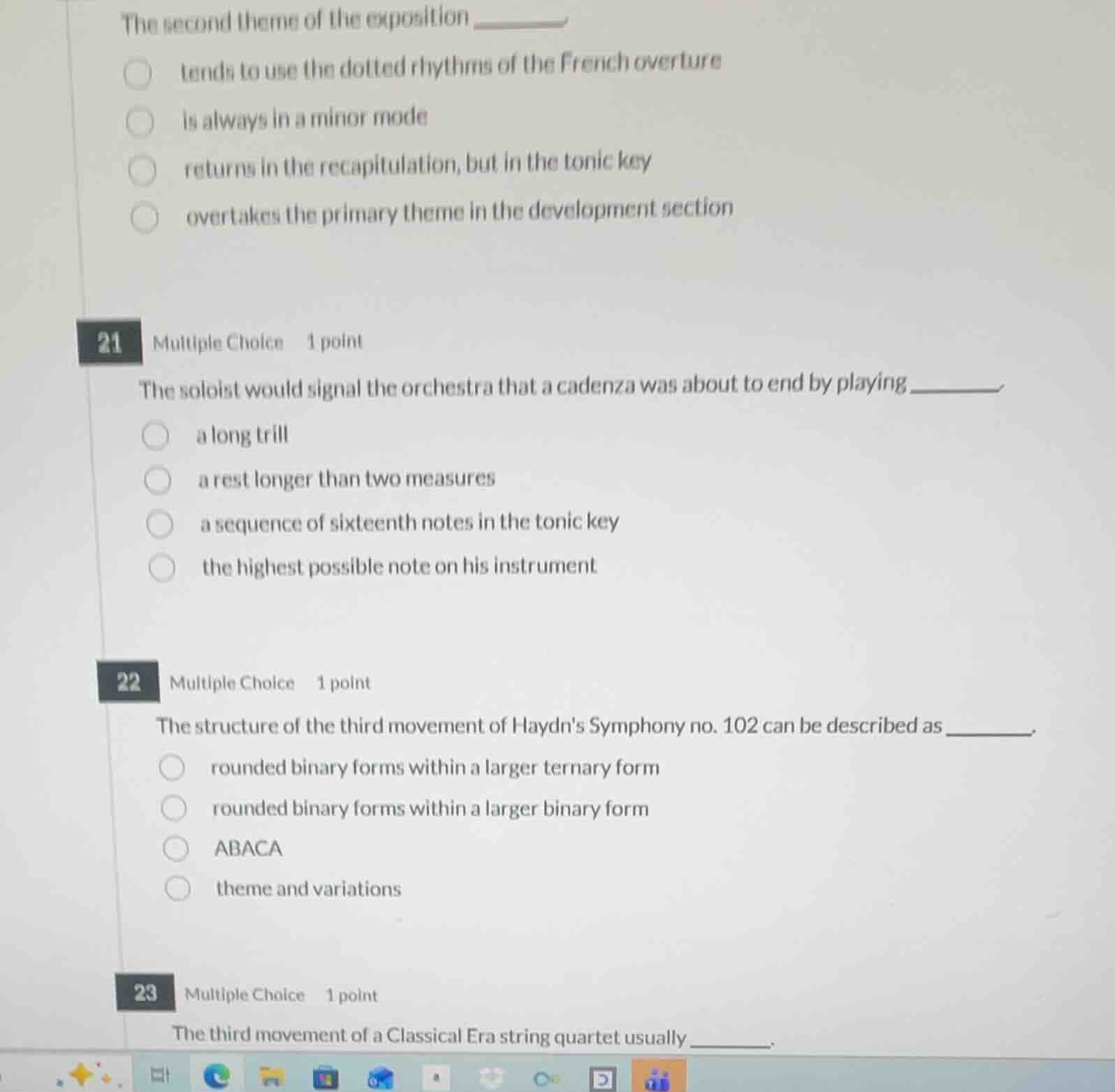
the second theme of the exposition
tends to use the dotted rhythms of the french overture
is always in a minor mode
returns in the recapitulation, but in the tonic key
overtakes the primary theme in the development section
21 multiple choice 1 point
the soloist would signal the orchestra that a cadenza was about to end by playing
a long trill
a rest longer than two measures
a sequence of sixteenth notes in the tonic key
the highest possible note on his instrument
22 multiple choice 1 point
the structure of the third movement of haydns symphony no. 102 can be described as
rounded binary forms within a larger ternary form
rounded binary forms within a larger binary form
abaca
theme and variations
23 multiple choice 1 point
the third movement of a classical era string quartet usually
Analyze the first question
Using the Sonata Form Structure knowledge point
- The first question asks about the behavior of the second theme of the exposition in sonata form.
- In the exposition, the second theme is presented in a contrasting key (usually the dominant or relative major).
- During the recapitulation, all themes return, but the second theme is transposed to the tonic key to resolve tonal tension.
- Therefore, the correct option is "returns in the recapitulation, but in the tonic key".
Analyze Question 21
Using the Classical Cadenza knowledge point
- Question 21 asks how a soloist signals the end of a cadenza to the orchestra.
- Historically, the standard signal for the orchestra to re-enter at the end of a solo cadenza is a long, sustained, or accelerating trill on the dominant chord.
- Therefore, the correct option is "a long trill".
Analyze Question 22
Using the Classical Symphony Structure knowledge point
- Question 22 asks about the structure of the third movement of Haydn's Symphony No. 102.
- The third movement of a Classical symphony is typically a Minuet and Trio.
- The overall form of a Minuet and Trio is ternary (\(A-B-A\)), where both the Minuet (\(A\)) and the Trio (\(B\)) are individually structured in rounded binary form.
- Therefore, the correct option is "rounded binary forms within a larger ternary form".
Analyze Question 23
Using the Classical String Quartet Structure knowledge point
- Question 23 asks about the typical characteristics of the third movement of a Classical Era string quartet.
- The third movement of a standard four-movement Classical string quartet is almost always a stylized dance, specifically a Minuet and Trio (or later, a Scherzo and Trio), written in triple meter.
- Looking at the visible portion of the prompt, the standard completion is that it is a minuet and trio or in triple meter.

Snap & solve any problem in the app
Get step-by-step solutions on Sovi AI
Photo-based solutions with guided steps
Explore more problems and detailed explanations
Question 1
- tends to use the dotted rhythms of the French overture
- is always in a minor mode
- returns in the recapitulation, but in the tonic key (Correct answer)
- overtakes the primary theme in the development section
Question 21
- a long trill (Correct answer)
- a rest longer than two measures
- a sequence of sixteenth notes in the tonic key
- the highest possible note on his instrument
Question 22
- rounded binary forms within a larger ternary form (Correct answer)
- rounded binary forms within a larger binary form
- ABACA
- theme and variations
Question 23
- is a minuet and trio in triple meter (Correct answer)