Sovi.AI - AI Math Tutor

Scan to solve math questions

QUESTION IMAGE

read the underlined text carefully. according to monroe, how would amer…

Question

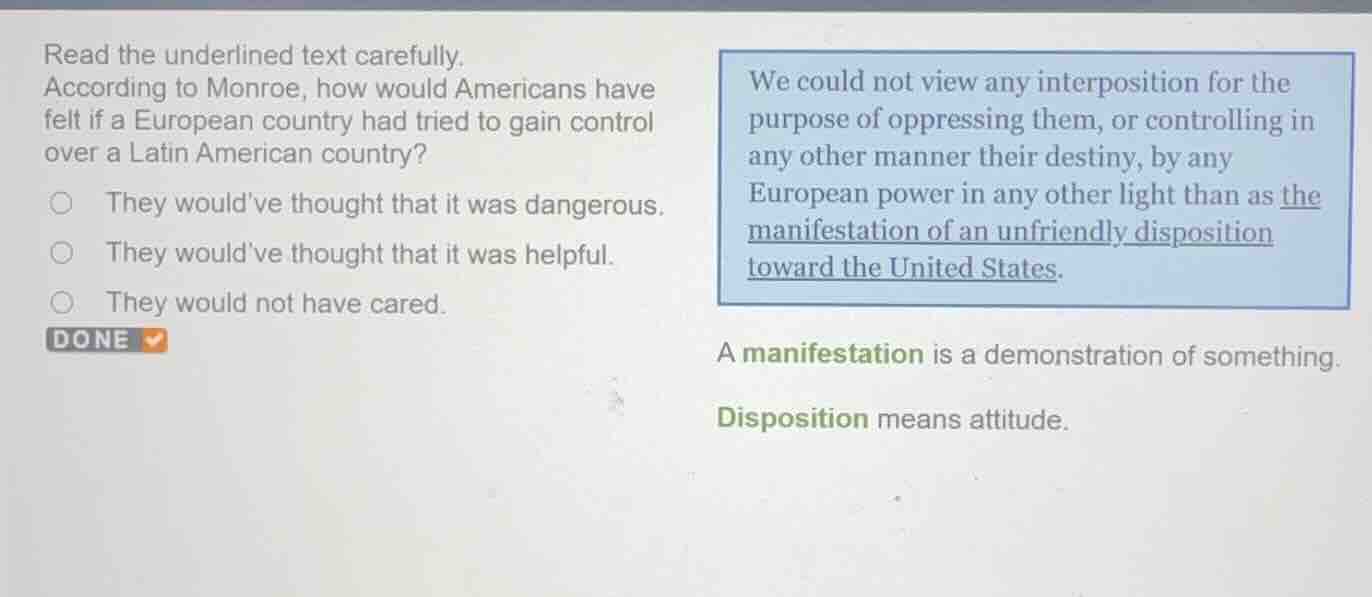
read the underlined text carefully.
according to monroe, how would americans have felt if a european country had tried to gain control over a latin american country?

they wouldve thought that it was dangerous.
they wouldve thought that it was helpful.
they would not have cared.

we could not view any interposition for the purpose of oppressing them, or controlling in any other manner their destiny, by any european power in any other light than as the manifestation of an unfriendly disposition toward the united states.

a manifestation is a demonstration of something.
disposition means attitude.

Explanation:

Response

<pre_analysis>
{
"quality": "clear",
"question_count": 1,
"skills_matched": [
"direct_cot",
"multiple_choice_formatter",
"explain_then_answer",
"tutor"
],
"needs_drawing": false,
"concepts_used": [
"Monroe Doctrine Context",
"Textual Evidence Analysis"
],
"new_concepts": [],
"current_concepts": [
"Monroe Doctrine Context",
"Textual Evidence Analysis"
]
}
</pre_analysis>

<reasoning>

Analyze the question and source text

The question asks how Americans would have felt if a European country tried to gain control over a Latin American country, based on the provided excerpt from James Monroe.

We must apply Textual Evidence Analysis to evaluate the underlined passage:
"the manifestation of an unfriendly disposition toward the United States."

Interpret the vocabulary and context

The text provides helpful definitions:

  • "Manifestation" means a demonstration.
  • "Disposition" means attitude.

Therefore, "the manifestation of an unfriendly disposition" translates to "a demonstration of an unfriendly attitude" toward the United States.

Connect to the historical context

Under the Monroe Doctrine Context, President Monroe declared that European intervention in the Western Hemisphere would be viewed as a direct threat to the peace and safety of the United States. An "unfriendly disposition" (hostile attitude) from a foreign power near American borders would be considered dangerous to national security.

Evaluate the options

  • "They would've thought that it was dangerous": This matches the idea of an "unfriendly disposition" (hostile/dangerous threat) toward the U.S.
  • "They would've thought that it was helpful": This contradicts "unfriendly."
  • "They would not have cared": This contradicts the active warning issued in the doctrine.

Thus, the first option is the correct choice.
</reasoning>

<answer>
<mcq-correct>They would've thought that it was dangerous.</mcq-correct>
<mcq-option>They would've thought that it was helpful.</mcq-option>
<mcq-option>They would not have cared.</mcq-option>
</answer>

<post_analysis>
{
"subject": "Social Science",
"question_type": "Multiple Choice",
"knowledge_point": [
"Social Science",
"US History",
"Monroe Doctrine Context"
]
}
</post_analysis>

Answer:

<pre_analysis>
{
"quality": "clear",
"question_count": 1,
"skills_matched": [
"direct_cot",
"multiple_choice_formatter",
"explain_then_answer",
"tutor"
],
"needs_drawing": false,
"concepts_used": [
"Monroe Doctrine Context",
"Textual Evidence Analysis"
],
"new_concepts": [],
"current_concepts": [
"Monroe Doctrine Context",
"Textual Evidence Analysis"
]
}
</pre_analysis>

<reasoning>

Analyze the question and source text

The question asks how Americans would have felt if a European country tried to gain control over a Latin American country, based on the provided excerpt from James Monroe.

We must apply Textual Evidence Analysis to evaluate the underlined passage:
"the manifestation of an unfriendly disposition toward the United States."

Interpret the vocabulary and context

The text provides helpful definitions:

  • "Manifestation" means a demonstration.
  • "Disposition" means attitude.

Therefore, "the manifestation of an unfriendly disposition" translates to "a demonstration of an unfriendly attitude" toward the United States.

Connect to the historical context

Under the Monroe Doctrine Context, President Monroe declared that European intervention in the Western Hemisphere would be viewed as a direct threat to the peace and safety of the United States. An "unfriendly disposition" (hostile attitude) from a foreign power near American borders would be considered dangerous to national security.

Evaluate the options

  • "They would've thought that it was dangerous": This matches the idea of an "unfriendly disposition" (hostile/dangerous threat) toward the U.S.
  • "They would've thought that it was helpful": This contradicts "unfriendly."
  • "They would not have cared": This contradicts the active warning issued in the doctrine.

Thus, the first option is the correct choice.
</reasoning>

<answer>
<mcq-correct>They would've thought that it was dangerous.</mcq-correct>
<mcq-option>They would've thought that it was helpful.</mcq-option>
<mcq-option>They would not have cared.</mcq-option>
</answer>

<post_analysis>
{
"subject": "Social Science",
"question_type": "Multiple Choice",
"knowledge_point": [
"Social Science",
"US History",
"Monroe Doctrine Context"
]
}
</post_analysis>