QUESTION IMAGE
Question
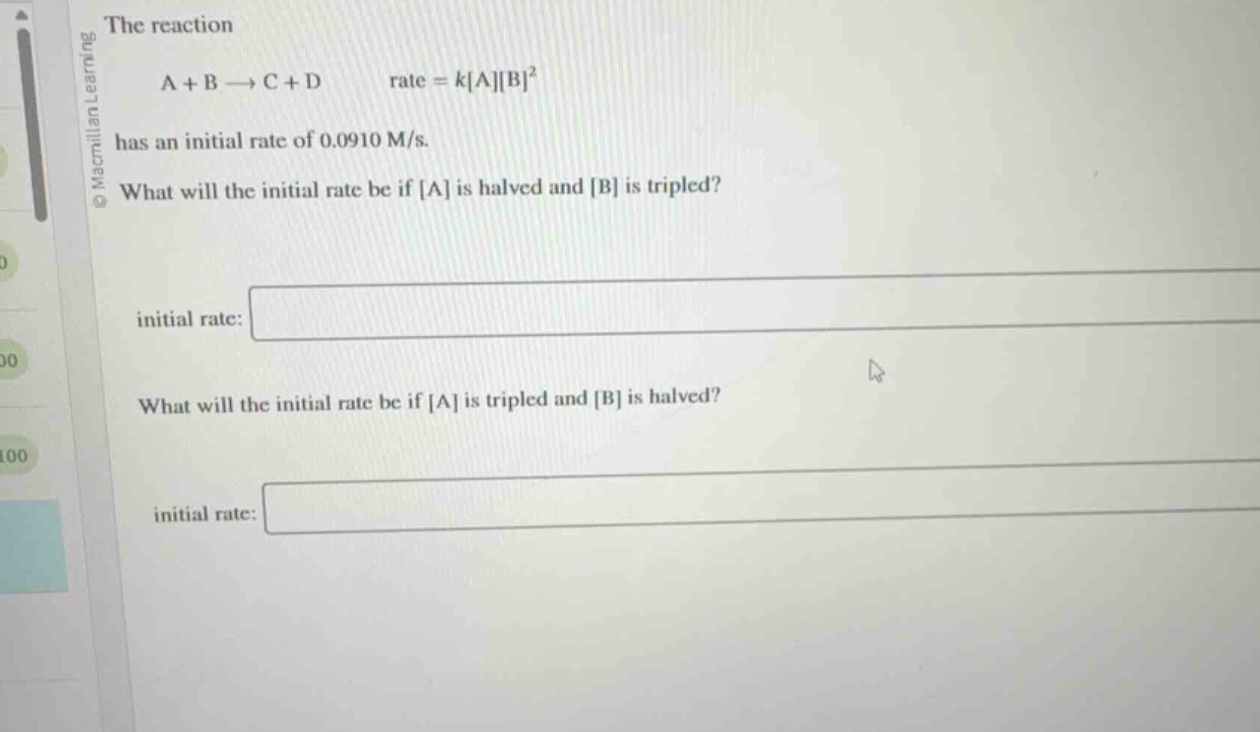
the reaction
\\ a + b \longrightarrow c + d \quad \text{rate} = kab^2 \\
has an initial rate of \\(0.0910\text{ m/s}\\).
what will the initial rate be if \\(a\\) is halved and \\(b\\) is tripled?
initial rate:
what will the initial rate be if \\(a\\) is tripled and \\(b\\) is halved?
initial rate:
Identify the rate law and initial conditions
We are given the rate law:
The initial rate is:
This is related to the Rate Law concept.
Calculate the rate when [A] is halved and [B] is tripled
Let the new concentrations be \([\text{A}]_1 = 0.5[\text{A}]_0\) and \([\text{B}]_1 = 3[\text{B}]_0\).
The new rate is:
Calculate the rate when [A] is tripled and [B] is halved
Let the new concentrations be \([\text{A}]_2 = 3[\text{A}]_0\) and \([\text{B}]_2 = 0.5[\text{B}]_0\).
The new rate is:

Snap & solve any problem in the app
Get step-by-step solutions on Sovi AI
Photo-based solutions with guided steps
Explore more problems and detailed explanations
Question 1
What will the initial rate be if [A] is halved and [B] is tripled?
initial rate: <blank>\(0.410\)</blank> M/s
Question 2
What will the initial rate be if [A] is tripled and [B] is halved?
initial rate: <blank>\(0.0683\)</blank> M/s