QUESTION IMAGE
Question
question
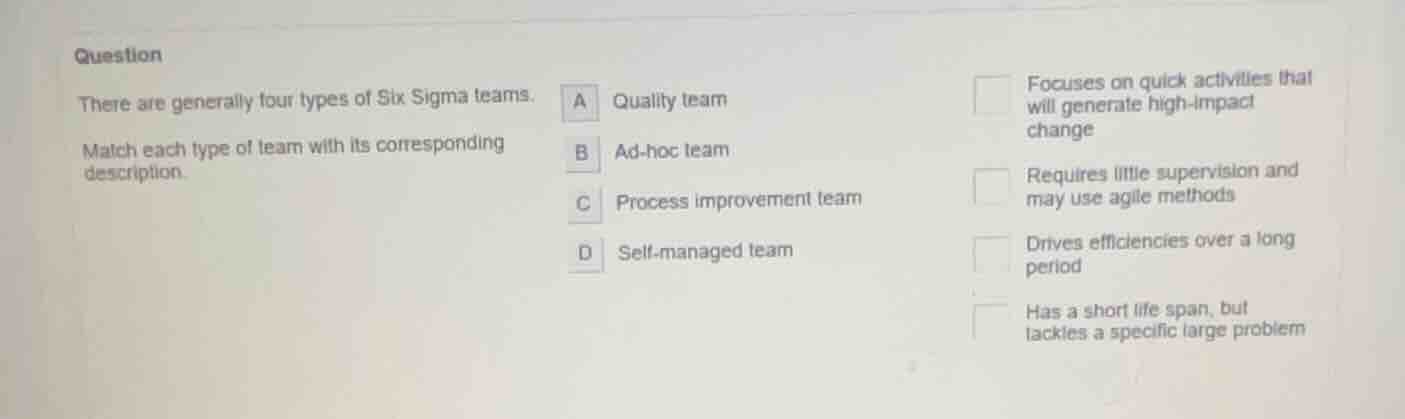
there are generally four types of six sigma teams.
match each type of team with its corresponding description.
a quality team
b ad-hoc team
c process improvement team
d self-managed team
focuses on quick activities that will generate high-impact change
requires little supervision and may use agile methods
drives efficiencies over a long period
has a short life span, but tackles a specific large problem
Analyze Six Sigma team types
We examine the four types of Six Sigma teams: Quality, Ad-hoc, Process improvement, and Self-managed.
Match Quality team
Quality teams focus on long-term, continuous improvement and driving efficiencies over an extended period.
- Match: A corresponds to "Drives efficiencies over a long period".
Match Ad-hoc team
Ad-hoc teams are formed for a specific, temporary purpose to address a single issue and then disband.
- Match: B corresponds to "Has a short life span, but tackles a specific large problem".
Match Process improvement team
Process improvement teams focus on rapid, high-impact changes (often through Kaizen events or targeted projects).
- Match: C corresponds to "Focuses on quick activities that will generate high-impact change".
Match Self-managed team
Self-managed teams operate with high autonomy, requiring minimal external supervision and often utilizing agile methodologies.
- Match: D corresponds to "Requires little supervision and may use agile methods".

Snap & solve any problem in the app
Get step-by-step solutions on Sovi AI
Photo-based solutions with guided steps
Explore more problems and detailed explanations
| Team Type | Description |
|---|---|
| B Ad-hoc team | Has a short life span, but tackles a specific large problem |
| C Process improvement team | Focuses on quick activities that will generate high-impact change |
| D Self-managed team | Requires little supervision and may use agile methods |