QUESTION IMAGE
Question
question 1
1 pts
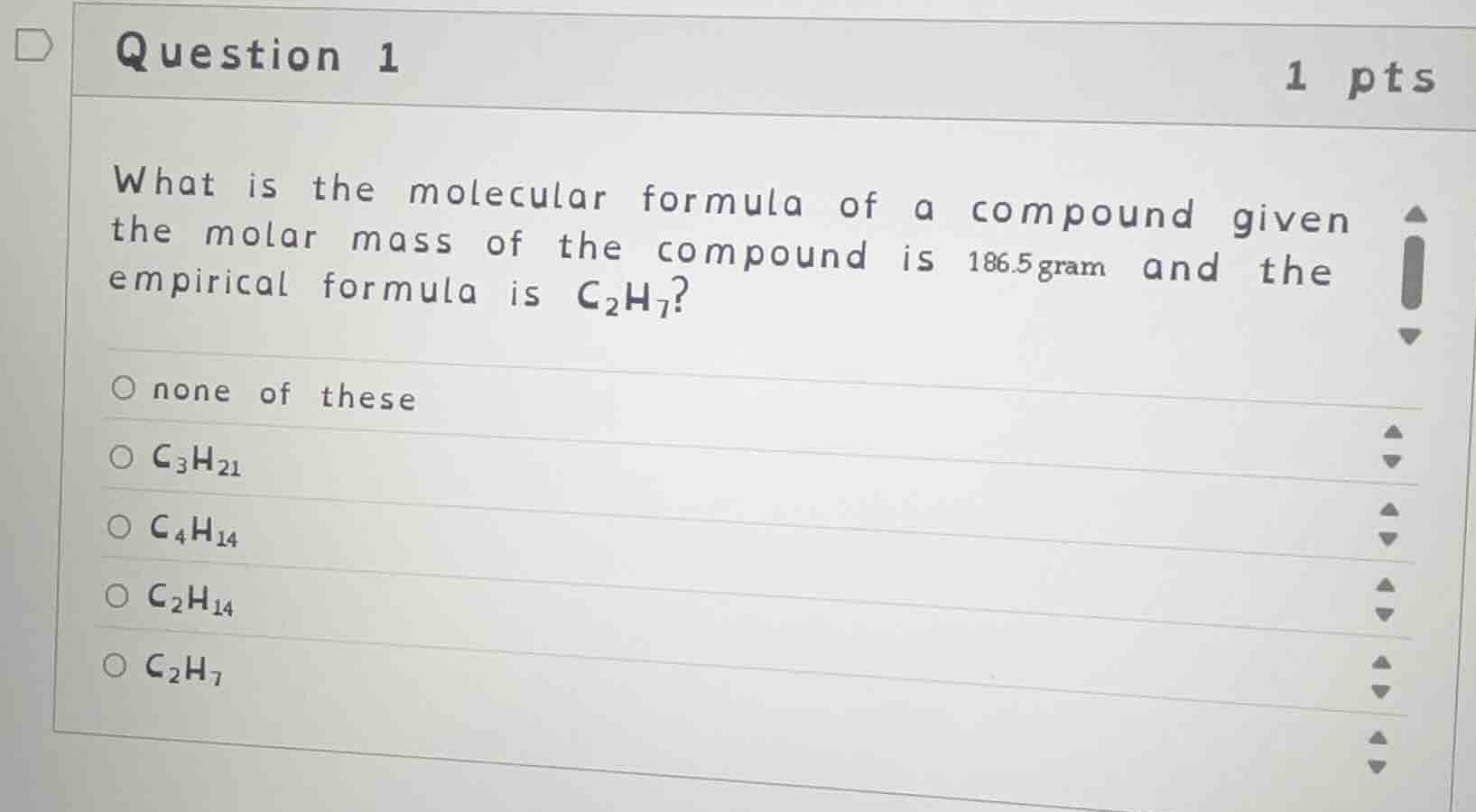
what is the molecular formula of a compound given the molar mass of the compound is \\(186.5\text{ gram}\\) and the empirical formula is \\(\text{c}_2\text{h}_7\\)?
none of these
\\(\text{c}_3\text{h}_{21}\\)
\\(\text{c}_4\text{h}_{14}\\)
\\(\text{c}_2\text{h}_{14}\\)
\\(\text{c}_2\text{h}_7\\)
🆕 New Concept Discovered: Empirical to Molecular Formula Conversion
Scaling up the simplest ratio to match the actual mass
Step 1: Calculate the empirical formula mass
The empirical formula is \(\text{C}_2\text{H}_7\). We find its mass using the average atomic masses of carbon (\(\approx 12.011\text{ g/mol}\)) and hydrogen (\(\approx 1.008\text{ g/mol}\)):
Step 2: Determine the scaling factor
To find how many times larger the actual molecule is compared to its empirical formula, we divide the given molar mass of the compound by the empirical formula mass:
Step 3: Multiply the empirical subscripts
Multiply the subscripts in the empirical formula \(\text{C}_2\text{H}_7\) by the scaling factor \(n = 6\):
Since \(\text{C}_{12}\text{H}_{42}\) is not listed among the multiple-choice options, the correct choice is "none of these".

Snap & solve any problem in the app
Get step-by-step solutions on Sovi AI
Photo-based solutions with guided steps
Explore more problems and detailed explanations
none of these