Sovi.AI - AI Math Tutor

Scan to solve math questions

QUESTION IMAGE

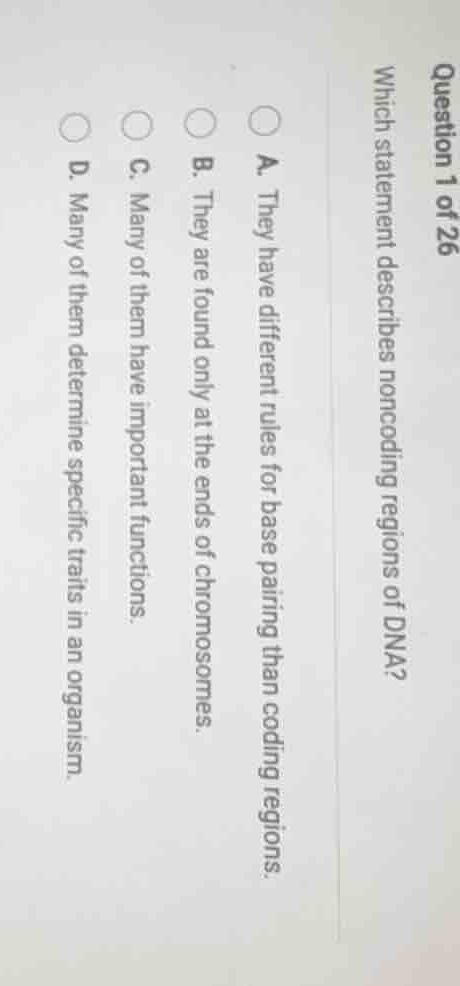
question 1 of 26 which statement describes noncoding regions of dna? a.…

Question

question 1 of 26
which statement describes noncoding regions of dna?
a. they have different rules for base pairing than coding regions.
b. they are found only at the ends of chromosomes.
c. many of them have important functions.
d. many of them determine specific traits in an organism.

Explanation:

Response

<pre_analysis>
{
"quality": "clear",
"question_count": 1,
"skills_matched": [
"direct_cot",
"multiple_choice_formatter",
"explain_then_answer",
"tutor"
],
"needs_drawing": false,
"concepts_used": [],
"new_concepts": [
"Noncoding DNA",
"DNA Structure"
],
"current_concepts": [
"Noncoding DNA",
"DNA Structure",
"Genetics"
]
}
</pre_analysis>

<reasoning>

Analyze the question

The question asks which statement describes noncoding regions of DNA.

Evaluate Option A

Option A states they have different rules for base pairing. This is incorrect because all DNA follows standard Watson-Crick base pairing rules.

Evaluate Option B

Option B states they are found only at the ends of chromosomes. This is incorrect because noncoding DNA is distributed throughout the genome, not just at telomeres.

Evaluate Option C

Option C states many of them have important functions. This is correct because noncoding regions include regulatory elements, promoters, and introns that are vital for gene expression.

Evaluate Option D

Option D states many of them determine specific traits. This is incorrect because coding regions (genes) are primarily responsible for determining specific protein-driven traits.
</reasoning>

<answer>
<mcq-option>A. They have different rules for base pairing than coding regions.</mcq-option>
<mcq-option>B. They are found only at the ends of chromosomes.</mcq-option>
<mcq-correct>C. Many of them have important functions.</mcq-correct>
<mcq-option>D. Many of them determine specific traits in an organism.</mcq-option>
</answer>

<post_analysis>
{
"subject": "Natural Science",
"question_type": "Multiple Choice",
"knowledge_point": [
"Natural Science",
"Biology",
"Noncoding DNA"
]
}
</post_analysis>

Answer:

<pre_analysis>
{
"quality": "clear",
"question_count": 1,
"skills_matched": [
"direct_cot",
"multiple_choice_formatter",
"explain_then_answer",
"tutor"
],
"needs_drawing": false,
"concepts_used": [],
"new_concepts": [
"Noncoding DNA",
"DNA Structure"
],
"current_concepts": [
"Noncoding DNA",
"DNA Structure",
"Genetics"
]
}
</pre_analysis>

<reasoning>

Analyze the question

The question asks which statement describes noncoding regions of DNA.

Evaluate Option A

Option A states they have different rules for base pairing. This is incorrect because all DNA follows standard Watson-Crick base pairing rules.

Evaluate Option B

Option B states they are found only at the ends of chromosomes. This is incorrect because noncoding DNA is distributed throughout the genome, not just at telomeres.

Evaluate Option C

Option C states many of them have important functions. This is correct because noncoding regions include regulatory elements, promoters, and introns that are vital for gene expression.

Evaluate Option D

Option D states many of them determine specific traits. This is incorrect because coding regions (genes) are primarily responsible for determining specific protein-driven traits.
</reasoning>

<answer>
<mcq-option>A. They have different rules for base pairing than coding regions.</mcq-option>
<mcq-option>B. They are found only at the ends of chromosomes.</mcq-option>
<mcq-correct>C. Many of them have important functions.</mcq-correct>
<mcq-option>D. Many of them determine specific traits in an organism.</mcq-option>
</answer>

<post_analysis>
{
"subject": "Natural Science",
"question_type": "Multiple Choice",
"knowledge_point": [
"Natural Science",
"Biology",
"Noncoding DNA"
]
}
</post_analysis>