QUESTION IMAGE
Question
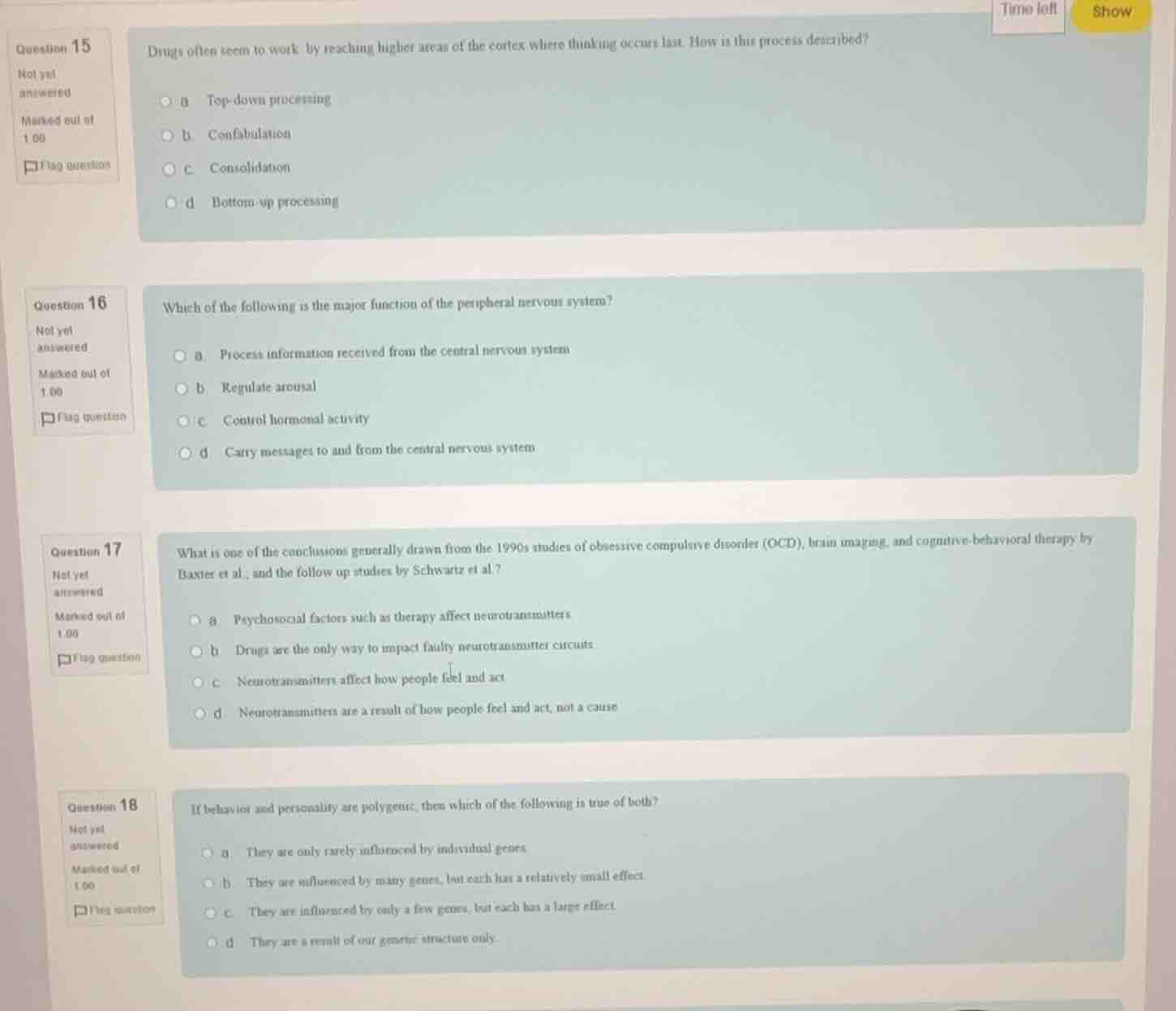
question 15
drugs often seem to work by reaching higher areas of the cortex where thinking occurs last. how is this process described?
a. top-down processing
b. confabulation
c. consolidation
d. bottom-up processing
question 16
which of the following is the major function of the peripheral nervous system?
a. process information received from the central nervous system
b. regulate arousal
c. control hormonal activity
d. carry messages to and from the central nervous system
question 17
what is one of the conclusions generally drawn from the 1990s studies of obsessive-compulsive disorder (ocd), brain imaging, and cognitive-behavioral therapy by baxter et al., and the follow-up studies by schwartz et al.?
a. psychosocial factors such as therapy affect neurotransmitters
b. drugs are the only way to impact faulty neurotransmitter circuits
c. neurotransmitters affect how people feel and act
d. neurotransmitters are a result of how people feel and act, not a cause
question 18
if behavior and personality are polygenic, then which of the following is true of both?
a. they are only rarely influenced by individual genes
b. they are influenced by many genes, but each has a relatively small effect
c. they are influenced by only a few genes, but each has a large effect
d. they are a result of our genetic structure only
<pre_analysis>
{
"quality": "clear",
"question_count": 4,
"skills_matched": [
"direct_cot",
"multiple_choice_formatter",
"explain_then_answer",
"tutor",
"mastery_adaptive_brevity"
],
"needs_drawing": false,
"concepts_used": [
"Neurotransmitters"
],
"new_concepts": [
"Nervous System Functions",
"Polygenic Inheritance",
"Information Processing Direction"
],
"current_concepts": [
"Information Processing Direction",
"Nervous System Functions",
"Neurotransmitters",
"Polygenic Inheritance"
]
}
</pre_analysis>
<reasoning>
Analyze Question 15
The question asks how the process is described when drugs work by reaching higher areas of the cortex where thinking occurs last.
- Bottom-up processing starts with sensory receptors and works up to higher levels of processing.
- Top-down processing is guided by higher-level mental processes, but in the context of neural pathway direction, signals moving from lower subcortical structures up to the higher cortex represent a bottom-up pathway.
- Specifically, drugs entering the system and affecting lower brain stem areas first before reaching the higher cortex is a bottom-up process.
Analyze Question 16
The question asks for the major function of the peripheral nervous system (PNS).
- The central nervous system (CNS) consists of the brain and spinal cord, which process information.
- The PNS connects the CNS to the rest of the body, serving to carry sensory and motor messages to and from the central nervous system.
Analyze Question 17
Using the Neurotransmitters knowledge point, we analyze the 1990s studies on OCD by Baxter et al. and Schwartz et al.
- These landmark studies used brain imaging (PET scans) to show that both cognitive-behavioral therapy (specifically exposure and response prevention) and medication (like fluoxetine) produced similar functional changes in the caudate nucleus.
- This demonstrated that psychological interventions (psychosocial factors) can directly influence brain chemistry and neural circuit activity.
Analyze Question 18
The question asks what is true if behavior and personality are polygenic.
- "Polygenic" means influenced by many genes.
- In polygenic inheritance, a trait is influenced by the collective effects of many different genes, where each individual gene typically exerts a relatively small effect on the overall phenotype.
</reasoning>
<answer>
Question 15
<mcq-option>(a) Top-down processing</mcq-option>
<mcq-option>(b) Confabulation</mcq-option>
<mcq-option>(c) Consolidation</mcq-option>
<mcq-correct>(d) Bottom-up processing</mcq-correct>
Question 16
<mcq-option>(a) Process information received from the central nervous system</mcq-option>
<mcq-option>(b) Regulate arousal</mcq-option>
<mcq-option>(c) Control hormonal activity</mcq-option>
<mcq-correct>(d) Carry messages to and from the central nervous system</mcq-correct>
Question 17
<mcq-correct>(a) Psychosocial factors such as therapy affect neurotransmitters</mcq-correct>
<mcq-option>(b) Drugs are the only way to impact faulty neurotransmitter circuits</mcq-option>
<mcq-option>(c) Neurotransmitters affect how people feel and act</mcq-option>
<mcq-option>(d) Neurotransmitters are a result of how people feel and act, not a cause</mcq-option>
Question 18
<mcq-option>(a) They are only rarely influenced by individual genes</mcq-option>
<mcq-correct>(b) They are influenced by many genes, but each has a relatively small effect</mcq-correct>
<mcq-option>(c) They are influenced by only a few genes, but each has a lar…
Snap & solve any problem in the app
Get step-by-step solutions on Sovi AI
Photo-based solutions with guided steps
Explore more problems and detailed explanations
<pre_analysis>
{
"quality": "clear",
"question_count": 4,
"skills_matched": [
"direct_cot",
"multiple_choice_formatter",
"explain_then_answer",
"tutor",
"mastery_adaptive_brevity"
],
"needs_drawing": false,
"concepts_used": [
"Neurotransmitters"
],
"new_concepts": [
"Nervous System Functions",
"Polygenic Inheritance",
"Information Processing Direction"
],
"current_concepts": [
"Information Processing Direction",
"Nervous System Functions",
"Neurotransmitters",
"Polygenic Inheritance"
]
}
</pre_analysis>
<reasoning>
Analyze Question 15
The question asks how the process is described when drugs work by reaching higher areas of the cortex where thinking occurs last.
- Bottom-up processing starts with sensory receptors and works up to higher levels of processing.
- Top-down processing is guided by higher-level mental processes, but in the context of neural pathway direction, signals moving from lower subcortical structures up to the higher cortex represent a bottom-up pathway.
- Specifically, drugs entering the system and affecting lower brain stem areas first before reaching the higher cortex is a bottom-up process.
Analyze Question 16
The question asks for the major function of the peripheral nervous system (PNS).
- The central nervous system (CNS) consists of the brain and spinal cord, which process information.
- The PNS connects the CNS to the rest of the body, serving to carry sensory and motor messages to and from the central nervous system.
Analyze Question 17
Using the Neurotransmitters knowledge point, we analyze the 1990s studies on OCD by Baxter et al. and Schwartz et al.
- These landmark studies used brain imaging (PET scans) to show that both cognitive-behavioral therapy (specifically exposure and response prevention) and medication (like fluoxetine) produced similar functional changes in the caudate nucleus.
- This demonstrated that psychological interventions (psychosocial factors) can directly influence brain chemistry and neural circuit activity.
Analyze Question 18
The question asks what is true if behavior and personality are polygenic.
- "Polygenic" means influenced by many genes.
- In polygenic inheritance, a trait is influenced by the collective effects of many different genes, where each individual gene typically exerts a relatively small effect on the overall phenotype.
</reasoning>
<answer>
Question 15
<mcq-option>(a) Top-down processing</mcq-option>
<mcq-option>(b) Confabulation</mcq-option>
<mcq-option>(c) Consolidation</mcq-option>
<mcq-correct>(d) Bottom-up processing</mcq-correct>
Question 16
<mcq-option>(a) Process information received from the central nervous system</mcq-option>
<mcq-option>(b) Regulate arousal</mcq-option>
<mcq-option>(c) Control hormonal activity</mcq-option>
<mcq-correct>(d) Carry messages to and from the central nervous system</mcq-correct>
Question 17
<mcq-correct>(a) Psychosocial factors such as therapy affect neurotransmitters</mcq-correct>
<mcq-option>(b) Drugs are the only way to impact faulty neurotransmitter circuits</mcq-option>
<mcq-option>(c) Neurotransmitters affect how people feel and act</mcq-option>
<mcq-option>(d) Neurotransmitters are a result of how people feel and act, not a cause</mcq-option>
Question 18
<mcq-option>(a) They are only rarely influenced by individual genes</mcq-option>
<mcq-correct>(b) They are influenced by many genes, but each has a relatively small effect</mcq-correct>
<mcq-option>(c) They are influenced by only a few genes, but each has a large effect</mcq-option>
<mcq-option>(d) They are a result of our genetic structure only</mcq-option>
</answer>
<post_analysis>
{
"subject": "Natural Science",
"question_type": "Multiple Choice",
"knowledge_point": [
"Natural Science",
"Biology",
"Neuroscience"
]
}
</post_analysis>