Sovi.AI - AI Math Tutor

Scan to solve math questions

QUESTION IMAGE

question 5 of 10 which two statements describe why dna replication is e…

Question

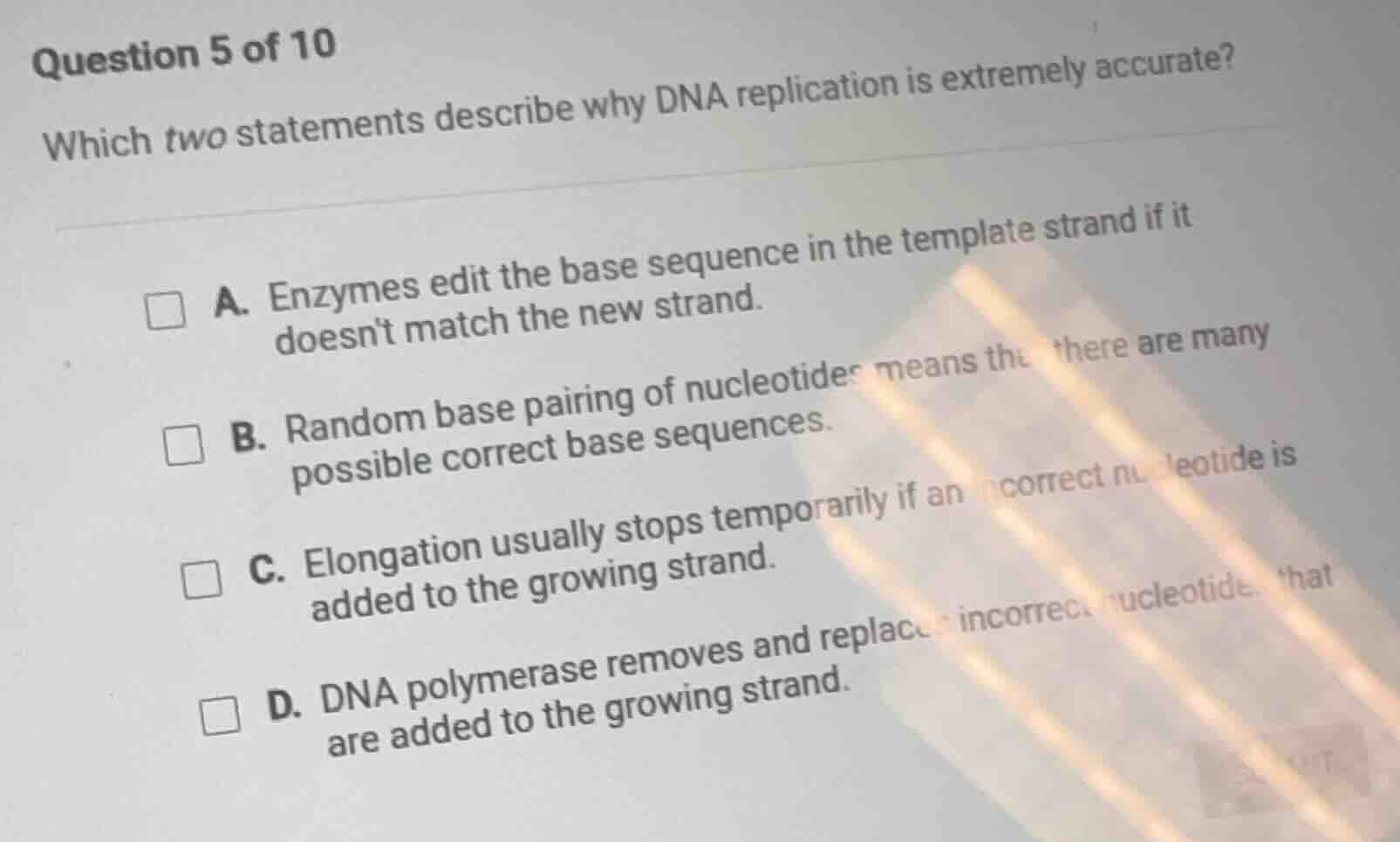
question 5 of 10
which two statements describe why dna replication is extremely accurate?
a. enzymes edit the base sequence in the template strand if it doesnt match the new strand.
b. random base pairing of nucleotides means that there are many possible correct base sequences.
c. elongation usually stops temporarily if an incorrect nucleotide is added to the growing strand.
d. dna polymerase removes and replaces incorrect nucleotides that are added to the growing strand.

Explanation:

Response

<pre_analysis>
{
"quality": "clear",
"question_count": 1,
"skills_matched": [
"direct_cot",
"multiple_choice_formatter",
"explain_then_answer",
"tutor"
],
"needs_drawing": false,
"concepts_used": [
"DNA Polymerase Proofreading",
"DNA Replication Errors"
],
"new_concepts": [],
"current_concepts": [
"DNA Replication Accuracy",
"DNA Polymerase Proofreading",
"DNA Replication Errors"
]
}
</pre_analysis>

<reasoning>

Analyze the question requirements

The question asks to identify two statements that explain why DNA replication is extremely accurate. High fidelity in DNA replication is crucial to prevent mutations.

Evaluate statement A

Statement A suggests that enzymes edit the base sequence in the template strand if it doesn't match the new strand. This is incorrect. The template strand serves as the original blueprint and is not edited or altered to match the newly synthesized strand.

Evaluate statement B

Statement B suggests that random base pairing of nucleotides means there are many possible correct base sequences. This is incorrect. Base pairing is highly specific (adenine pairs with thymine, and cytosine pairs with guanine) rather than random, which is what ensures the exact replication of genetic information.

Evaluate statement C

Statement C states that elongation usually stops temporarily if an incorrect nucleotide is added to the growing strand. This is correct. When a mismatch occurs, the physical distortion of the double helix causes DNA polymerase to pause, allowing the error to be recognized and corrected. This relates to DNA Replication Errors.

Evaluate statement D

Statement D states that DNA polymerase removes and replaces incorrect nucleotides that are added to the growing strand. This is correct. DNA polymerase has a \(3'
ightarrow5'\) exonuclease activity that allows it to proofread its work, removing mismatched bases and replacing them with the correct ones. This is the core mechanism of DNA Polymerase Proofreading.
</reasoning>

<answer>
<mcq-option>A. Enzymes edit the base sequence in the template strand if it doesn't match the new strand.</mcq-option>
<mcq-option>B. Random base pairing of nucleotides means there are many possible correct base sequences.</mcq-correct>
<mcq-correct>C. Elongation usually stops temporarily if an incorrect nucleotide is added to the growing strand.</mcq-correct>
<mcq-correct>D. DNA polymerase removes and replaces incorrect nucleotides that are added to the growing strand.</mcq-correct>
</answer>

<post_analysis>
{
"subject": "Natural Science",
"question_type": "Multiple Choice",
"knowledge_point": [
"Natural Science",
"Biology",
"DNA Replication Proofreading"
]
}
</post_analysis>

Answer:

<pre_analysis>
{
"quality": "clear",
"question_count": 1,
"skills_matched": [
"direct_cot",
"multiple_choice_formatter",
"explain_then_answer",
"tutor"
],
"needs_drawing": false,
"concepts_used": [
"DNA Polymerase Proofreading",
"DNA Replication Errors"
],
"new_concepts": [],
"current_concepts": [
"DNA Replication Accuracy",
"DNA Polymerase Proofreading",
"DNA Replication Errors"
]
}
</pre_analysis>

<reasoning>

Analyze the question requirements

The question asks to identify two statements that explain why DNA replication is extremely accurate. High fidelity in DNA replication is crucial to prevent mutations.

Evaluate statement A

Statement A suggests that enzymes edit the base sequence in the template strand if it doesn't match the new strand. This is incorrect. The template strand serves as the original blueprint and is not edited or altered to match the newly synthesized strand.

Evaluate statement B

Statement B suggests that random base pairing of nucleotides means there are many possible correct base sequences. This is incorrect. Base pairing is highly specific (adenine pairs with thymine, and cytosine pairs with guanine) rather than random, which is what ensures the exact replication of genetic information.

Evaluate statement C

Statement C states that elongation usually stops temporarily if an incorrect nucleotide is added to the growing strand. This is correct. When a mismatch occurs, the physical distortion of the double helix causes DNA polymerase to pause, allowing the error to be recognized and corrected. This relates to DNA Replication Errors.

Evaluate statement D

Statement D states that DNA polymerase removes and replaces incorrect nucleotides that are added to the growing strand. This is correct. DNA polymerase has a \(3'
ightarrow5'\) exonuclease activity that allows it to proofread its work, removing mismatched bases and replacing them with the correct ones. This is the core mechanism of DNA Polymerase Proofreading.
</reasoning>

<answer>
<mcq-option>A. Enzymes edit the base sequence in the template strand if it doesn't match the new strand.</mcq-option>
<mcq-option>B. Random base pairing of nucleotides means there are many possible correct base sequences.</mcq-correct>
<mcq-correct>C. Elongation usually stops temporarily if an incorrect nucleotide is added to the growing strand.</mcq-correct>
<mcq-correct>D. DNA polymerase removes and replaces incorrect nucleotides that are added to the growing strand.</mcq-correct>
</answer>

<post_analysis>
{
"subject": "Natural Science",
"question_type": "Multiple Choice",
"knowledge_point": [
"Natural Science",
"Biology",
"DNA Replication Proofreading"
]
}
</post_analysis>