QUESTION IMAGE
Question
question 3 of 10
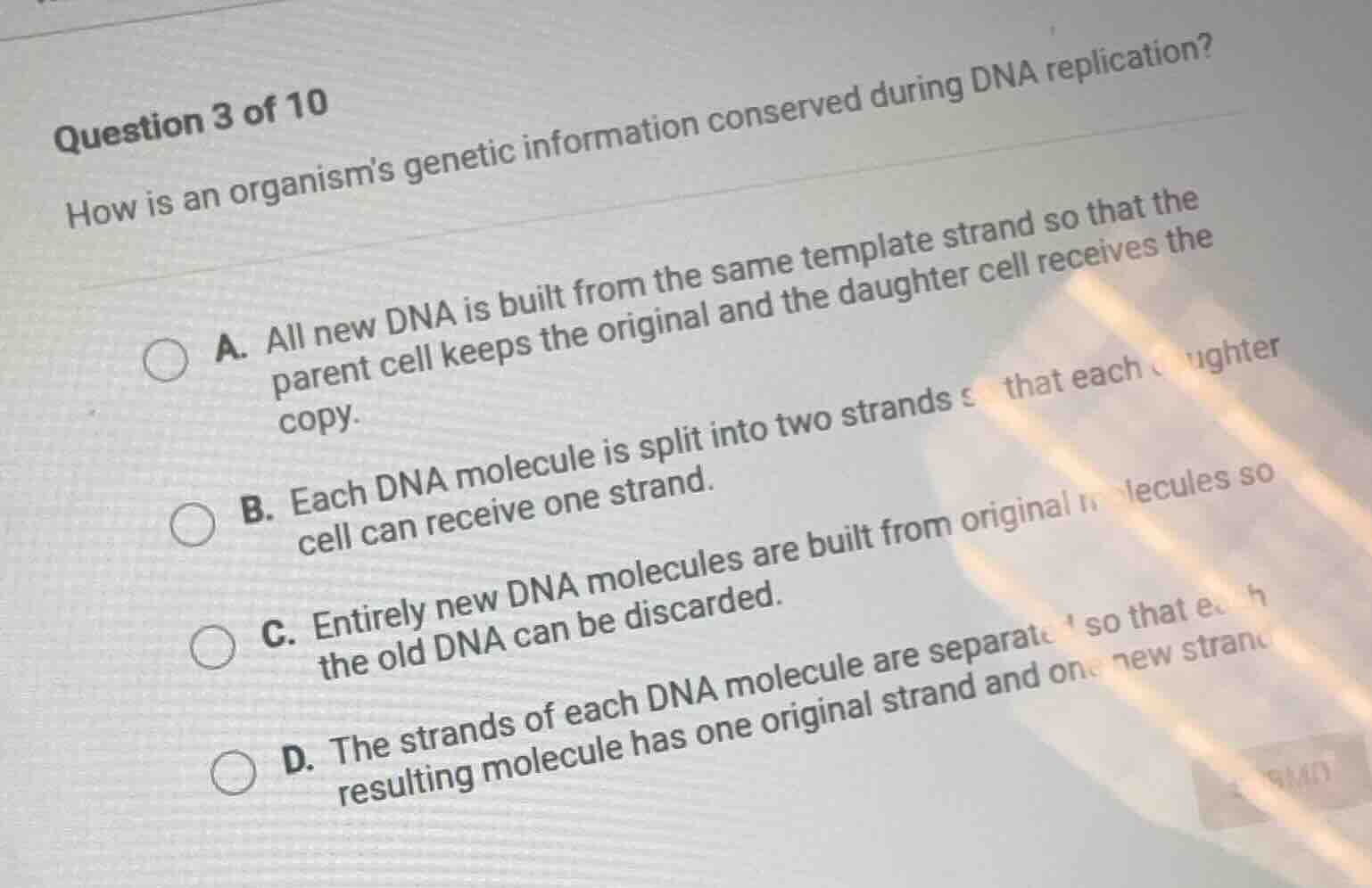
how is an organisms genetic information conserved during dna replication?
a. all new dna is built from the same template strand so that the parent cell keeps the original and the daughter cell receives the copy.
b. each dna molecule is split into two strands so that each daughter cell can receive one strand.
c. entirely new dna molecules are built from original molecules so the old dna can be discarded.
d. the strands of each dna molecule are separated so that each resulting molecule has one original strand and one new strand.
<pre_analysis>
{
"quality": "clear",
"question_count": 1,
"skills_matched": [
"direct_cot",
"multiple_choice_formatter",
"explain_then_answer",
"tutor"
],
"needs_drawing": false,
"concepts_used": [
"DNA Structure"
],
"new_concepts": [
"Semiconservative Replication"
],
"current_concepts": [
"DNA Structure",
"DNA Replication Stages",
"Semiconservative Replication"
]
}
</pre_analysis>
<reasoning>
Analyze the question
The question asks how genetic information is conserved during DNA replication. This relates to the fundamental mechanism of replication.
Evaluate DNA replication models
Using our knowledge of DNA Structure, we know that DNA is double-stranded. During replication, these two strands separate. Each original strand serves as a template for synthesizing a new complementary strand.
Assess the given options
- Option A suggests one cell keeps the original and the other gets a copy, which is incorrect.
- Option B suggests the molecule is split so each cell receives only one single strand, which is incorrect because cells need double-stranded DNA.
- Option C suggests entirely new molecules are built and old DNA is discarded, which is incorrect.
- Option D describes semiconservative replication: the strands separate, and each resulting double-stranded molecule contains one original strand and one newly synthesized strand.
Formulate the final conclusion
Option D correctly describes the semiconservative model of DNA replication, which ensures accurate conservation of genetic information.
</reasoning>
<answer>
<mcq-option>(A) All new DNA is built from the same template strand so that the parent cell keeps the original and the daughter cell receives the copy.</mcq-option>
<mcq-option>(B) Each DNA molecule is split into two strands so that each daughter cell can receive one strand.</mcq-option>
<mcq-option>(C) Entirely new DNA molecules are built from original molecules so the old DNA can be discarded.</mcq-option>
<mcq-correct>(D) The strands of each DNA molecule are separated so that each resulting molecule has one original strand and one new strand.</mcq-correct>
</answer>
<post_analysis>
{
"subject": "Natural Science",
"question_type": "Multiple Choice",
"knowledge_point": [
"Natural Science",
"Biology",
"Semiconservative Replication"
]
}
</post_analysis>
Snap & solve any problem in the app
Get step-by-step solutions on Sovi AI
Photo-based solutions with guided steps
Explore more problems and detailed explanations
<pre_analysis>
{
"quality": "clear",
"question_count": 1,
"skills_matched": [
"direct_cot",
"multiple_choice_formatter",
"explain_then_answer",
"tutor"
],
"needs_drawing": false,
"concepts_used": [
"DNA Structure"
],
"new_concepts": [
"Semiconservative Replication"
],
"current_concepts": [
"DNA Structure",
"DNA Replication Stages",
"Semiconservative Replication"
]
}
</pre_analysis>
<reasoning>
Analyze the question
The question asks how genetic information is conserved during DNA replication. This relates to the fundamental mechanism of replication.
Evaluate DNA replication models
Using our knowledge of DNA Structure, we know that DNA is double-stranded. During replication, these two strands separate. Each original strand serves as a template for synthesizing a new complementary strand.
Assess the given options
- Option A suggests one cell keeps the original and the other gets a copy, which is incorrect.
- Option B suggests the molecule is split so each cell receives only one single strand, which is incorrect because cells need double-stranded DNA.
- Option C suggests entirely new molecules are built and old DNA is discarded, which is incorrect.
- Option D describes semiconservative replication: the strands separate, and each resulting double-stranded molecule contains one original strand and one newly synthesized strand.
Formulate the final conclusion
Option D correctly describes the semiconservative model of DNA replication, which ensures accurate conservation of genetic information.
</reasoning>
<answer>
<mcq-option>(A) All new DNA is built from the same template strand so that the parent cell keeps the original and the daughter cell receives the copy.</mcq-option>
<mcq-option>(B) Each DNA molecule is split into two strands so that each daughter cell can receive one strand.</mcq-option>
<mcq-option>(C) Entirely new DNA molecules are built from original molecules so the old DNA can be discarded.</mcq-option>
<mcq-correct>(D) The strands of each DNA molecule are separated so that each resulting molecule has one original strand and one new strand.</mcq-correct>
</answer>
<post_analysis>
{
"subject": "Natural Science",
"question_type": "Multiple Choice",
"knowledge_point": [
"Natural Science",
"Biology",
"Semiconservative Replication"
]
}
</post_analysis>