Sovi.AI - AI Math Tutor

Scan to solve math questions

QUESTION IMAGE

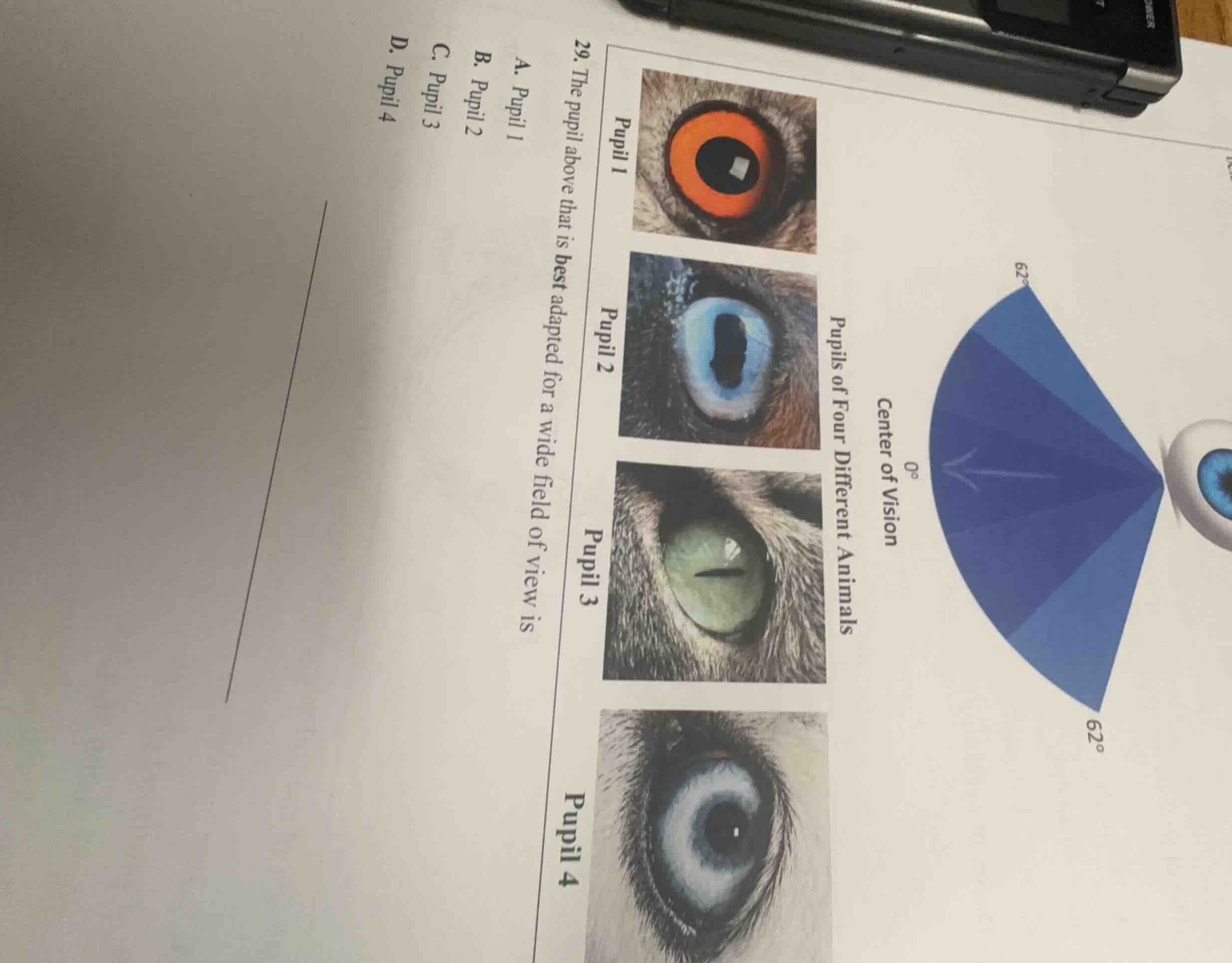
pupils of four different animals pupil 1 pupil 2 pupil 3 pupil 4 29. th…

Question

pupils of four different animals
pupil 1
pupil 2
pupil 3
pupil 4

  1. the pupil above that is best adapted for a wide field of view is

a. pupil 1
b. pupil 2
c. pupil 3
d. pupil 4

Explanation:

Response

<pre_analysis>
{
"quality": "clear",
"question_count": 1,
"skills_matched": [
"direct_cot",
"multiple_choice_formatter",
"explain_then_answer",
"tutor"
],
"needs_drawing": false,
"concepts_used": [],
"new_concepts": [
"Pupil Shapes",
"Animal Vision Adaptation",
"Field of View"
],
"current_concepts": [
"Pupil Shapes",
"Animal Vision Adaptation",
"Field of View"
]
}
</pre_analysis>

<reasoning>

Analyze pupil shapes and their functions

Pupils regulate light entering the eye, and their shapes are evolutionary adaptations linked to an animal's ecological niche (predator vs. prey) and activity patterns.

  • Pupil 1 (Circular): Found in active predators (like humans, dogs, and big cats) that chase prey. It provides good depth perception but a standard field of view.
  • Pupil 2 (Horizontal): Found in grazing prey animals (like sheep, goats, and horses). A horizontal slit creates a panoramic, wide field of view along the horizon to detect predators approaching from the sides.
  • Pupil 3 (Vertical Slit): Found in ambush predators (like domestic cats and foxes). It helps estimate distance accurately without moving the head.
  • Pupil 4 (Circular): Similar to Pupil 1, a circular pupil optimized for general vision.

Identify the best adaptation for a wide field of view

Prey animals require a wide field of view to scan the horizon for danger while grazing. The horizontal pupil (Pupil 2) allows more light to enter from the left and right sides, expanding the horizontal field of view while minimizing light from above and below. Therefore, Pupil 2 is the best adapted for a wide field of view.
</reasoning>

<answer>
<mcq-option>A. Pupil 1</mcq-option>
<mcq-correct>B. Pupil 2</mcq-correct>
<mcq-option>C. Pupil 3</mcq-option>
<mcq-option>D. Pupil 4</mcq-option>
</answer>

<post_analysis>
{
"subject": "Natural Science",
"question_type": "Multiple Choice",
"knowledge_point": [
"Natural Science",
"Biology",
"Animal Vision Adaptation"
]
}
</post_analysis>

Answer:

<pre_analysis>
{
"quality": "clear",
"question_count": 1,
"skills_matched": [
"direct_cot",
"multiple_choice_formatter",
"explain_then_answer",
"tutor"
],
"needs_drawing": false,
"concepts_used": [],
"new_concepts": [
"Pupil Shapes",
"Animal Vision Adaptation",
"Field of View"
],
"current_concepts": [
"Pupil Shapes",
"Animal Vision Adaptation",
"Field of View"
]
}
</pre_analysis>

<reasoning>

Analyze pupil shapes and their functions

Pupils regulate light entering the eye, and their shapes are evolutionary adaptations linked to an animal's ecological niche (predator vs. prey) and activity patterns.

  • Pupil 1 (Circular): Found in active predators (like humans, dogs, and big cats) that chase prey. It provides good depth perception but a standard field of view.
  • Pupil 2 (Horizontal): Found in grazing prey animals (like sheep, goats, and horses). A horizontal slit creates a panoramic, wide field of view along the horizon to detect predators approaching from the sides.
  • Pupil 3 (Vertical Slit): Found in ambush predators (like domestic cats and foxes). It helps estimate distance accurately without moving the head.
  • Pupil 4 (Circular): Similar to Pupil 1, a circular pupil optimized for general vision.

Identify the best adaptation for a wide field of view

Prey animals require a wide field of view to scan the horizon for danger while grazing. The horizontal pupil (Pupil 2) allows more light to enter from the left and right sides, expanding the horizontal field of view while minimizing light from above and below. Therefore, Pupil 2 is the best adapted for a wide field of view.
</reasoning>

<answer>
<mcq-option>A. Pupil 1</mcq-option>
<mcq-correct>B. Pupil 2</mcq-correct>
<mcq-option>C. Pupil 3</mcq-option>
<mcq-option>D. Pupil 4</mcq-option>
</answer>

<post_analysis>
{
"subject": "Natural Science",
"question_type": "Multiple Choice",
"knowledge_point": [
"Natural Science",
"Biology",
"Animal Vision Adaptation"
]
}
</post_analysis>