QUESTION IMAGE
Question
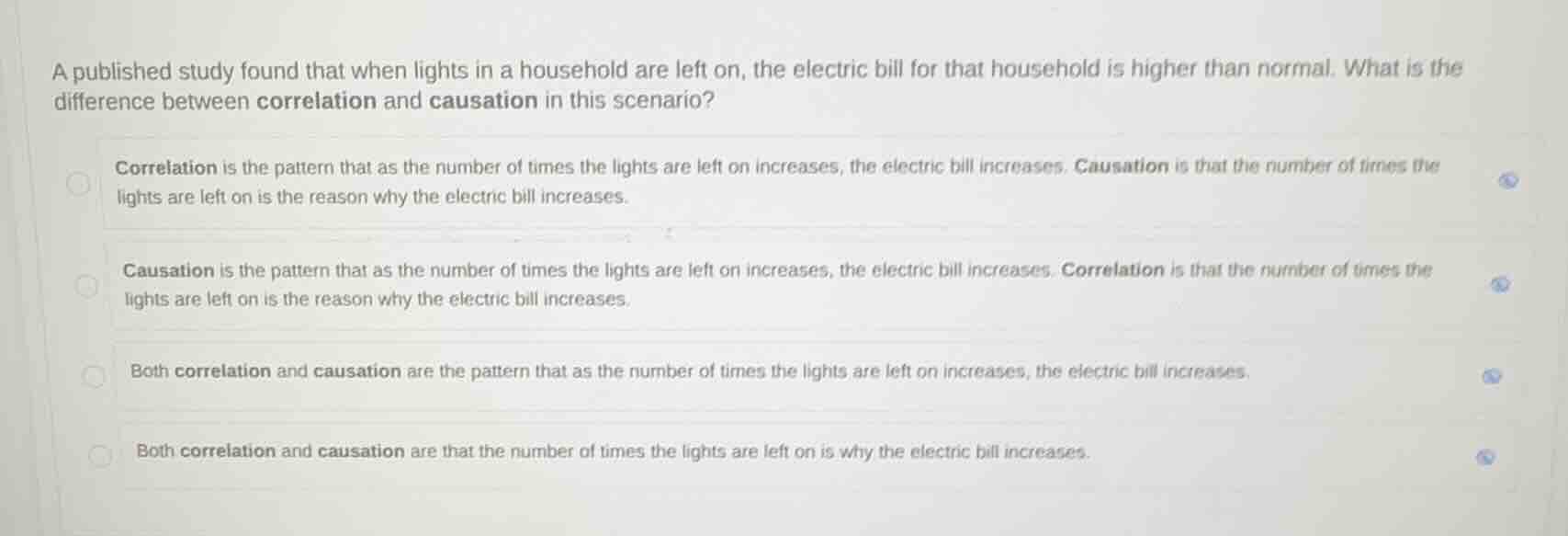
a published study found that when lights in a household are left on, the electric bill for that household is higher than normal. what is the difference between correlation and causation in this scenario?
correlation is the pattern that as the number of times the lights are left on increases, the electric bill increases. causation is that the number of times the lights are left on is the reason why the electric bill increases.
causation is the pattern that as the number of times the lights are left on increases, the electric bill increases. correlation is that the number of times the lights are left on is the reason why the electric bill increases.
both correlation and causation are the pattern that as the number of times the lights are left on increases, the electric bill increases.
both correlation and causation are that the number of times the lights are left on is why the electric bill increases.
Define correlation and causation in context
Using the Correlation vs Causation knowledge point
- Correlation describes a mutual relationship or connection between two or more things where they tend to occur together. In this scenario, it is the observed pattern that as the number of times lights are left on increases, the electric bill also increases.
- Causation indicates that one event is the direct result of the occurrence of the other event. In this scenario, it means that leaving the lights on is the actual reason (the cause) that makes the electric bill increase.
Evaluate the given options
- Option 1: Correctly defines correlation as the observed pattern of both variables increasing together, and causation as the relationship where leaving the lights on is the direct reason why the bill increases.
- Option 2: Reverses the definitions of correlation and causation.
- Option 3: Incorrectly claims both terms represent only the observed pattern.
- Option 4: Incorrectly claims both terms represent the causal mechanism.

Snap & solve any problem in the app
Get step-by-step solutions on Sovi AI
Photo-based solutions with guided steps
Explore more problems and detailed explanations
- (A) Correlation is the pattern that as the number of times the lights are left on increases, the electric bill increases. Causation is that the number of times the lights are left on is the reason why the electric bill increases. (Correct answer)
- (B) Causation is the pattern that as the number of times the lights are left on increases, the electric bill increases. Correlation is that the number of times the lights are left on is the reason why the electric bill increases.
- (C) Both correlation and causation are the pattern that as the number of times the lights are left on increases, the electric bill increases.
- (D) Both correlation and causation are that the number of times the lights are left on is why the electric bill increases.