QUESTION IMAGE
Question
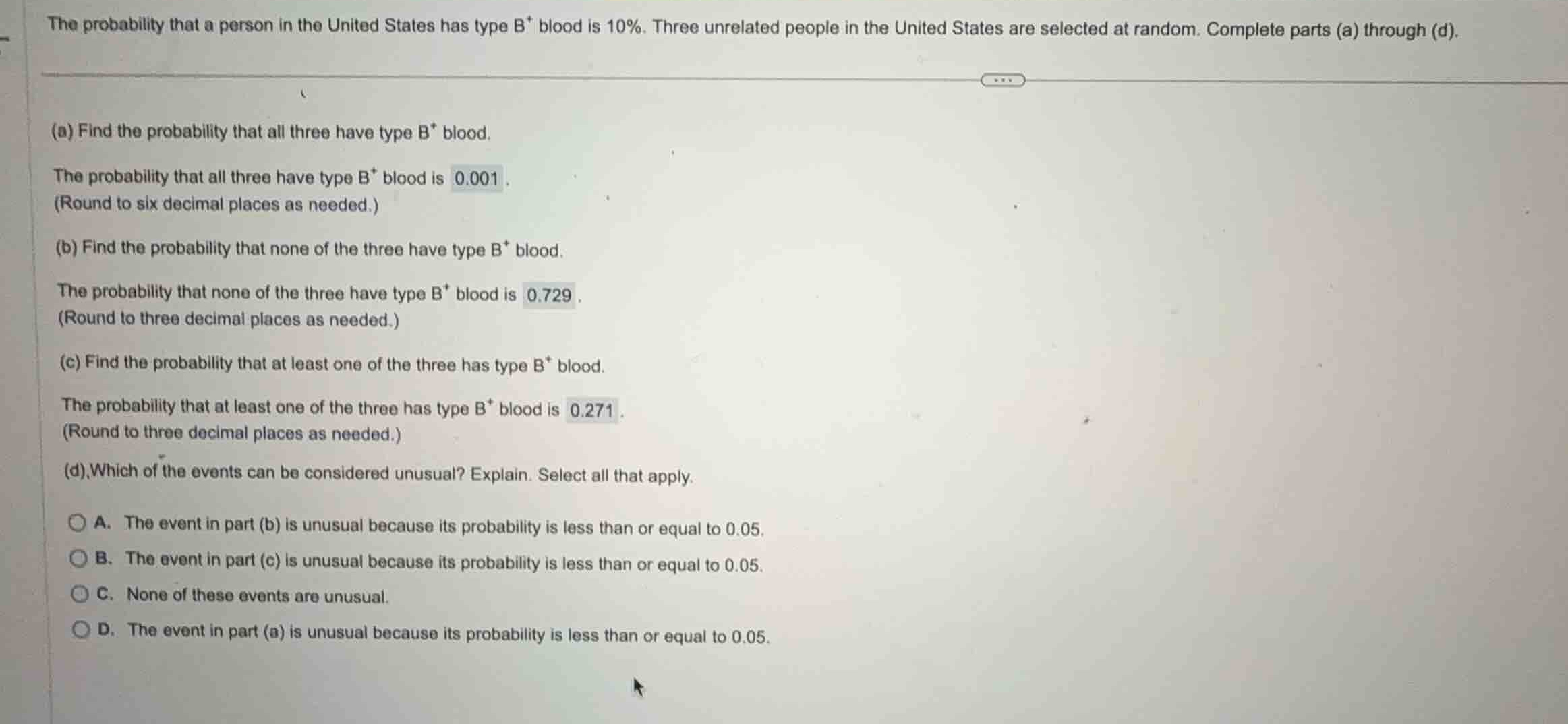
the probability that a person in the united states has type \\(b^+\\) blood is 10%. three unrelated people in the united states are selected at random. complete parts (a) through (d).
(a) find the probability that all three have type \\(b^+\\) blood.
the probability that all three have type \\(b^+\\) blood is 0.001.
(round to six decimal places as needed.)
(b) find the probability that none of the three have type \\(b^+\\) blood.
the probability that none of the three have type \\(b^+\\) blood is 0.729.
(round to three decimal places as needed.)
(c) find the probability that at least one of the three has type \\(b^+\\) blood.
the probability that at least one of the three has type \\(b^+\\) blood is 0.271.
(round to three decimal places as needed.)
(d) which of the events can be considered unusual? explain. select all that apply.
a. the event in part (b) is unusual because its probability is less than or equal to 0.05.
b. the event in part (c) is unusual because its probability is less than or equal to 0.05.
c. none of these events are unusual.
d. the event in part (a) is unusual because its probability is less than or equal to 0.05.
Define the given parameters
Using the Independent Events Probability knowledge point
Calculate the probability that all three have type B+ blood
Using the Independent Events Probability knowledge point
Calculate the probability that none of the three have type B+ blood
Using the Complementary Events and Independent Events Probability knowledge points
Calculate the probability that at least one has type B+ blood
Using the At Least One Probability and Complementary Events knowledge points
Identify unusual events
Using the Unusual Event Probability knowledge point

Snap & solve any problem in the app
Get step-by-step solutions on Sovi AI
Photo-based solutions with guided steps
Explore more problems and detailed explanations
Question 1
The probability that all three have type \(B^+\) blood is <blank>0.001000</blank>.
Question 2
The probability that none of the three have type \(B^+\) blood is <blank>0.729</blank>.
Question 3
The probability that at least one of the three has type \(B^+\) blood is <blank>0.271</blank>.
Question 4
- A. The event in part (b) is unusual because its probability is less than or equal to 0.05.
- B. The event in part (c) is unusual because its probability is less than or equal to 0.05.
- C. None of these events are unusual.
- D. The event in part (a) is unusual because its probability is less than or equal to 0.05. (Correct answer)