Sovi.AI - AI Math Tutor

Scan to solve math questions

QUESTION IMAGE

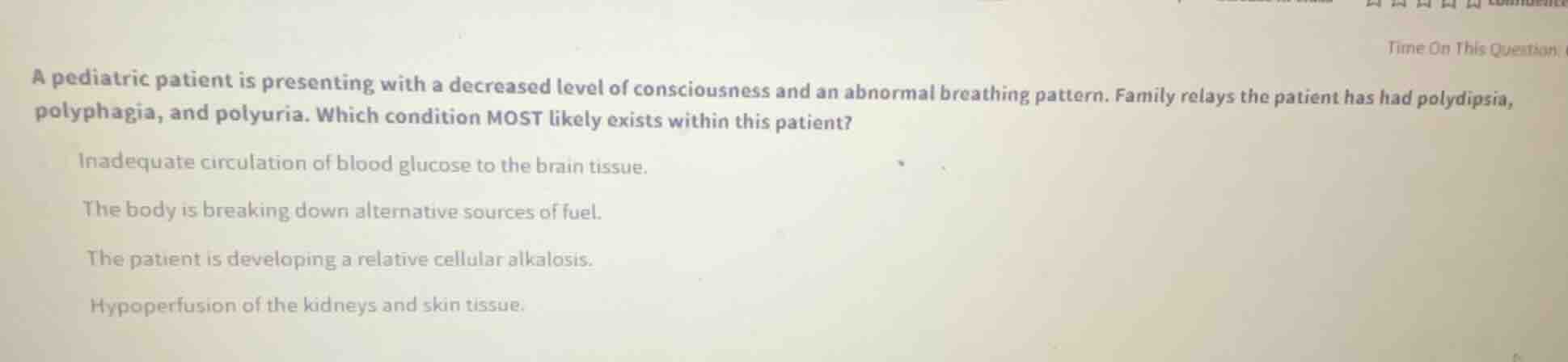
a pediatric patient is presenting with a decreased level of consciousne…

Question

a pediatric patient is presenting with a decreased level of consciousness and an abnormal breathing pattern. family relays the patient has had polydipsia, polyphagia, and polyuria. which condition most likely exists within this patient?

inadequate circulation of blood glucose to the brain tissue.
the body is breaking down alternative sources of fuel.
the patient is developing a relative cellular alkalosis.
hypoperfusion of the kidneys and skin tissue.

Explanation:

Response

<pre_analysis>
{
"quality": "clear",
"question_count": 1,
"skills_matched": [
"direct_cot",
"multiple_choice_formatter",
"explain_then_answer",
"tutor",
"mastery_adaptive_brevity"
],
"needs_drawing": false,
"concepts_used": [
"Diabetes Mellitus Epidemiology",
"Cerebral Glucose Metabolism"
],
"new_concepts": [
"Diabetic Ketoacidosis Pathophysiology",
"Kussmaul Respiration"
],
"current_concepts": [
"Diabetes Mellitus Epidemiology",
"Cerebral Glucose Metabolism",
"Diabetic Ketoacidosis Pathophysiology",
"Kussmaul Respiration"
]
}
</pre_analysis>

<reasoning>

Analyze clinical presentation

Using the Diabetes Mellitus Epidemiology knowledge point

The pediatric patient presents with a decreased level of consciousness, abnormal breathing pattern (likely Kussmaul respirations), and the classic triad of diabetes mellitus: polydipsia (excessive thirst), polyphagia (excessive hunger), and polyuria (excessive urination). These symptoms strongly point to undiagnosed or uncontrolled Type 1 Diabetes Mellitus progressing to Diabetic Ketoacidosis (DKA).

Evaluate cellular pathophysiology

Using the Cerebral Glucose Metabolism knowledge point

In DKA, a lack of functional insulin prevents glucose from entering insulin-dependent cells. Because cells cannot utilize glucose for energy, the body is forced to break down alternative sources of fuel, specifically lipids (fats), through lipolysis. This process produces free fatty acids, which are converted by the liver into ketone bodies (acetoacetate and beta-hydroxybutyrate) to serve as an alternative energy source.

Rule out incorrect options

  • Inadequate circulation of blood glucose to the brain tissue: Incorrect. Brain tissue utilizes insulin-independent glucose transporters (GLUT-1 and GLUT-3) and has a high concentration of circulating blood glucose in this state, though the patient's altered mental status is caused by acidosis and hyperosmolarity.
  • The patient is developing a relative cellular alkalosis: Incorrect. The accumulation of ketone bodies (which are organic acids) leads to metabolic acidosis, not alkalosis.
  • Hypoperfusion of the kidneys and skin tissue: Incorrect. While dehydration occurs due to osmotic diuresis, the primary underlying condition explaining the abnormal breathing (compensatory hyperventilation for metabolic acidosis) and metabolic state is the systemic shift to alternative fuel metabolism.

</reasoning>

<answer>
<mcq-option>(A) Inadequate circulation of blood glucose to the brain tissue.</mcq-option>
<mcq-correct>(B) The body is breaking down alternative sources of fuel.</mcq-correct>
<mcq-option>(C) The patient is developing a relative cellular alkalosis.</mcq-option>
<mcq-option>(D) Hypoperfusion of the kidneys and skin tissue.</mcq-option>
</answer>

<post_analysis>
{
"subject": "Natural Science",
"question_type": "Multiple Choice",
"knowledge_point": [
"Natural Science",
"Medicine",
"Diabetic Ketoacidosis Pathophysiology"
]
}
</post_analysis>

Answer:

<pre_analysis>
{
"quality": "clear",
"question_count": 1,
"skills_matched": [
"direct_cot",
"multiple_choice_formatter",
"explain_then_answer",
"tutor",
"mastery_adaptive_brevity"
],
"needs_drawing": false,
"concepts_used": [
"Diabetes Mellitus Epidemiology",
"Cerebral Glucose Metabolism"
],
"new_concepts": [
"Diabetic Ketoacidosis Pathophysiology",
"Kussmaul Respiration"
],
"current_concepts": [
"Diabetes Mellitus Epidemiology",
"Cerebral Glucose Metabolism",
"Diabetic Ketoacidosis Pathophysiology",
"Kussmaul Respiration"
]
}
</pre_analysis>

<reasoning>

Analyze clinical presentation

Using the Diabetes Mellitus Epidemiology knowledge point

The pediatric patient presents with a decreased level of consciousness, abnormal breathing pattern (likely Kussmaul respirations), and the classic triad of diabetes mellitus: polydipsia (excessive thirst), polyphagia (excessive hunger), and polyuria (excessive urination). These symptoms strongly point to undiagnosed or uncontrolled Type 1 Diabetes Mellitus progressing to Diabetic Ketoacidosis (DKA).

Evaluate cellular pathophysiology

Using the Cerebral Glucose Metabolism knowledge point

In DKA, a lack of functional insulin prevents glucose from entering insulin-dependent cells. Because cells cannot utilize glucose for energy, the body is forced to break down alternative sources of fuel, specifically lipids (fats), through lipolysis. This process produces free fatty acids, which are converted by the liver into ketone bodies (acetoacetate and beta-hydroxybutyrate) to serve as an alternative energy source.

Rule out incorrect options

  • Inadequate circulation of blood glucose to the brain tissue: Incorrect. Brain tissue utilizes insulin-independent glucose transporters (GLUT-1 and GLUT-3) and has a high concentration of circulating blood glucose in this state, though the patient's altered mental status is caused by acidosis and hyperosmolarity.
  • The patient is developing a relative cellular alkalosis: Incorrect. The accumulation of ketone bodies (which are organic acids) leads to metabolic acidosis, not alkalosis.
  • Hypoperfusion of the kidneys and skin tissue: Incorrect. While dehydration occurs due to osmotic diuresis, the primary underlying condition explaining the abnormal breathing (compensatory hyperventilation for metabolic acidosis) and metabolic state is the systemic shift to alternative fuel metabolism.

</reasoning>

<answer>
<mcq-option>(A) Inadequate circulation of blood glucose to the brain tissue.</mcq-option>
<mcq-correct>(B) The body is breaking down alternative sources of fuel.</mcq-correct>
<mcq-option>(C) The patient is developing a relative cellular alkalosis.</mcq-option>
<mcq-option>(D) Hypoperfusion of the kidneys and skin tissue.</mcq-option>
</answer>

<post_analysis>
{
"subject": "Natural Science",
"question_type": "Multiple Choice",
"knowledge_point": [
"Natural Science",
"Medicine",
"Diabetic Ketoacidosis Pathophysiology"
]
}
</post_analysis>