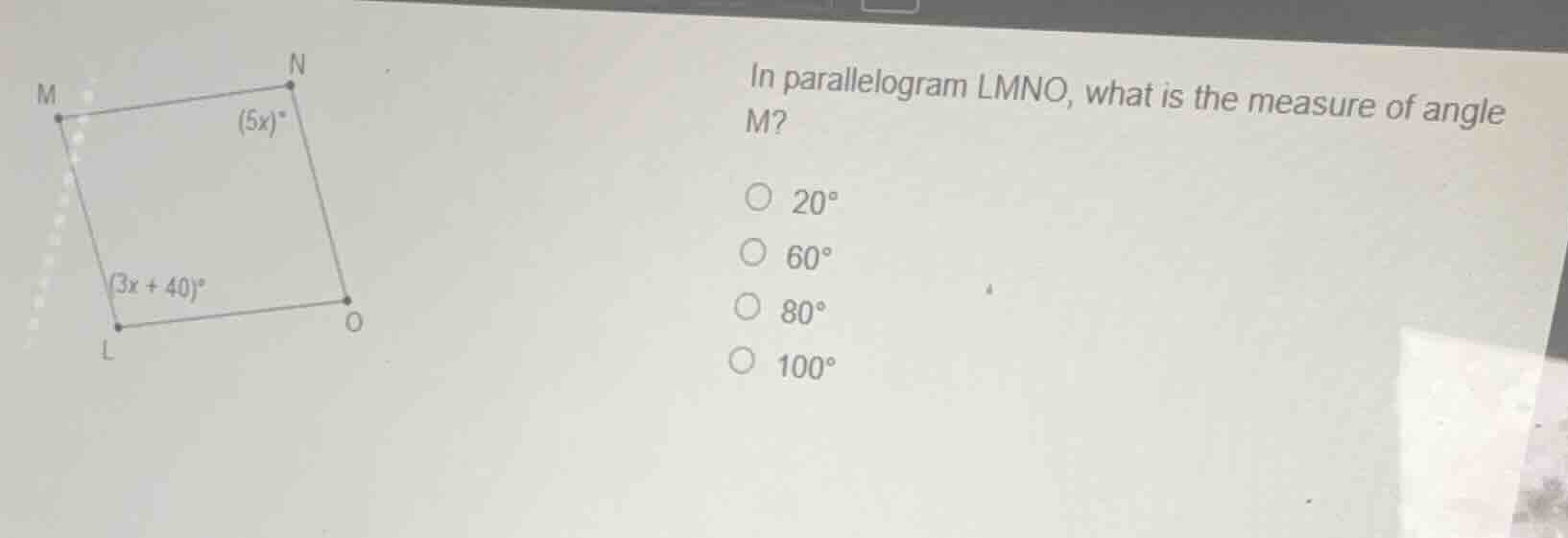
QUESTION IMAGE
Question
in parallelogram lmno, what is the measure of angle m?
\\(20^\circ\\)
\\(60^\circ\\)
\\(80^\circ\\)
\\(100^\circ\\)
<pre_analysis>
{
"quality": "clear",
"question_count": 1,
"skills_matched": [
"step_cot",
"multiple_choice_formatter",
"explain_then_answer",
"quick"
],
"needs_drawing": false,
"concepts_used": [
"Properties of Quadrilaterals",
"Parallelogram Definition"
],
"new_concepts": [],
"current_concepts": [
"Properties of Quadrilaterals",
"Parallelogram Definition"
]
}
</pre_analysis>
<reasoning>
Set up the equation using consecutive interior angles
\[
\]
Solve for x
\[
\]
Calculate the measure of angle M
\[
\]
(Self-correction: In a standard parallelogram labeled consecutively \(L-M-N-O\), the consecutive vertices are \(L, M, N, O\). Thus, \(\angle L\) and \(\angle N\) are opposite angles, meaning \(m\angle L = m\angle N\). Let's re-evaluate:)
\[
\]
\[
\]
</reasoning>
<answer>
<mcq-option>(A) \(20^\circ\)</mcq-option>
<mcq-option>(B) \(60^\circ\)</mcq-option>
<mcq-correct>(C) \(80^\circ\)</mcq-correct>
<mcq-option>(D) \(100^\circ\)</mcq-option>
</answer>
<post_analysis>
{
"subject": "Mathematics",
"question_type": "Multiple Choice",
"knowledge_point": [
"Mathematics",
"Geometry",
"Properties of Quadrilaterals"
]
}
</post_analysis>
Snap & solve any problem in the app
Get step-by-step solutions on Sovi AI
Photo-based solutions with guided steps
Explore more problems and detailed explanations
<pre_analysis>
{
"quality": "clear",
"question_count": 1,
"skills_matched": [
"step_cot",
"multiple_choice_formatter",
"explain_then_answer",
"quick"
],
"needs_drawing": false,
"concepts_used": [
"Properties of Quadrilaterals",
"Parallelogram Definition"
],
"new_concepts": [],
"current_concepts": [
"Properties of Quadrilaterals",
"Parallelogram Definition"
]
}
</pre_analysis>
<reasoning>
Set up the equation using consecutive interior angles
\[
\]
Solve for x
\[
\]
Calculate the measure of angle M
\[
\]
(Self-correction: In a standard parallelogram labeled consecutively \(L-M-N-O\), the consecutive vertices are \(L, M, N, O\). Thus, \(\angle L\) and \(\angle N\) are opposite angles, meaning \(m\angle L = m\angle N\). Let's re-evaluate:)
\[
\]
\[
\]
</reasoning>
<answer>
<mcq-option>(A) \(20^\circ\)</mcq-option>
<mcq-option>(B) \(60^\circ\)</mcq-option>
<mcq-correct>(C) \(80^\circ\)</mcq-correct>
<mcq-option>(D) \(100^\circ\)</mcq-option>
</answer>
<post_analysis>
{
"subject": "Mathematics",
"question_type": "Multiple Choice",
"knowledge_point": [
"Mathematics",
"Geometry",
"Properties of Quadrilaterals"
]
}
</post_analysis>