QUESTION IMAGE
Question
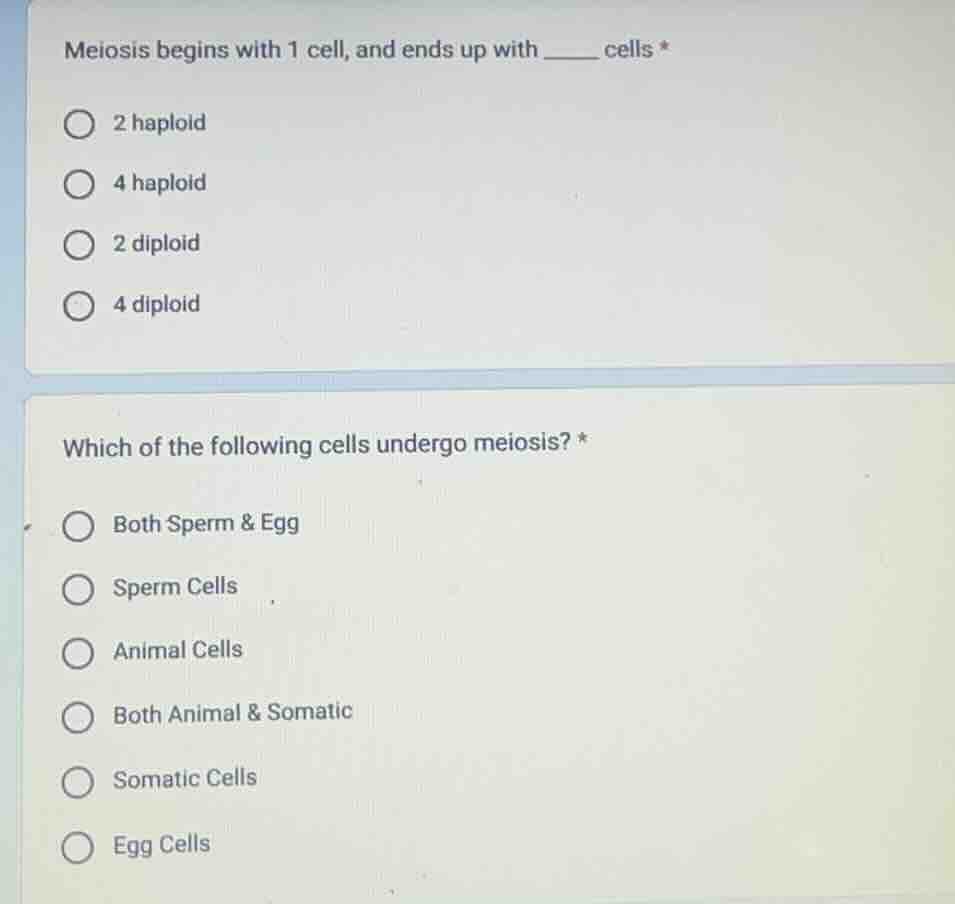
meiosis begins with 1 cell, and ends up with _____ cells *
2 haploid
4 haploid
2 diploid
4 diploid
which of the following cells undergo meiosis? *
both sperm & egg
sperm cells
animal cells
both animal & somatic
somatic cells
egg cells
Analyze the first question
The first question asks: "Meiosis begins with 1 cell, and ends up with _____ cells".
Meiosis is a specialized type of cell division that reduces the chromosome number by half, producing four genetically diverse haploid daughter cells from a single diploid parent cell. Therefore, it starts with 1 diploid cell and ends with 4 haploid cells.
Analyze the second question
The second question asks: "Which of the following cells undergo meiosis?".
Meiosis is the process of gamete formation, occurring in germline cells to produce haploid gametes (sperm and egg cells).
- Sperm and egg cells themselves are already haploid gametes and do not undergo meiosis; they are the products of meiosis.
- Somatic cells undergo mitosis, not meiosis.
- Animal cells is too broad, as most animal cells are somatic.
- Germline cells (which are specialized cells in the gonads that give rise to gametes) undergo meiosis. In the context of standard high school biology multiple-choice questions, the cells that undergo meiosis to produce gametes are often referred to as germ cells or precursor cells. However, looking at the options: "Both Sperm & Egg", "Sperm Cells", "Animal Cells", "Both Animal & Somatic", "Somatic Cells", "Egg Cells". None of these options perfectly describe "germline cells".
Let's re-evaluate the biological definitions. Germline cells undergo meiosis to produce sperm and egg cells. If the question is interpreted as "which cells are produced by/involved in the process of meiosis", or if it refers to the precursor cells that produce sperm and egg, let's look at standard curriculum questions. Often, questions of this level might have a slight simplification or we must identify the most accurate option among the choices.
Wait, let's look at the options again:
- "Both Sperm & Egg": Sperm and egg are gametes.
- "Sperm Cells" / "Egg Cells": These are gametes.
- "Somatic Cells": These undergo mitosis.
- "Animal Cells": Some animal cells (germ cells) undergo meiosis, but most do not.
If the question is a standard school quiz, sometimes "germ cells" is the expected answer, but it is not listed. Let's think if there is an alternative interpretation where germ cells are referred to by their lineage, or if the question implies which cells are formed by meiosis, or if "germ cells" was mislabeled.
Actually, germ cells (which undergo meiosis) are often contrasted with somatic cells. Since germ cells are not listed, let's consider if any option represents the cells that undergo meiosis. Specialized diploid cells in the testes and ovaries (which are animal cells, specifically germline cells) undergo meiosis. Since "Somatic Cells" only undergo mitosis, and "Sperm Cells" and "Egg Cells" are the final haploid products, the precursor cells that undergo meiosis are germ cells. If "germ cells" is not an option, let's re-read the options carefully:
- Both Sperm & Egg
- Sperm Cells
- Animal Cells
- Both Animal & Somatic
- Somatic Cells
- Egg Cells
In many high school biology curricula, germ cells are the diploid cells that undergo meiosis to produce sperm and egg cells. Since "germ cells" is missing, let's identify if "A…

Snap & solve any problem in the app
Get step-by-step solutions on Sovi AI
Photo-based solutions with guided steps
Explore more problems and detailed explanations
Question 1
- 2 haploid
- 4 haploid (Correct answer)
- 2 diploid
- 4 diploid
Question 2
- Both Sperm & Egg (Correct answer)
- Sperm Cells
- Animal Cells
- Both Animal & Somatic
- Somatic Cells
- Egg Cells