QUESTION IMAGE
Question
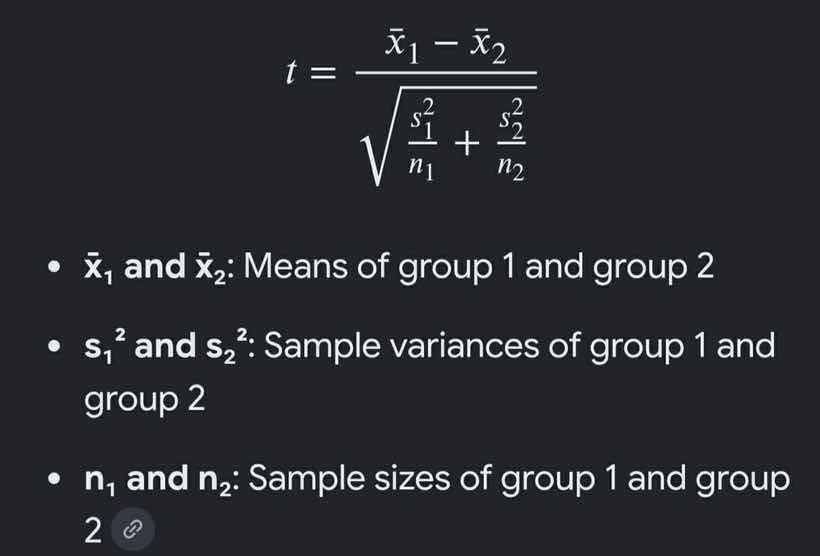
\\t = \frac{\bar{x}_1 - \bar{x}_2}{\sqrt{\frac{s_1^2}{n_1} + \frac{s_2^2}{n_2}}}\\
- \\(\bar{x}_1\\) and \\(\bar{x}_2\\): means of group 1 and group 2
- \\(s_1^2\\) and \\(s_2^2\\): sample variances of group 1 and group 2
- \\(n_1\\) and \\(n_2\\): sample sizes of group 1 and group 2
Identify the formula and variables
The image displays the formula for the test statistic \(t\) used in an independent two-sample \(t\)-test with unequal variances (also known as Welch's \(t\)-test).
The formula is:
The variables are defined as:
- \(\bar{x}_1\) and \(\bar{x}_2\): Sample means of group 1 and group 2.
- \(s_1^2\) and \(s_2^2\): Sample variances of group 1 and group 2.
- \(n_1\) and \(n_2\): Sample sizes of group 1 and group 2.
Explain the numerator
The numerator, \(\bar{x}_1 - \bar{x}_2\), represents the difference between the two sample means. This measures the observed effect size or the distance between the centers of the two groups.
Explain the denominator
The denominator, \(\sqrt{\frac{s_1^2}{n_1} + \frac{s_2^2}{n_2}}\), represents the estimated standard error of the difference between the two sample means. It accounts for the variability within each group (\(s^2\)) scaled by their respective sample sizes (\(n\)).
Explain the purpose of the t-statistic
The \(t\)-statistic measures how many standard errors the observed difference between the sample means is away from the hypothesized difference (usually \(0\)). It is used to determine if the difference between the two groups is statistically significant.

Snap & solve any problem in the app
Get step-by-step solutions on Sovi AI
Photo-based solutions with guided steps
Explore more problems and detailed explanations
The image presents the formula for the test statistic of an independent two-sample \(t\)-test (Welch's \(t\)-test) used to compare the means of two independent groups with unequal variances:
Where:
- \(\bar{x}_1, \bar{x}_2\) are the sample means.
- \(s_1^2, s_2^2\) are the sample variances.
- \(n_1, n_2\) are the sample sizes.