QUESTION IMAGE
Question
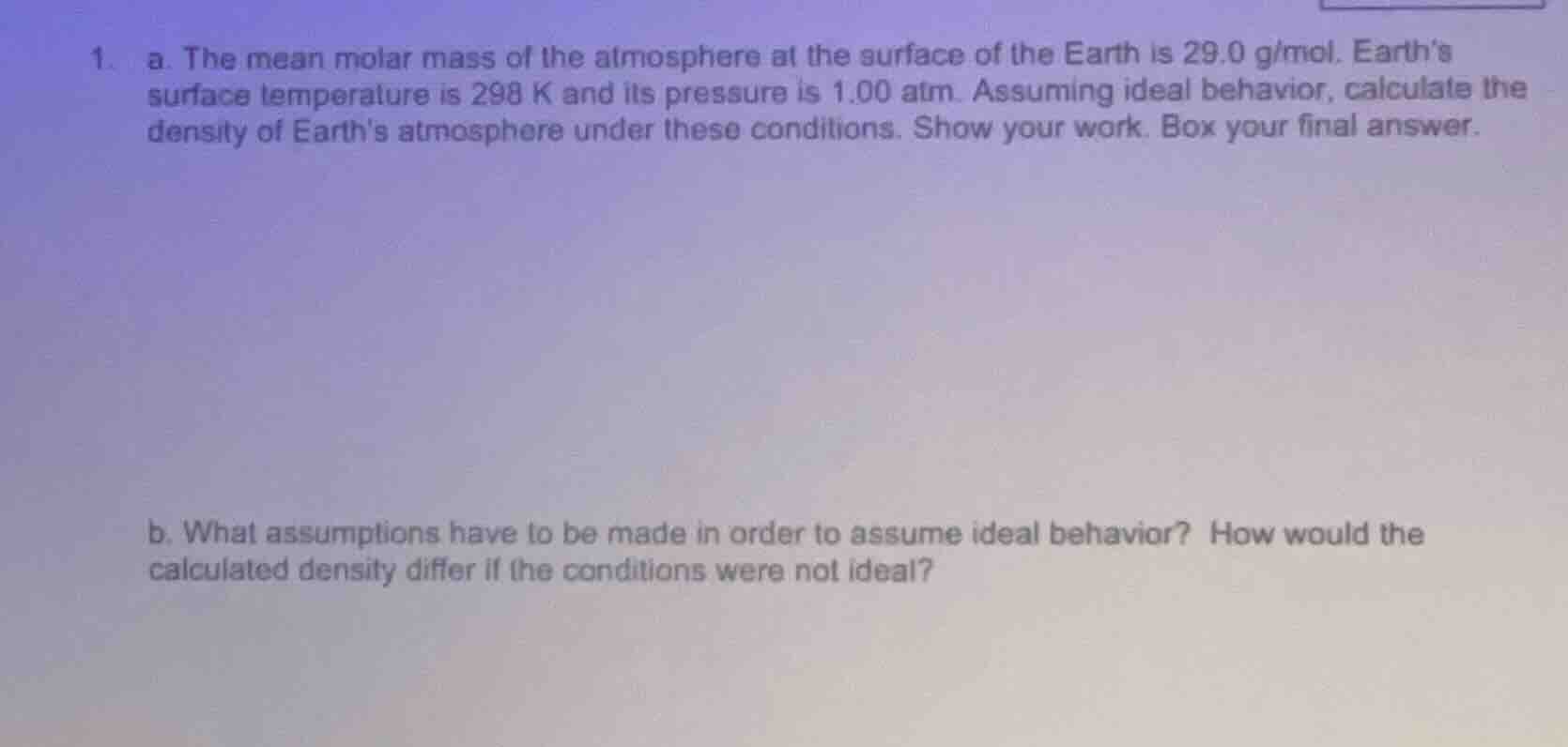
- a. the mean molar mass of the atmosphere at the surface of the earth is \\(29.0\text{ g/mol}\\). earths surface temperature is \\(298\text{ k}\\) and its pressure is \\(1.00\text{ atm}\\). assuming ideal behavior, calculate the density of earths atmosphere under these conditions. show your work. box your final answer.
b. what assumptions have to be made in order to assume ideal behavior? how would the calculated density differ if the conditions were not ideal?
Identify given values and target variables
Using the Molar Mass of Gases and Ideal Gas Law Calculations knowledge points
Derive the gas density formula
Using the Ideal Gas Law Calculations knowledge point
Calculate the density of the atmosphere
Using the Ideal Gas Law Calculations knowledge point
Analyze assumptions for ideal behavior
To assume ideal behavior, we assume:
- The volume of individual gas particles is negligible compared to the total volume of the container.
- There are no intermolecular attractive or repulsive forces between the gas particles.
Evaluate real gas deviations
Under non-ideal conditions (such as high pressure or low temperature), intermolecular attractions become significant, drawing molecules closer together and reducing the effective volume. This causes the real density to be higher than the calculated ideal density. Additionally, the finite volume of the molecules themselves reduces the free space, also leading to a higher actual density.

Snap & solve any problem in the app
Get step-by-step solutions on Sovi AI
Photo-based solutions with guided steps
Explore more problems and detailed explanations
Question 1a
The density of Earth's atmosphere under these conditions is \(1.19\text{ g/L}\).
Question 1b
To assume ideal behavior, we assume that the gas particles have negligible volume and experience no intermolecular attractive or repulsive forces.
If the conditions were not ideal, intermolecular attractive forces would pull the molecules closer together, causing the actual volume to be smaller and the real density to be higher than the calculated ideal density.