QUESTION IMAGE
Question
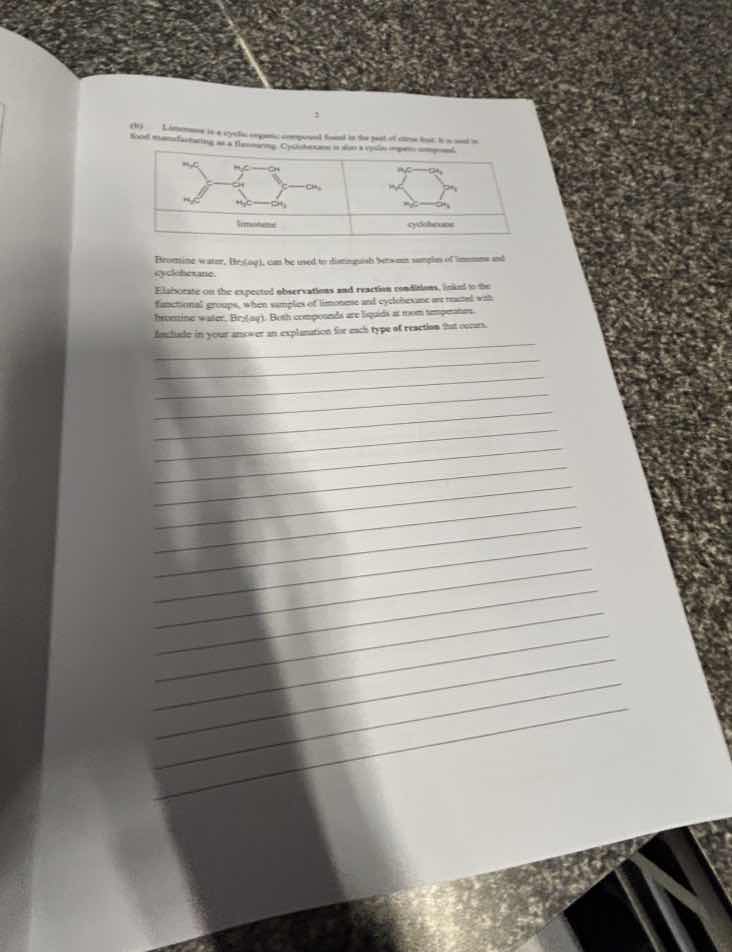
(b) limonene is a cyclic organic compound found in the peel of citrus fruit. it is used in food manufacturing as a flavouring. cyclohexane is also a cyclic organic compound.
bromine water, \\(\text{br}_2(\text{aq})\\), can be used to distinguish between samples of limonene and cyclohexane.
elaborate on the expected observations and reaction conditions, linked to the functional groups, when samples of limonene and cyclohexane are reacted with bromine water, \\(\text{br}_2(\text{aq})\\). both compounds are liquids at room temperature.
include in your answer an explanation for each type of reaction that occurs.
Identify functional groups and reaction types
Limonene contains carbon-carbon double bonds (\(\text{C}=\text{C}\) alkenes), which undergo electrophilic addition. Cyclohexane contains only carbon-carbon single bonds (\(\text{C}-\text{C}\) alkanes), which undergo free-radical substitution.
Determine reaction conditions and observations
- Limonene: Reacts rapidly with bromine water, \(\text{Br}_2\text{(aq)}\), at room temperature in the dark. The orange-brown solution decolors immediately.
- Cyclohexane: Requires ultraviolet (UV) light or sunlight to react. Under UV light, it slowly decolors the orange-brown bromine water, releasing acidic hydrogen bromide (\(\text{HBr}\)) gas.
Formulate explanations for each reaction
- Addition reaction (Limonene): Bromine atoms add across the \(\text{C}=\text{C}\) double bonds, forming a colorless dibromo saturated compound.
- Substitution reaction (Cyclohexane): A hydrogen atom on the ring is replaced by a bromine atom, requiring UV light to homolytically cleave the \(\text{Br}-\text{Br}\) bond.

Snap & solve any problem in the app
Get step-by-step solutions on Sovi AI
Photo-based solutions with guided steps
Explore more problems and detailed explanations
- Limonene:
- Functional Group: Alkene (\(\text{C}=\text{C}\) double bonds).
- Reaction Type: Electrophilic addition.
- Conditions: Room temperature, dark (no UV light required).
- Observation: Rapid decolourization of bromine water from orange-brown to colorless.
- Explanation: Bromine adds across the \(\text{C}=\text{C}\) double bonds to form a saturated dihalogenoalkane.
- Cyclohexane:
- Functional Group: Alkane (\(\text{C}-\text{C}\) single bonds).
- Reaction Type: Free-radical substitution.
- Conditions: Presence of ultraviolet (UV) light.
- Observation: Slow decolourization of bromine water under UV light.
- Explanation: UV light provides energy to homolytically cleave the \(\text{Br}-\text{Br}\) bond, allowing a bromine atom to substitute a hydrogen atom on the cyclohexane ring.