QUESTION IMAGE
Question
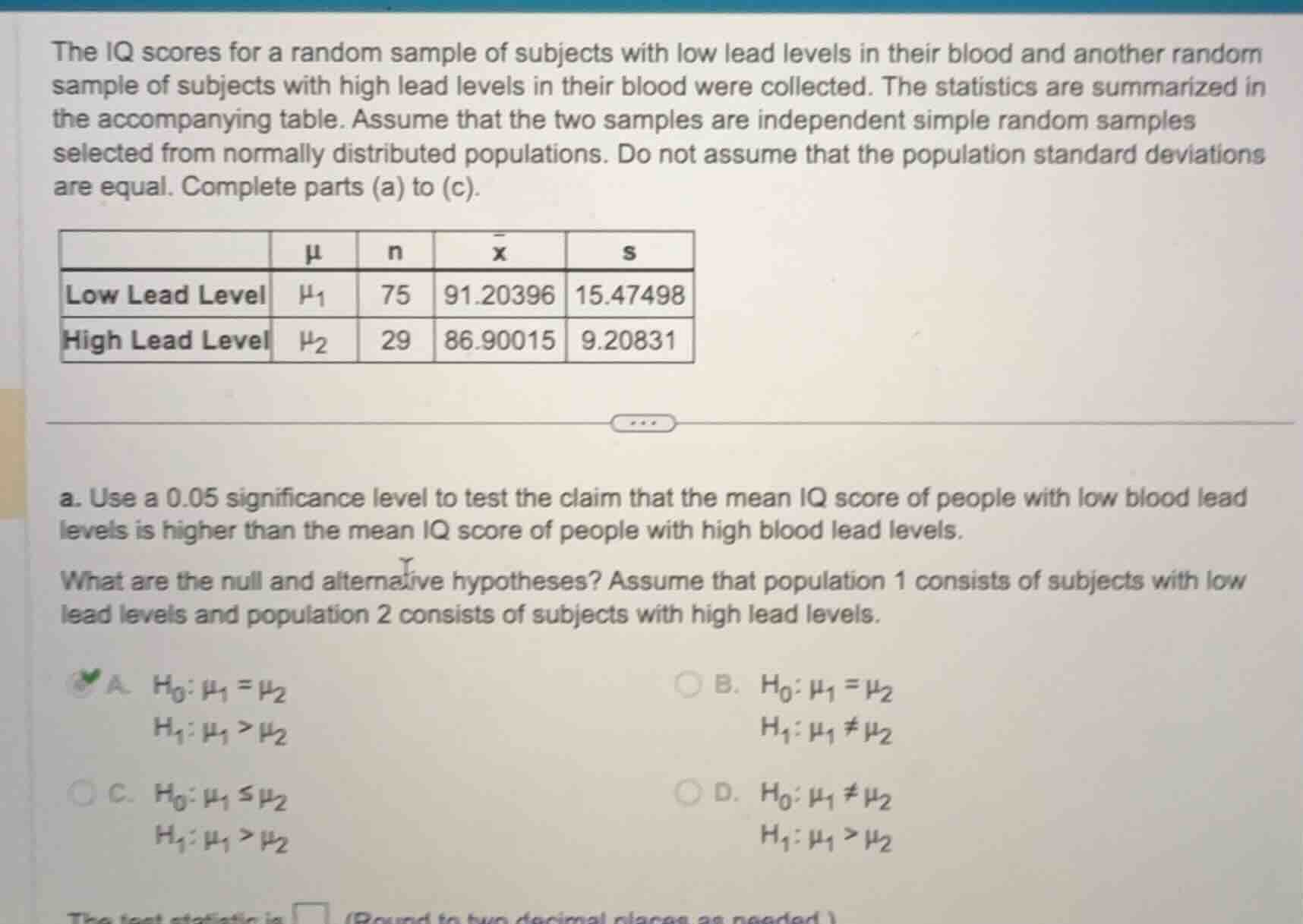
the iq scores for a random sample of subjects with low lead levels in their blood and another random sample of subjects with high lead levels in their blood were collected. the statistics are summarized in the accompanying table. assume that the two samples are independent simple random samples selected from normally distributed populations. do not assume that the population standard deviations are equal. complete parts (a) to (c).
\
a. use a 0.05 significance level to test the claim that the mean iq score of people with low blood lead levels is higher than the mean iq score of people with high blood lead levels.
what are the null and alternative hypotheses? assume that population 1 consists of subjects with low lead levels and population 2 consists of subjects with high lead levels.
a. \\(h_0: \mu_1 = \mu_2\\)
\\(h_1: \mu_1 > \mu_2\\)
b. \\(h_0: \mu_1 = \mu_2\\)
\\(h_1: \mu_1 \
eq \mu_2\\)
c. \\(h_0: \mu_1 \le \mu_2\\)
\\(h_1: \mu_1 > \mu_2\\)
d. \\(h_0: \mu_1 \
eq \mu_2\\)
\\(h_1: \mu_1 > \mu_2\\)
Identify the claim and define the hypotheses
Match with the given multiple-choice options

Snap & solve any problem in the app
Get step-by-step solutions on Sovi AI
Photo-based solutions with guided steps
Explore more problems and detailed explanations
- A. \(H_0: \mu_1 = \mu_2\), \(H_1: \mu_1 > \mu_2\) (Correct answer)
- B. \(H_0: \mu_1 = \mu_2\), \(H_1: \mu_1
eq \mu_2\)
- C. \(H_0: \mu_1 \le \mu_2\), \(H_1: \mu_1 > \mu_2\)
- D. \(H_0: \mu_1
eq \mu_2\), \(H_1: \mu_1 > \mu_2\)