QUESTION IMAGE
Question
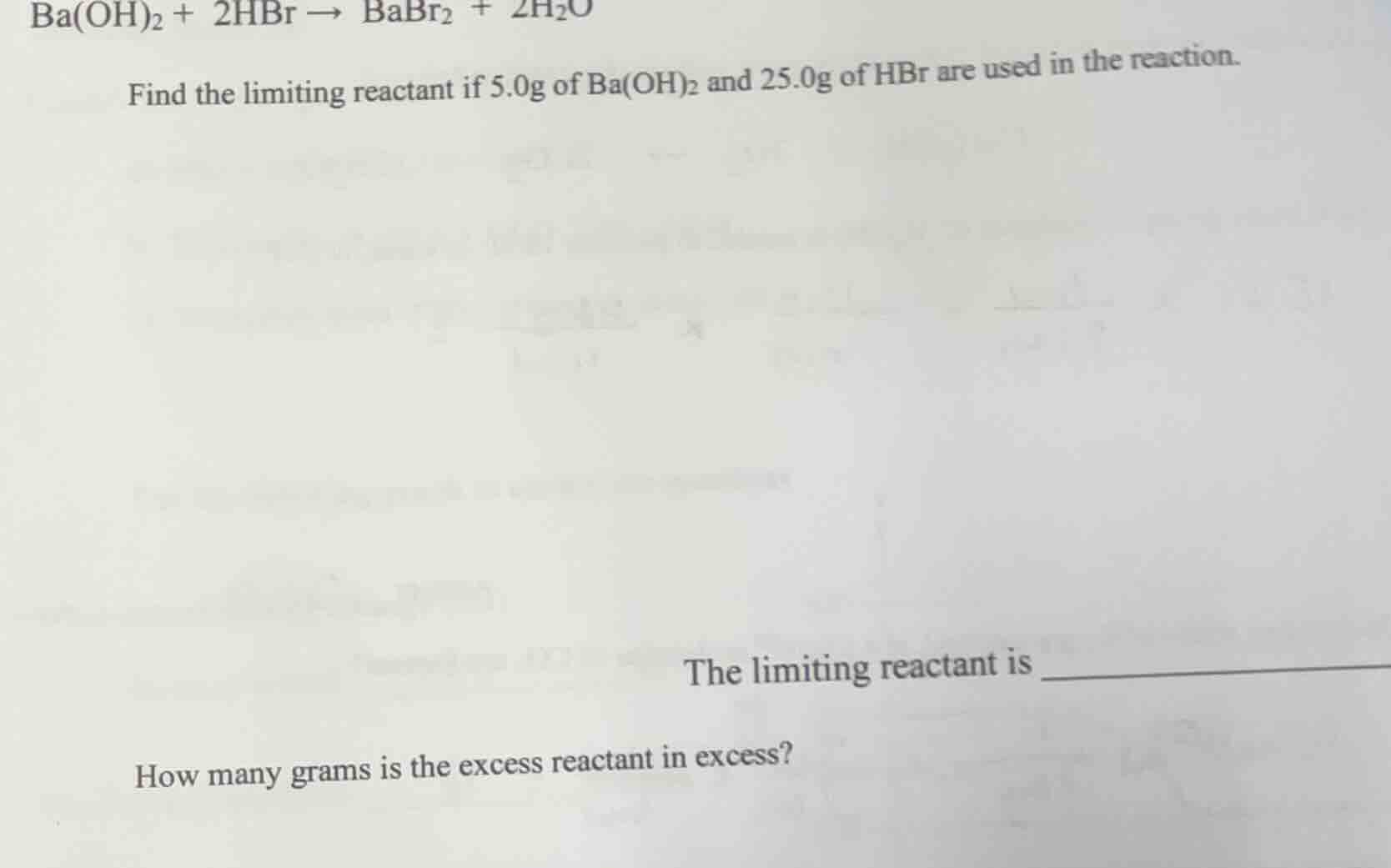
\\\text{ba(oh)}_2 + 2\text{hbr} \
ightarrow \text{babr}_2 + 2\text{h}_2\text{o}\\
find the limiting reactant if \\(5.0\text{g}\\) of \\(\text{ba(oh)}_2\\) and \\(25.0\text{g}\\) of \\(\text{hbr}\\) are used in the reaction.
the limiting reactant is \\_\\_\\_\\_\\_\\_\\_\\_\\_\\_\\_\\_\\_\\_\\_\\_\\_\\_\\_\\_\\_\\_\\_\\_\\_\\_
how many grams is the excess reactant in excess?
Calculate moles of each reactant
Using the Stoichiometry knowledge point
Determine the limiting reactant
We compare the mole ratio of the reactants to the balanced equation:
Each mole of \(\text{Ba(OH)}_2\) requires 2 moles of \(\text{HBr}\).
Since the available \(n_{\text{HBr}} = 0.3090\text{ mol}\) is greater than \(0.05836\text{ mol}\), \(\text{HBr}\) is in excess.
Therefore, \(\text{Ba(OH)}_2\) is the limiting reactant.
Calculate the mass of excess reactant remaining
We find the moles and mass of \(\text{HBr}\) that remain unreacted:
Rounding to significant figures (two significant figures based on \(5.0\text{ g}\)):

Snap & solve any problem in the app
Get step-by-step solutions on Sovi AI
Photo-based solutions with guided steps
Explore more problems and detailed explanations
Question 1
The limiting reactant is \(\text{Ba(OH)}_2\)
Question 2
\(20\text{ g}\)