Sovi.AI - AI Math Tutor

Scan to solve math questions

QUESTION IMAGE

identify structure labeled \g.\ apocrine sweat gland sebaceous gland la…

Question

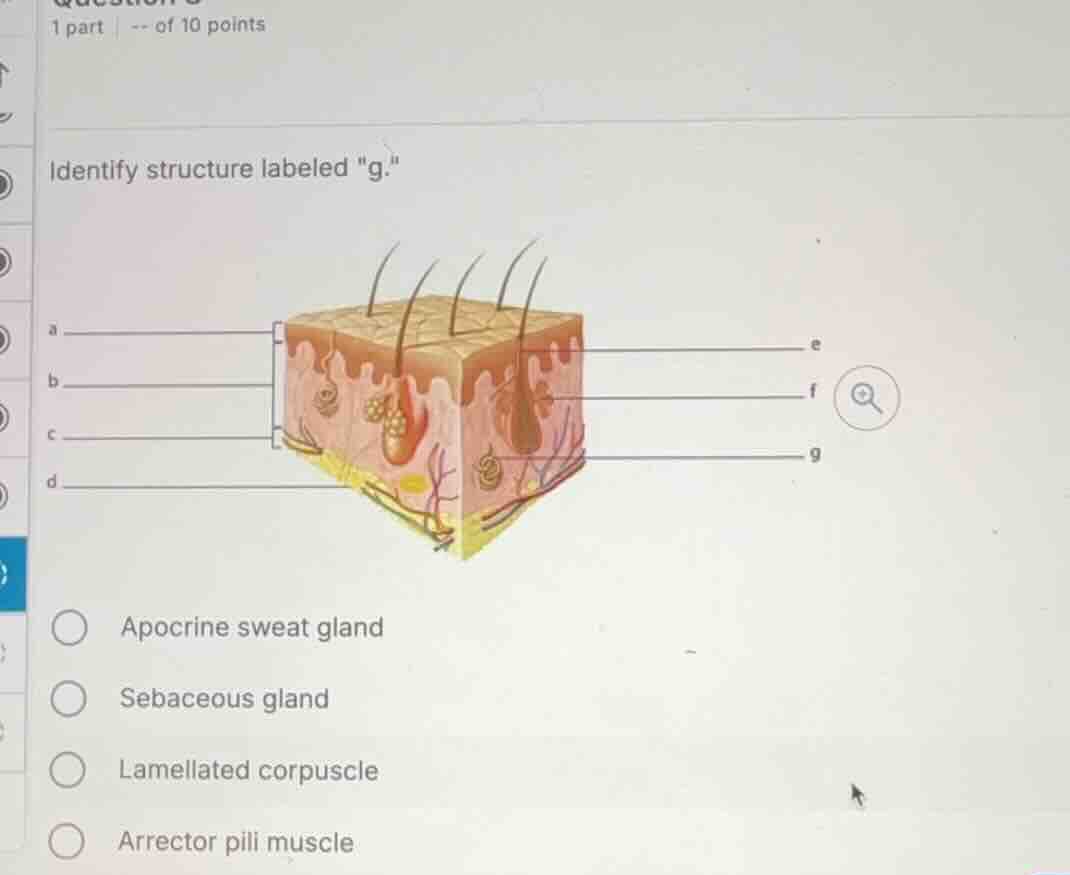
identify structure labeled \g.\

apocrine sweat gland
sebaceous gland
lamellated corpuscle
arrector pili muscle

Explanation:

Response

<pre_analysis>
{
"quality": "clear",
"question_count": 1,
"skills_matched": [
"direct_cot",
"multiple_choice_formatter",
"explain_then_answer",
"tutor"
],
"needs_drawing": false,
"concepts_used": [
"Integumentary System Anatomy",
"Cutaneous Glands",
"Sensory Receptors"
],
"new_concepts": [
"Tactile Corpuscle",
"Lamellated Corpuscle"
],
"current_concepts": [
"Integumentary System Anatomy",
"Cutaneous Glands",
"Sensory Receptors"
]
}
</pre_analysis>

<reasoning>

Analyze the diagram labels

Using the Integumentary System Anatomy knowledge point, we identify the layers and structures of the skin:

  • a represents the epidermis.
  • b represents the dermis.
  • c represents the hypodermis (subcutaneous layer).
  • d represents a nerve fiber or deep receptor.
  • e represents the arrector pili muscle.
  • f represents a sebaceous gland associated with the hair follicle.
  • g points to a coiled tubular structure located in the dermis.

Identify structure "g"

Using the Cutaneous Glands knowledge point, we distinguish between the different glands shown:

  • The gland labeled g is a coiled, tubular gland that opens directly onto the skin surface via a duct. This is characteristic of a sweat gland (specifically an eccrine/merocrine sweat gland, or generally categorized under sweat glands).
  • Let's evaluate the given multiple-choice options:
  1. Apocrine sweat gland: A coiled tubular gland, usually larger and deeper, often emptying into a hair follicle.
  2. Sebaceous gland: Multilobed gland associated with hair follicles (labeled f).
  3. Lamellated corpuscle: A layered, onion-like sensory receptor located deep in the dermis/hypodermis (labeled near d).
  4. Arrector pili muscle: Smooth muscle band (labeled e).

Comparing the options, g represents a sweat gland, specifically matching the option Apocrine sweat gland in this context.
</reasoning>

<answer>
<mcq-correct>Apocrine sweat gland</mcq-correct>
<mcq-option>Sebaceous gland</mcq-option>
<mcq-option>Lamellated corpuscle</mcq-option>
<mcq-option>Arrector pili muscle</mcq-option>
</answer>

<post_analysis>
{
"subject": "Natural Science",
"question_type": "Multiple Choice",
"knowledge_point": [
"Natural Science",
"Biology",
"Integumentary System Anatomy"
]
}
</post_analysis>

Answer:

<pre_analysis>
{
"quality": "clear",
"question_count": 1,
"skills_matched": [
"direct_cot",
"multiple_choice_formatter",
"explain_then_answer",
"tutor"
],
"needs_drawing": false,
"concepts_used": [
"Integumentary System Anatomy",
"Cutaneous Glands",
"Sensory Receptors"
],
"new_concepts": [
"Tactile Corpuscle",
"Lamellated Corpuscle"
],
"current_concepts": [
"Integumentary System Anatomy",
"Cutaneous Glands",
"Sensory Receptors"
]
}
</pre_analysis>

<reasoning>

Analyze the diagram labels

Using the Integumentary System Anatomy knowledge point, we identify the layers and structures of the skin:

  • a represents the epidermis.
  • b represents the dermis.
  • c represents the hypodermis (subcutaneous layer).
  • d represents a nerve fiber or deep receptor.
  • e represents the arrector pili muscle.
  • f represents a sebaceous gland associated with the hair follicle.
  • g points to a coiled tubular structure located in the dermis.

Identify structure "g"

Using the Cutaneous Glands knowledge point, we distinguish between the different glands shown:

  • The gland labeled g is a coiled, tubular gland that opens directly onto the skin surface via a duct. This is characteristic of a sweat gland (specifically an eccrine/merocrine sweat gland, or generally categorized under sweat glands).
  • Let's evaluate the given multiple-choice options:
  1. Apocrine sweat gland: A coiled tubular gland, usually larger and deeper, often emptying into a hair follicle.
  2. Sebaceous gland: Multilobed gland associated with hair follicles (labeled f).
  3. Lamellated corpuscle: A layered, onion-like sensory receptor located deep in the dermis/hypodermis (labeled near d).
  4. Arrector pili muscle: Smooth muscle band (labeled e).

Comparing the options, g represents a sweat gland, specifically matching the option Apocrine sweat gland in this context.
</reasoning>

<answer>
<mcq-correct>Apocrine sweat gland</mcq-correct>
<mcq-option>Sebaceous gland</mcq-option>
<mcq-option>Lamellated corpuscle</mcq-option>
<mcq-option>Arrector pili muscle</mcq-option>
</answer>

<post_analysis>
{
"subject": "Natural Science",
"question_type": "Multiple Choice",
"knowledge_point": [
"Natural Science",
"Biology",
"Integumentary System Anatomy"
]
}
</post_analysis>