QUESTION IMAGE
Question
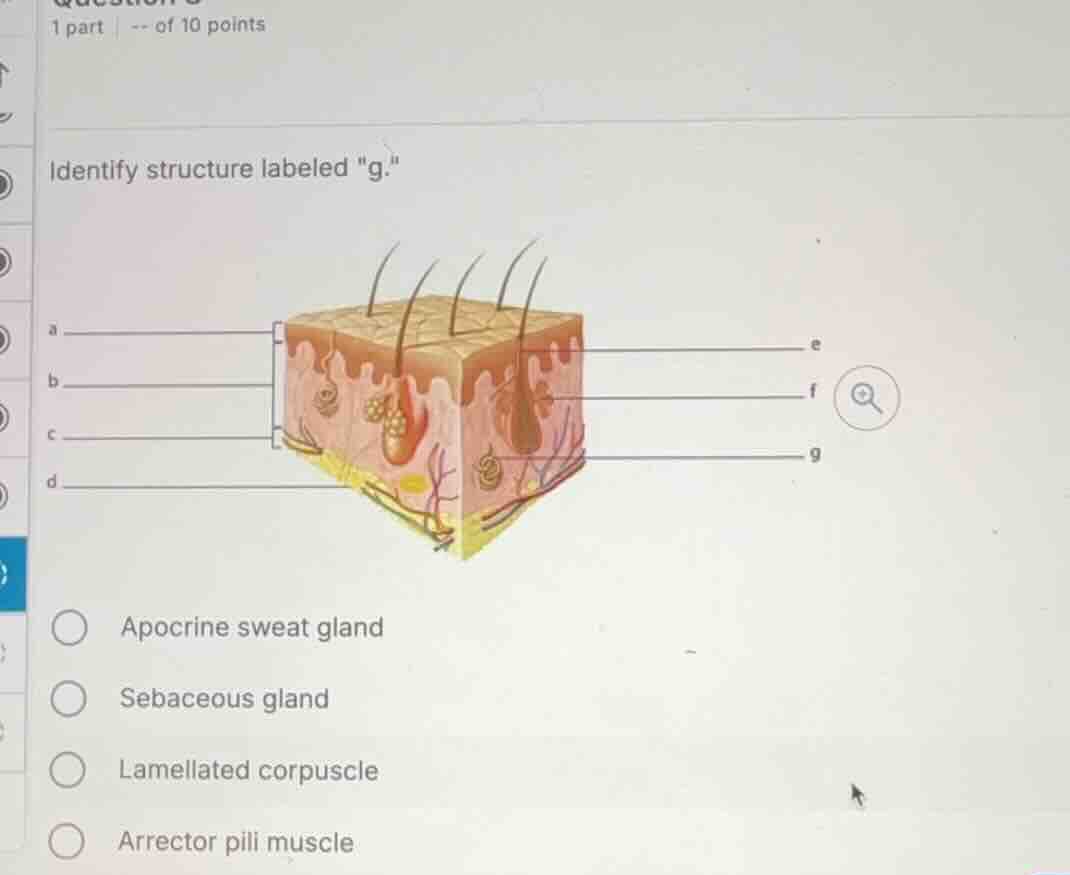
identify structure labeled \g.\
apocrine sweat gland
sebaceous gland
lamellated corpuscle
arrector pili muscle
<pre_analysis>
{
"quality": "clear",
"question_count": 1,
"skills_matched": [
"direct_cot",
"multiple_choice_formatter",
"explain_then_answer",
"tutor"
],
"needs_drawing": false,
"concepts_used": [
"Integumentary System Anatomy",
"Cutaneous Glands",
"Sensory Receptors"
],
"new_concepts": [
"Tactile Corpuscle",
"Lamellated Corpuscle"
],
"current_concepts": [
"Integumentary System Anatomy",
"Cutaneous Glands",
"Sensory Receptors"
]
}
</pre_analysis>
<reasoning>
Analyze the diagram labels
Using the Integumentary System Anatomy knowledge point, we identify the layers and structures of the skin:
- a represents the epidermis.
- b represents the dermis.
- c represents the hypodermis (subcutaneous layer).
- d represents a nerve fiber or deep receptor.
- e represents the arrector pili muscle.
- f represents a sebaceous gland associated with the hair follicle.
- g points to a coiled tubular structure located in the dermis.
Identify structure "g"
Using the Cutaneous Glands knowledge point, we distinguish between the different glands shown:
- The gland labeled g is a coiled, tubular gland that opens directly onto the skin surface via a duct. This is characteristic of a sweat gland (specifically an eccrine/merocrine sweat gland, or generally categorized under sweat glands).
- Let's evaluate the given multiple-choice options:
- Apocrine sweat gland: A coiled tubular gland, usually larger and deeper, often emptying into a hair follicle.
- Sebaceous gland: Multilobed gland associated with hair follicles (labeled f).
- Lamellated corpuscle: A layered, onion-like sensory receptor located deep in the dermis/hypodermis (labeled near d).
- Arrector pili muscle: Smooth muscle band (labeled e).
Comparing the options, g represents a sweat gland, specifically matching the option Apocrine sweat gland in this context.
</reasoning>
<answer>
<mcq-correct>Apocrine sweat gland</mcq-correct>
<mcq-option>Sebaceous gland</mcq-option>
<mcq-option>Lamellated corpuscle</mcq-option>
<mcq-option>Arrector pili muscle</mcq-option>
</answer>
<post_analysis>
{
"subject": "Natural Science",
"question_type": "Multiple Choice",
"knowledge_point": [
"Natural Science",
"Biology",
"Integumentary System Anatomy"
]
}
</post_analysis>
Snap & solve any problem in the app
Get step-by-step solutions on Sovi AI
Photo-based solutions with guided steps
Explore more problems and detailed explanations
<pre_analysis>
{
"quality": "clear",
"question_count": 1,
"skills_matched": [
"direct_cot",
"multiple_choice_formatter",
"explain_then_answer",
"tutor"
],
"needs_drawing": false,
"concepts_used": [
"Integumentary System Anatomy",
"Cutaneous Glands",
"Sensory Receptors"
],
"new_concepts": [
"Tactile Corpuscle",
"Lamellated Corpuscle"
],
"current_concepts": [
"Integumentary System Anatomy",
"Cutaneous Glands",
"Sensory Receptors"
]
}
</pre_analysis>
<reasoning>
Analyze the diagram labels
Using the Integumentary System Anatomy knowledge point, we identify the layers and structures of the skin:
- a represents the epidermis.
- b represents the dermis.
- c represents the hypodermis (subcutaneous layer).
- d represents a nerve fiber or deep receptor.
- e represents the arrector pili muscle.
- f represents a sebaceous gland associated with the hair follicle.
- g points to a coiled tubular structure located in the dermis.
Identify structure "g"
Using the Cutaneous Glands knowledge point, we distinguish between the different glands shown:
- The gland labeled g is a coiled, tubular gland that opens directly onto the skin surface via a duct. This is characteristic of a sweat gland (specifically an eccrine/merocrine sweat gland, or generally categorized under sweat glands).
- Let's evaluate the given multiple-choice options:
- Apocrine sweat gland: A coiled tubular gland, usually larger and deeper, often emptying into a hair follicle.
- Sebaceous gland: Multilobed gland associated with hair follicles (labeled f).
- Lamellated corpuscle: A layered, onion-like sensory receptor located deep in the dermis/hypodermis (labeled near d).
- Arrector pili muscle: Smooth muscle band (labeled e).
Comparing the options, g represents a sweat gland, specifically matching the option Apocrine sweat gland in this context.
</reasoning>
<answer>
<mcq-correct>Apocrine sweat gland</mcq-correct>
<mcq-option>Sebaceous gland</mcq-option>
<mcq-option>Lamellated corpuscle</mcq-option>
<mcq-option>Arrector pili muscle</mcq-option>
</answer>
<post_analysis>
{
"subject": "Natural Science",
"question_type": "Multiple Choice",
"knowledge_point": [
"Natural Science",
"Biology",
"Integumentary System Anatomy"
]
}
</post_analysis>