QUESTION IMAGE
Question
how does the maori story of creation influence spatial design?
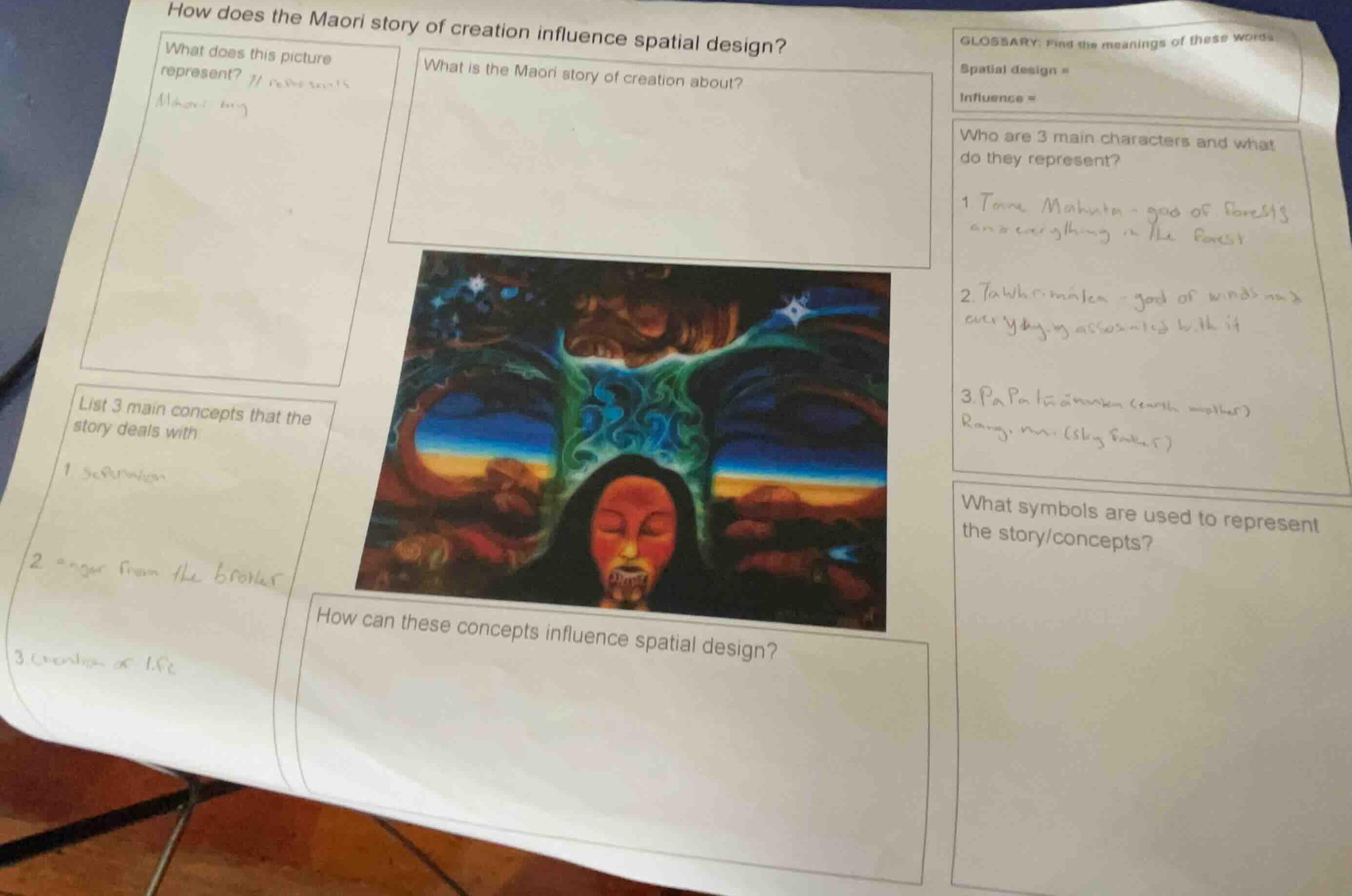
what does this picture represent?
what is the maori story of creation about?
list 3 main concepts that the story deals with
how can these concepts influence spatial design?
glossary: find the meanings of these words
spatial design =
influence =
who are 3 main characters and what do they represent?
what symbols are used to represent the story/concepts?
Identify the core topic
The worksheet explores how the Māori creation story (the separation of Ranginui, the Sky Father, and Papatūānuku, the Earth Mother) influences spatial design. It asks several questions to connect cultural narratives with physical space, architecture, and design principles.
Analyze the visual and written clues
The central image depicts the separation of the earth and sky, with a figure (likely Tāne Mahuta) pushing them apart, allowing light and life to enter the world. The handwritten notes on the sheet identify key characters like Tāne Mahuta (god of forests), Tāwhirimātea (god of winds), Papatūānuku (Earth Mother), and Ranginui (Sky Father), alongside concepts like separation, anger, and the creation of life.
Define spatial design and influence
Spatial design is the design of human-scale environments, including architecture, interior design, landscape design, and public spaces. Cultural narratives influence these spaces by dictating layout, light, materials, and the relationship between indoor and outdoor environments.
Connect Māori creation concepts to spatial design
The transition from darkness (Te Po) to light (Te Ao Mārama) through the separation of earth and sky is a fundamental concept. In spatial design, this translates to how light enters a building, the vertical transition from ground to ceiling, and the integration of natural elements (forests/gardens representing Tāne, open air representing Tāwhirimātea).
Synthesize answers for each section
We will address each of the blank or partially filled sections on the worksheet to provide a comprehensive guide for the student.

Snap & solve any problem in the app
Get step-by-step solutions on Sovi AI
Photo-based solutions with guided steps
Explore more problems and detailed explanations
Question 1: What does this picture represent?
The picture represents the Māori creation story, specifically the separation of Ranginui (the Sky Father) and Papatūānuku (the Earth Mother) by their children, which allowed light (Te Ao Mārama) to enter the world.
Question 2: What is the Māori story of creation about?
The story is about the primordial parents, Ranginui (sky) and Papatūānuku (earth), who locked in a tight embrace, keeping the world in darkness. Their children, seeking light and space to live, decided to push them apart. Tāne Mahuta (god of the forest) succeeded by placing his shoulders on the earth and pushing the sky up with his feet, bringing light, air, and life into the world.
Question 3: List 3 main concepts that the story deals with
- Separation and Transition: The movement from darkness (Te Pō) to light and knowledge (Te Ao Mārama).
- Connection to Nature: The sacred relationship between humans, the earth, the sky, and all living things.
- Conflict and Balance: The tension between the siblings (such as Tāwhirimātea's anger) and the search for harmony in the newly created world.
Question 4: How can these concepts influence spatial design?
These concepts influence spatial design by shaping how physical environments are structured:
- Light and Void: Designing spaces that transition from dark, enclosed entryways to bright, open, double-height communal areas to mimic the transition from Te Pō to Te Ao Mārama.
- Verticality: Emphasizing the connection between the ground (using natural stone or timber representing Papatūānuku) and the ceiling/roof (using skylights or high glass panels representing Ranginui).
- Thresholds: Creating clear boundaries and transitional zones that respect the sacred (tapu) and common (noa) aspects of a space.
Question 5: Glossary
- Spatial design: The practice of designing physical spaces—including architecture, landscapes, interiors, and public environments—focusing on how people move through and experience them.
- Influence: The capacity to have an effect on the character, development, or behavior of something; in design, it refers to how ideas, culture, or narratives shape physical forms.
Question 6: Who are 3 main characters and what do they represent?
- Tāne Mahuta: God of the forests and birds; represents growth, strength, and the bridge between earth and sky.
- Tāwhirimātea: God of wind and storms; represents the weather, natural forces, and emotional intensity.
- Papatūānuku & Ranginui: The Earth Mother and Sky Father; they represent the foundational elements of existence, nurturing, and the cosmic boundary.
Question 7: What symbols are used to represent the story/concepts?
- The Koru (spiral): Represents new life, growth, and the unfolding of creation.
- Vertical Pillars/Columns: Represent Tāne Mahuta holding up the sky, often carved to tell ancestral stories.
- Contrast of Light and Shadow: Used in architectural openings to symbolize the emergence from darkness into light.