QUESTION IMAGE
Question
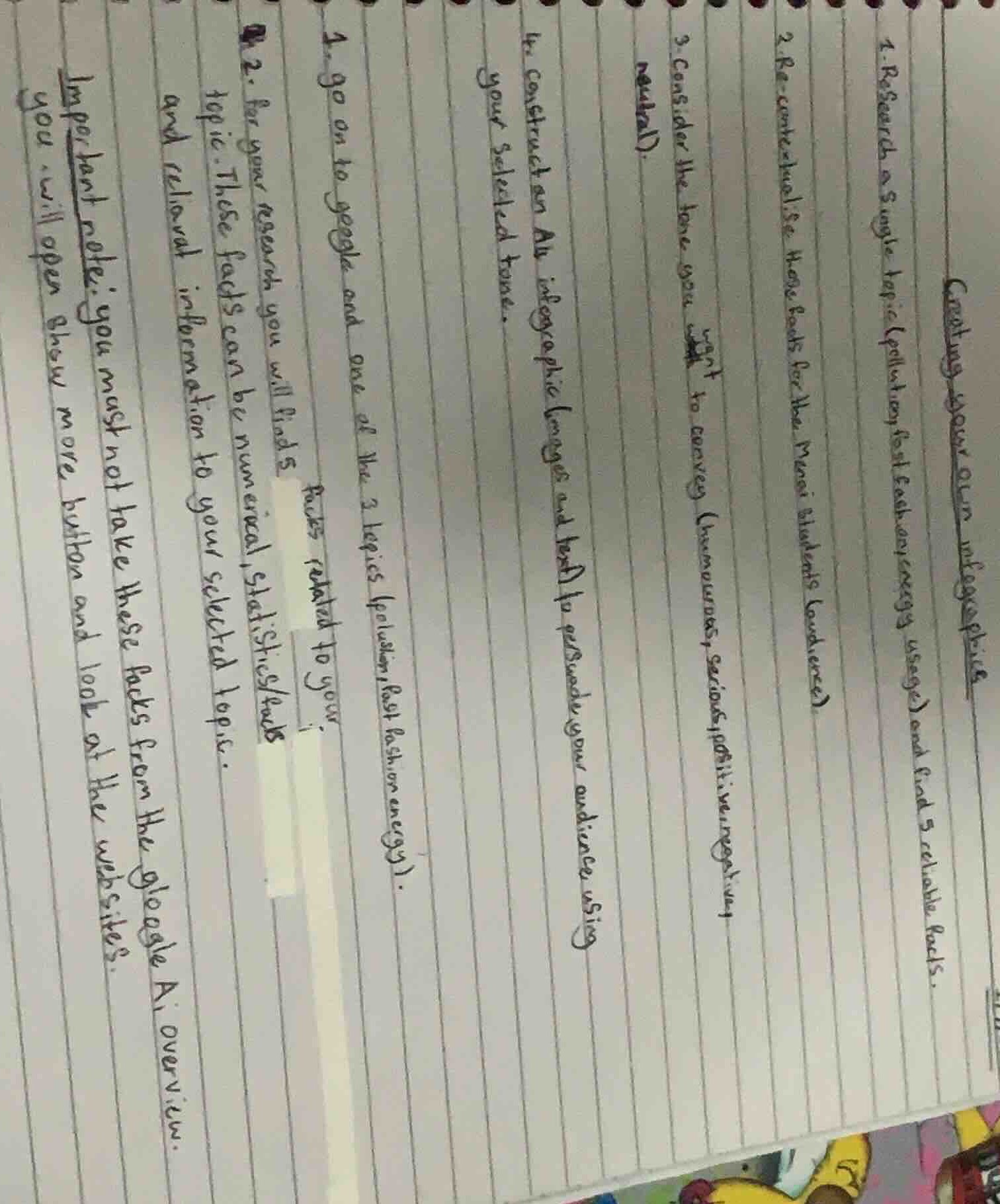
creating your own infographics
- research a single topic (pollution, fast fashion, energy usage) and find 5 reliable facts.
- re-contextualise those facts for the menai students (audience).
- consider the tone you want to convey (humourous, serious, positive, negative, neutral).
- construct an ai infographic (images and text) to persuade your audience using your selected tone.
- go on to google and one of the 3 topics (pollution, fast fashion, energy).
- for your research you will find 5 facts related to your topic. these facts can be numerical, statistics/facts and relevant information to your selected topic.
important note: you must not take these facts from the google ai overview. you will open show more button and look at the websites.
Analyze the task requirements
The handwritten prompt outlines a project titled "Creating your own infographic". The steps are:
- Research a single topic (pollution, fast fashion, energy usage) and find 5 reliable facts.
- Go to Google and choose one of the 3 topics.
- Find 5 facts related to your topic (numerical, statistics, facts).
- Important note: Do not take facts from the Google AI overview; open the websites.
- Re-contextualise these facts for the Menai students (audience).
- Consider the tone you want to convey (humorous, serious, positive, negative, neutral).
- Construct an A4 infographic (images and text) to persuade your audience using your selected tone.
We will focus on the student's chosen topic: Fast Fashion, tailored for Menai students (high school audience), using a serious yet engaging tone to persuade them to reduce fast fashion consumption.
Select and re-contextualize 5 reliable facts
Using the Audience Positioning knowledge point, we select and adapt 5 key facts about fast fashion to resonate directly with high school students:
- Global Fact: The fashion industry produces 92 million tons of textile waste annually.
- Re-contextualized: That is equivalent to throwing away a garbage truck full of clothes every single second.
- Global Fact: It takes about 2,700 liters of water to make one cotton t-shirt.
- Re-contextualized: That is enough drinking water for one student for 3 full years.
- Global Fact: The average consumer buys 60% more clothing than 15 years ago but keeps them half as long.
- Re-contextualized: We are buying more but wearing less, leading to cluttered closets and wasted money.
- Global Fact: Synthetic fibers like polyester take up to 200 years to decompose in landfills.
- Re-contextualized: The cheap polyester hoodie bought today will still exist when our great-great-grandchildren are in high school.
- Global Fact: Less than 1% of used clothing is recycled into new garments.
- Re-contextualized: Donating isn't a perfect fix; most discarded fast fashion ends up incinerated or in landfills.
Design the visual layout and structure
Using the Visual Rhetoric and Infographic Design knowledge points, we structure the A4 page into a clear, hierarchical layout:
- Header: Bold, catchy title to grab attention immediately.
- Section 1 (The Problem): Visual comparison of water consumption using a t-shirt graphic.
- Section 2 (The Waste): A central timeline or scale showing decomposition time.
- Section 3 (The Local Impact/Action): Direct call-to-action steps for Menai students to make a difference.
Draft the infographic content
We will write out the exact copy and layout instructions for the student to copy onto their A4 sheet, ensuring the tone remains serious, persuasive, and highly relevant to their peers.

Snap & solve any problem in the app
Get step-by-step solutions on Sovi AI
Photo-based solutions with guided steps
Explore more problems and detailed explanations
Here is a complete, step-by-step guide and visual layout to help you create your A4 infographic on Fast Fashion for Menai students.
---
Part 1: The Infographic Content & Copy
You can write this exact text directly onto your poster.
[HEADER - Top of Page]
THE REAL COST OF CHEAP THREADS
What Menai Students Need to Know About Fast Fashion
---
[SECTION 1: Water Waste]
- Headline: Thirsty Threads
- Fact: It takes 2,700 liters of water to make just one standard cotton t-shirt.
- Re-contextualized for Menai: That is enough drinking water to last one student for 3 entire years! Every time we buy a cheap tee we don't need, we drain our planet's future.
---
[SECTION 2: The Waste Mountain]
- Headline: Wear Today, Trash Tomorrow
- Fact: The fashion industry generates 92 million tons of textile waste every year.
- Re-contextualized for Menai: Globally, this is equivalent to dumping one garbage truck full of clothes into landfills every single second.
---
[SECTION 3: Synthetic Lifespans]
- Headline: Outliving Us All
- Fact: Synthetic fabrics like polyester take up to 200 years to decompose.
- Re-contextualized for Menai: That cheap polyester hoodie bought for a school theme day will still be sitting in a landfill when our great-great-grandchildren are walking the halls of Menai.
---
[SECTION 4: The Recycling Myth]
- Headline: The "Donation" Illusion
- Fact: Less than 1% of discarded clothing is recycled into new garments.
- Re-contextualized for Menai: While donating feels good, the vast majority of cheap fast fashion is too low-quality to be resold and ends up shipped overseas or buried in landfills.
---
[SECTION 5: Call to Action - Bottom of Page]
WHAT CAN WE DO, MENAI?
- The 30-Wear Rule: Before buying, ask yourself: "Will I wear this at least 30 times?"
- Thrift & Swap: Host a clothing swap meet at school or shop secondhand.
- Quality over Quantity: Save up for one durable item instead of five cheap ones.
---
Part 2: Visual Layout Diagram
Below is a visual blueprint showing exactly how to arrange these sections on your A4 page to maximize visual impact.