QUESTION IMAGE
Question
consider your observations when adding light and heavy gas particles into the container.
use the drop-down menus to complete the sentences correctly.
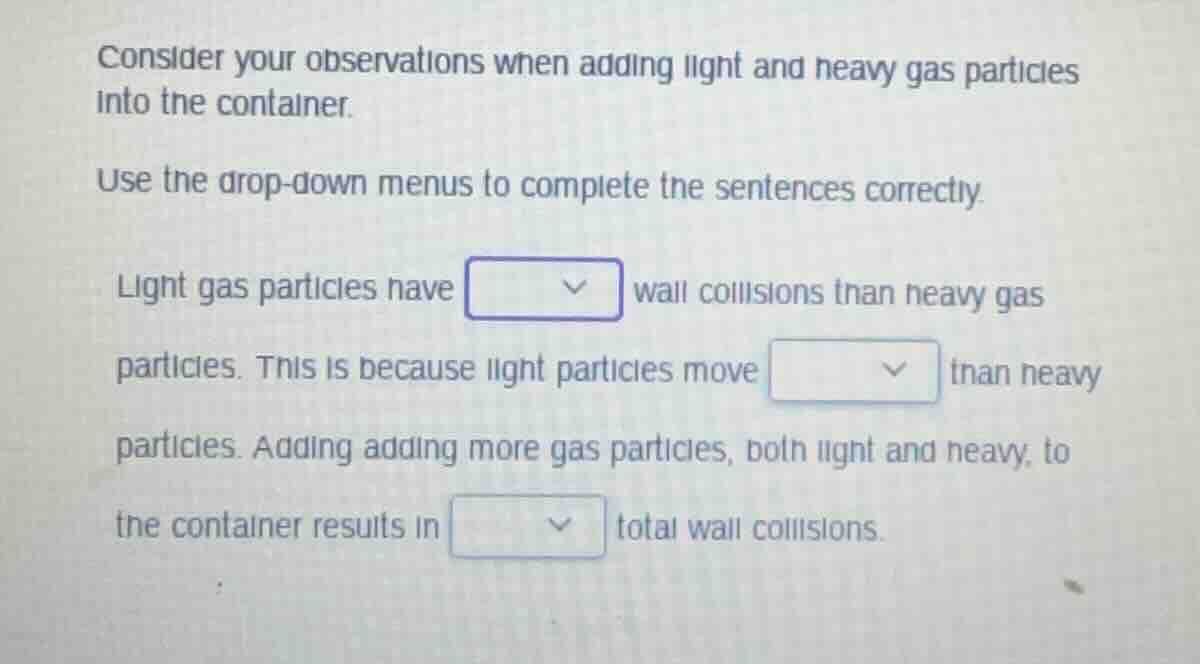
light gas particles have drop-down wall collisions than heavy gas particles. this is because light particles move drop-down than heavy particles. adding adding more gas particles, both light and heavy, to the container results in drop-down total wall collisions.
Relate particle mass to speed
Using the Kinetic Molecular Theory knowledge point
At a constant temperature, lighter gas particles (\(m\) is smaller) have a higher root-mean-square speed (\(v_{rms}\)) and thus move faster than heavier gas particles.
Relate speed to collision frequency
Using the Wall Collisions knowledge point
Because lighter particles move faster, they traverse the container more quickly and collide with the walls more frequently, resulting in more wall collisions than heavier gas particles.
Analyze the effect of adding more particles
Using the Kinetic Molecular Theory and Wall Collisions knowledge points
Adding more gas particles of any type increases the total number of particles in the container, which directly increases the frequency of total wall collisions.

Snap & solve any problem in the app
Get step-by-step solutions on Sovi AI
Photo-based solutions with guided steps
Explore more problems and detailed explanations
Consider your observations when adding light and heavy gas particles into the container.
Use the drop-down menus to complete the sentences correctly.
Light gas particles have <blank>more</blank> wall collisions than heavy gas particles. This is because light particles move <blank>faster</blank> than heavy particles. Adding more gas particles, both light and heavy, to the container results in <blank>more</blank> total wall collisions.