QUESTION IMAGE
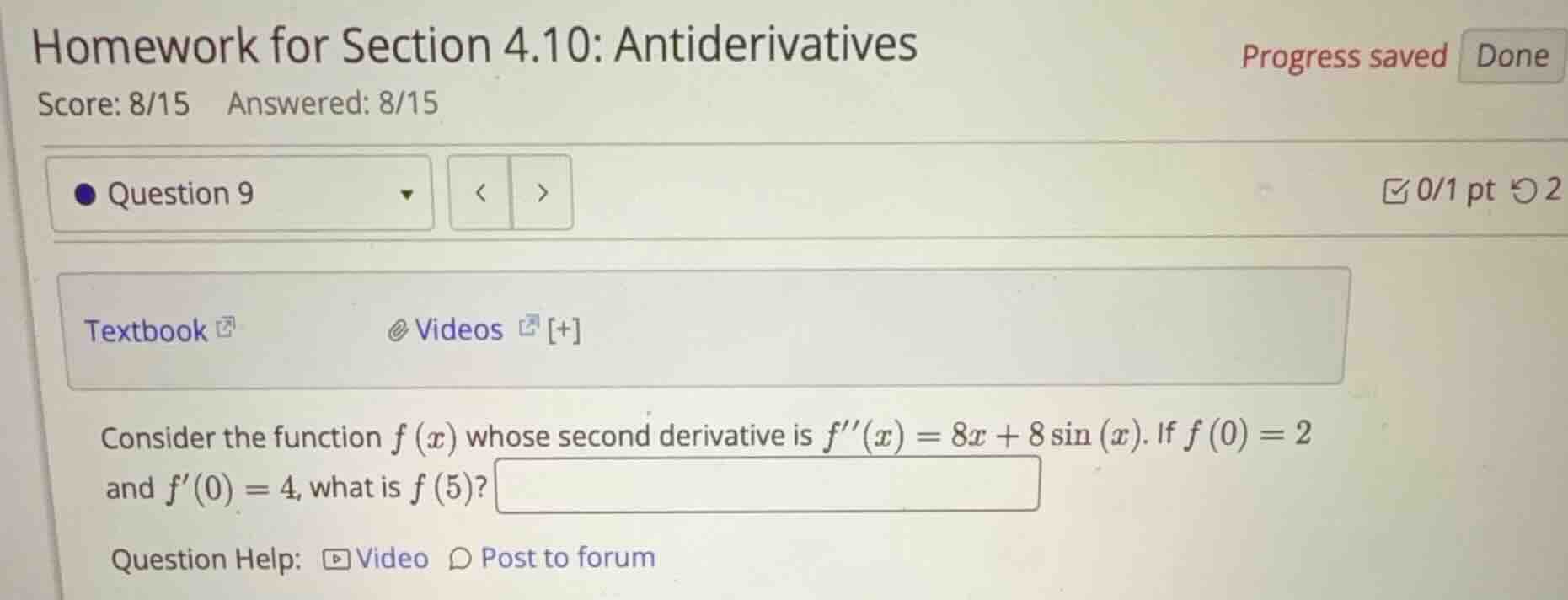
Question
consider the function (f(x)) whose second derivative is (f(x) = 8x + 8sin(x)). if (f(0) = 2) and (f(0) = 4), what is (f(5))?
Find the first derivative \(f'(x)\) by integration
$$
f'(x) = \int f''(x) \, dx = \int (8x + 8\sin(x)) \, dx = 4x^2 - 8\cos(x) + C_1
$$
Using the initial condition \(f'(0) = 4\):
$$
4 = 4(0)^2 - 8\cos(0) + C_1 \implies 4 = -8 + C_1 \implies C_1 = 12
$$
$$
f'(x) = 4x^2 - 8\cos(x) + 12
$$
Find the function \(f(x)\) by integration
$$
f(x) = \int f'(x) \, dx = \int (4x^2 - 8\cos(x) + 12) \, dx = \frac{4}{3}x^3 - 8\sin(x) + 12x + C_2
$$
Using the initial condition \(f(0) = 2\):
$$
2 = \frac{4}{3}(0)^3 - 8\sin(0) + 12(0) + C_2 \implies C_2 = 2
$$
$$
f(x) = \frac{4}{3}x^3 - 8\sin(x) + 12x + 2
$$
Evaluate \(f(5)\)
$$
f(5) = \frac{4}{3}(5)^3 - 8\sin(5) + 12(5) + 2 = \frac{500}{3} - 8\sin(5) + 60 + 2 = \frac{686}{3} - 8\sin(5)
$$

Snap & solve any problem in the app
Get step-by-step solutions on Sovi AI
Photo-based solutions with guided steps
Explore more problems and detailed explanations
Consider the function \(f(x)\) whose second derivative is \(f''(x) = 8x + 8\sin(x)\). If \(f(0) = 2\) and \(f'(0) = 4\), what is \(f(5)\)? <blank>\(\frac{686}{3} - 8\sin(5)\)</blank>