QUESTION IMAGE
Question
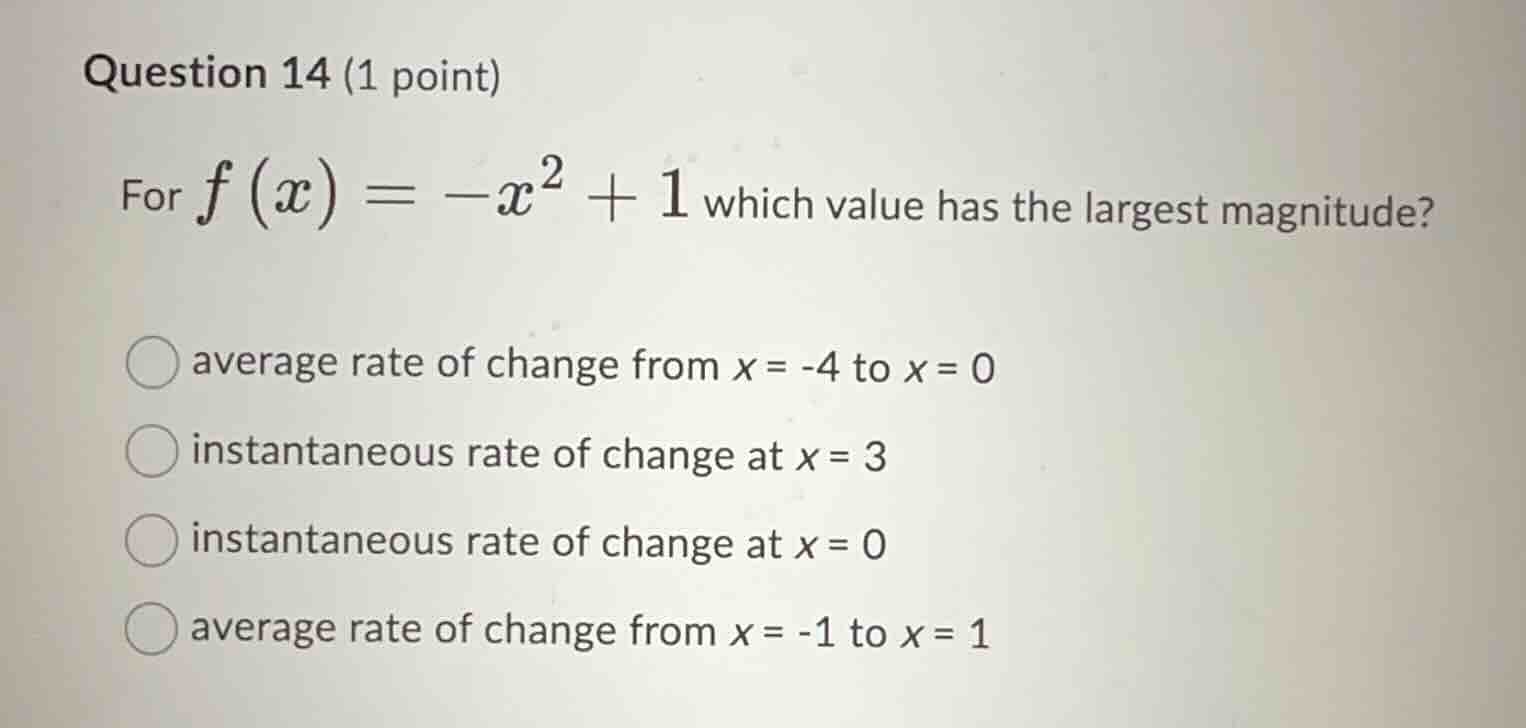
question 14 (1 point)
for (f(x) = -x^2 + 1) which value has the largest magnitude?
average rate of change from (x = -4) to (x = 0)
instantaneous rate of change at (x = 3)
instantaneous rate of change at (x = 0)
average rate of change from (x = -1) to (x = 1)
Calculate average rate of change from x = -4 to x = 0
The average rate of change of a function \(f(x)\) over the interval \([a, b]\) is given by:
For \(f(x) = -x^2 + 1\) on \([-4, 0]\):
The magnitude of this rate is \(|4| = 4\).
Calculate instantaneous rate of change at x = 3
Using the Instantaneous Rate of Change knowledge point, we find the derivative \(f'(x)\) of \(f(x) = -x^2 + 1\):
Evaluating at \(x = 3\):
The magnitude of this rate is \(|-6| = 6\).
Calculate instantaneous rate of change at x = 0
Using the Instantaneous Rate of Change knowledge point, we evaluate the derivative at \(x = 0\):
The magnitude of this rate is \(|0| = 0\).
Calculate average rate of change from x = -1 to x = 1
For \(f(x) = -x^2 + 1\) on \([-1, 1]\):
The magnitude of this rate is \(|0| = 0\).
Compare the magnitudes of the rates of change
We compare the absolute values of each calculated rate of change:
- Option 1: Magnitude is \(4\)
- Option 2: Magnitude is \(6\)
- Option 3: Magnitude is \(0\)
- Option 4: Magnitude is \(0\)
The largest magnitude is \(6\), which corresponds to the instantaneous rate of change at \(x = 3\).

Snap & solve any problem in the app
Get step-by-step solutions on Sovi AI
Photo-based solutions with guided steps
Explore more problems and detailed explanations
- average rate of change from x = -4 to x = 0
- instantaneous rate of change at x = 3 (Correct answer)
- instantaneous rate of change at x = 0
- average rate of change from x = -1 to x = 1