Sovi.AI - AI Math Tutor

Scan to solve math questions

QUESTION IMAGE

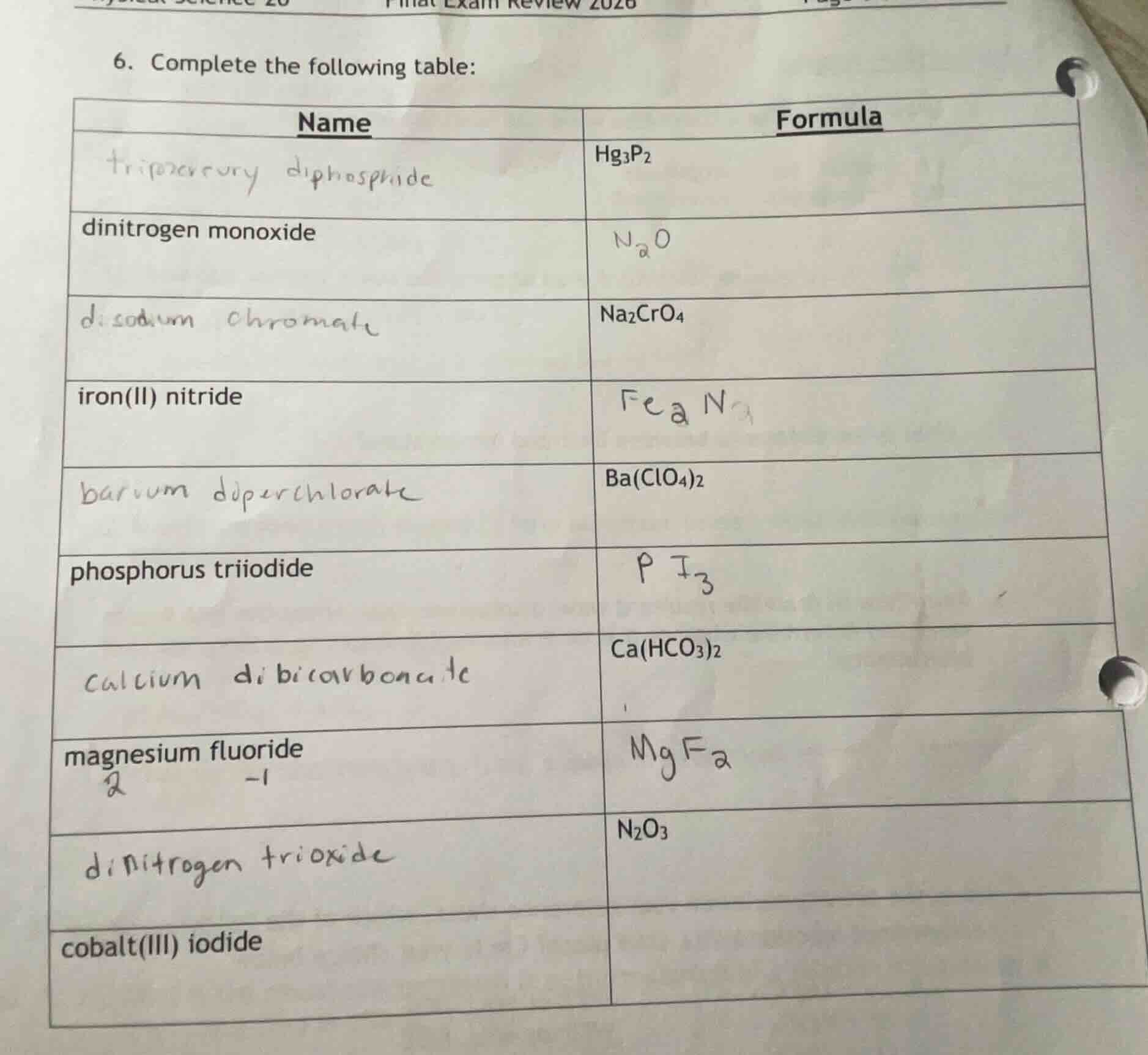
6. complete the following table: \\begin{tabular}{|l|l|} \\hline \\text…

Question

  1. complete the following table:

\

$$\begin{tabular}{|l|l|} \\hline \\textbf{name} & \\textbf{formula} \\\\ \\hline & \\text{hg}_3\\text{p}_2 \\\\ \\hline \\text{dinitrogen monoxide} & \\\\ \\hline & \\text{na}_2\\text{cro}_4 \\\\ \\hline \\text{iron(ii) nitride} & \\\\ \\hline & \\text{ba(clo}_4)_2 \\\\ \\hline \\text{phosphorus triiodide} & \\\\ \\hline & \\text{ca(hco}_3)_2 \\\\ \\hline \\text{magnesium fluoride} & \\\\ \\hline & \\text{n}_2\\text{o}_3 \\\\ \\hline \\text{cobalt(iii) iodide} & \\\\ \\hline \\end{tabular}$$

Explanation:

Response

<pre_analysis>
{
"quality": "clear",
"question_count": 1,
"skills_matched": [
"step_cot",
"table_formatter",
"explain_then_answer",
"tutor"
],
"needs_drawing": false,
"concepts_used": [],
"new_concepts": [
"Chemical Nomenclature",
"Chemical Formulas",
"Ionic Compounds"
],
"current_concepts": [
"Chemical Nomenclature",
"Chemical Formulas",
"Ionic Compounds"
]
}
</pre_analysis>

<reasoning>

Identify naming rules

We need to complete the table by matching chemical names with formulas.

  • Ionic compounds use Roman numerals for variable-charge metals, and no prefixes.
  • Covalent compounds use Greek prefixes (mono-, di-, tri-, etc.).
  • Polyatomic ions retain their specific names (e.g., chromate, perchlorate, bicarbonate).

Analyze each row

  1. Row 1: Formula is \(\text{Hg}_3\text{P}_2\). Mercury is a metal, phosphorus is a nonmetal. Mercury can have multiple charges. Since phosphide is \(\text{P}^{3-}\), three mercury ions must balance two phosphide ions (\(2 \times 3- = -6\)), so each mercury has a \(2+\) charge: \(\text{Hg}^{2+}\). The correct IUPAC name is mercury(II) phosphide.
  2. Row 2: Name is dinitrogen monoxide. This is a covalent compound. "Di-" means 2 nitrogen, "mono-" means 1 oxygen. Formula: \(\text{N}_2\text{O}\).
  3. Row 3: Formula is \(\text{Na}_2\text{CrO}_4\). Sodium (\(\text{Na}^+\)) and chromate (\(\text{CrO}_4^{2-}\)). Name: sodium chromate.
  4. Row 4: Name is iron(II) nitride. Iron(II) is \(\text{Fe}^{2+}\), nitride is \(\text{N}^{3-}\). To balance charges, we need three \(\text{Fe}^{2+}\) and two \(\text{N}^{3-}\). Formula: \(\text{Fe}_3\text{N}_2\).
  5. Row 5: Formula is \(\text{Ba(ClO}_4)_2\). Barium (\(\text{Ba}^{2+}\)) and perchlorate (\(\text{ClO}_4^-\)). Name: barium perchlorate.
  6. Row 6: Name is phosphorus triiodide. One phosphorus, three iodines. Formula: \(\text{PI}_3\).
  7. Row 7: Formula is \(\text{Ca(HCO}_3)_2\). Calcium (\(\text{Ca}^{2+}\)) and hydrogen carbonate (or bicarbonate, \(\text{HCO}_3^-\)). Name: calcium hydrogen carbonate (or calcium bicarbonate).
  8. Row 8: Name is magnesium fluoride. Magnesium (\(\text{Mg}^{2+}\)) and fluoride (\(\text{F}^-\)). Formula: \(\text{MgF}_2\).
  9. Row 9: Formula is \(\text{N}_2\text{O}_3\). Two nitrogens, three oxygens. Name: dinitrogen trioxide.
  10. Row 10: Name is cobalt(III) iodide. Cobalt(III) is \(\text{Co}^{3+}\), iodide is \(\text{I}^-\). Formula: \(\text{CoI}_3\).

</reasoning>

<answer>

NameFormula
dinitrogen monoxide\(\text{N}_2\text{O}\)
sodium chromate\(\text{Na}_2\text{CrO}_4\)
iron(II) nitride\(\text{Fe}_3\text{N}_2\)
barium perchlorate\(\text{Ba(ClO}_4)_2\)
phosphorus triiodide\(\text{PI}_3\)
calcium hydrogen carbonate (or calcium bicarbonate)\(\text{Ca(HCO}_3)_2\)
magnesium fluoride\(\text{MgF}_2\)
dinitrogen trioxide\(\text{N}_2\text{O}_3\)
cobalt(III) iodide\(\text{CoI}_3\)

</answer>

<post_analysis>
{
"subject": "Natural Science",
"question_type": "Fill-in-the-blank",
"knowledge_point": [
"Natural Science",
"Chemistry",
"Chemical Nomenclature"
]
}
</post_analysis>

Answer:

<pre_analysis>
{
"quality": "clear",
"question_count": 1,
"skills_matched": [
"step_cot",
"table_formatter",
"explain_then_answer",
"tutor"
],
"needs_drawing": false,
"concepts_used": [],
"new_concepts": [
"Chemical Nomenclature",
"Chemical Formulas",
"Ionic Compounds"
],
"current_concepts": [
"Chemical Nomenclature",
"Chemical Formulas",
"Ionic Compounds"
]
}
</pre_analysis>

<reasoning>

Identify naming rules

We need to complete the table by matching chemical names with formulas.

  • Ionic compounds use Roman numerals for variable-charge metals, and no prefixes.
  • Covalent compounds use Greek prefixes (mono-, di-, tri-, etc.).
  • Polyatomic ions retain their specific names (e.g., chromate, perchlorate, bicarbonate).

Analyze each row

  1. Row 1: Formula is \(\text{Hg}_3\text{P}_2\). Mercury is a metal, phosphorus is a nonmetal. Mercury can have multiple charges. Since phosphide is \(\text{P}^{3-}\), three mercury ions must balance two phosphide ions (\(2 \times 3- = -6\)), so each mercury has a \(2+\) charge: \(\text{Hg}^{2+}\). The correct IUPAC name is mercury(II) phosphide.
  2. Row 2: Name is dinitrogen monoxide. This is a covalent compound. "Di-" means 2 nitrogen, "mono-" means 1 oxygen. Formula: \(\text{N}_2\text{O}\).
  3. Row 3: Formula is \(\text{Na}_2\text{CrO}_4\). Sodium (\(\text{Na}^+\)) and chromate (\(\text{CrO}_4^{2-}\)). Name: sodium chromate.
  4. Row 4: Name is iron(II) nitride. Iron(II) is \(\text{Fe}^{2+}\), nitride is \(\text{N}^{3-}\). To balance charges, we need three \(\text{Fe}^{2+}\) and two \(\text{N}^{3-}\). Formula: \(\text{Fe}_3\text{N}_2\).
  5. Row 5: Formula is \(\text{Ba(ClO}_4)_2\). Barium (\(\text{Ba}^{2+}\)) and perchlorate (\(\text{ClO}_4^-\)). Name: barium perchlorate.
  6. Row 6: Name is phosphorus triiodide. One phosphorus, three iodines. Formula: \(\text{PI}_3\).
  7. Row 7: Formula is \(\text{Ca(HCO}_3)_2\). Calcium (\(\text{Ca}^{2+}\)) and hydrogen carbonate (or bicarbonate, \(\text{HCO}_3^-\)). Name: calcium hydrogen carbonate (or calcium bicarbonate).
  8. Row 8: Name is magnesium fluoride. Magnesium (\(\text{Mg}^{2+}\)) and fluoride (\(\text{F}^-\)). Formula: \(\text{MgF}_2\).
  9. Row 9: Formula is \(\text{N}_2\text{O}_3\). Two nitrogens, three oxygens. Name: dinitrogen trioxide.
  10. Row 10: Name is cobalt(III) iodide. Cobalt(III) is \(\text{Co}^{3+}\), iodide is \(\text{I}^-\). Formula: \(\text{CoI}_3\).

</reasoning>

<answer>

NameFormula
dinitrogen monoxide\(\text{N}_2\text{O}\)
sodium chromate\(\text{Na}_2\text{CrO}_4\)
iron(II) nitride\(\text{Fe}_3\text{N}_2\)
barium perchlorate\(\text{Ba(ClO}_4)_2\)
phosphorus triiodide\(\text{PI}_3\)
calcium hydrogen carbonate (or calcium bicarbonate)\(\text{Ca(HCO}_3)_2\)
magnesium fluoride\(\text{MgF}_2\)
dinitrogen trioxide\(\text{N}_2\text{O}_3\)
cobalt(III) iodide\(\text{CoI}_3\)

</answer>

<post_analysis>
{
"subject": "Natural Science",
"question_type": "Fill-in-the-blank",
"knowledge_point": [
"Natural Science",
"Chemistry",
"Chemical Nomenclature"
]
}
</post_analysis>